
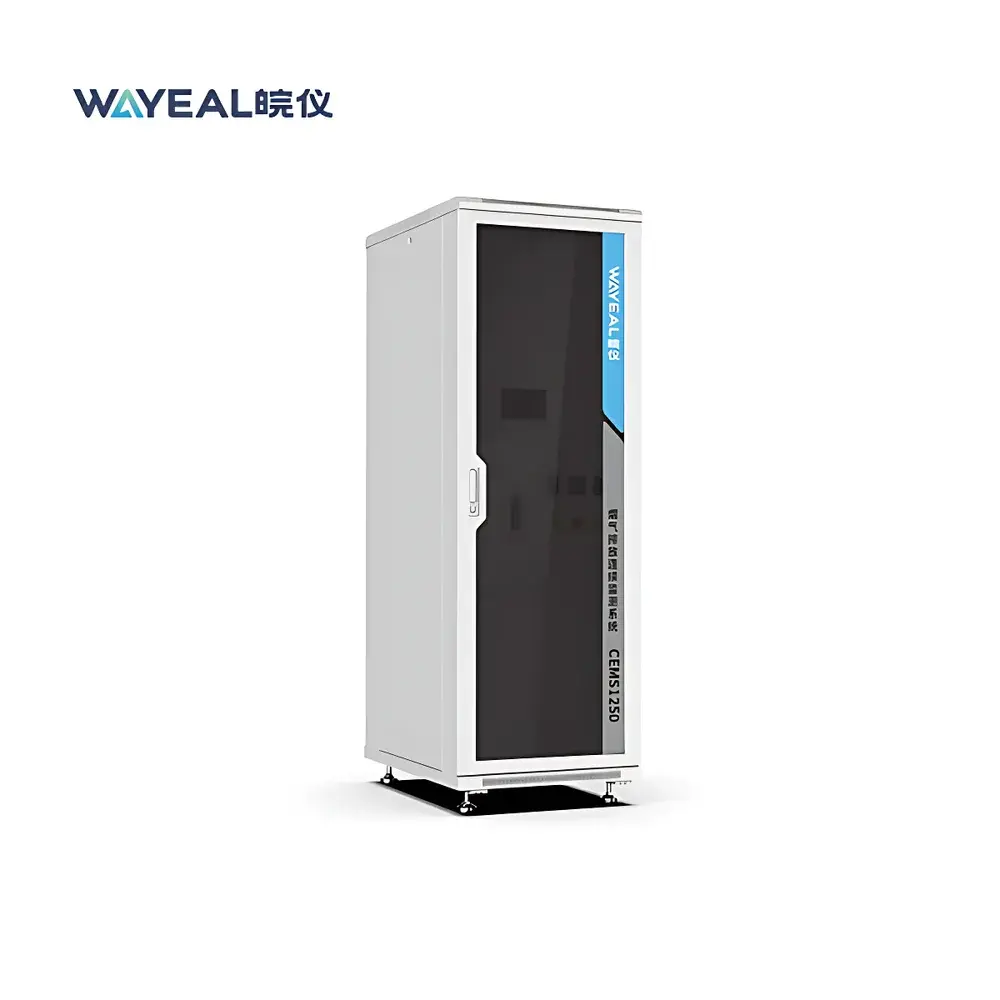
WAYEAL CEMS1250 Continuous Emission Monitoring System (CEMS)
| Brand | WAYEAL |
|---|---|
| Origin | Anhui, China |
| Manufacturer Type | Direct Manufacturer |
| Product Category | Domestic |
| Model | CEMS1250 |
| Instrument Type | Flue Gas Continuous Emission Monitoring System |
| Measurement Accuracy | ±2.5% FS |
| Repeatability | ±2% FS |
| Response Time | 200 s |
| Long-term Stability | ±5% FS |
| Measured Parameters | SO₂, NO, O₂, Particulate Matter (PM) Concentration, Flue Gas Temperature, Pressure, Velocity, Relative Humidity |
| Derived Outputs | Emission Rate, Total Emissions |
| Sampling Method | Direct Extraction with Cold-Dry Conditioning |
| Certified Low-Range Quantification | SO₂ & NO at 0–45 mg/m³ |
| PM Detection Principle | Laser Forward Scattering |
| PM Certified Range | 0–15 mg/m³ |
| Compliance | Meets Chinese HJ 75–2017 and HJ 76–2017 Technical Specifications for CEMS |
Overview
The WAYEAL CEMS1250 Continuous Emission Monitoring System is an integrated, stack-mounted analytical platform engineered for regulatory-grade, real-time quantification of gaseous and particulate pollutants from stationary combustion sources. Operating on the principle of direct extraction with cold-dry gas conditioning, the system draws flue gas through a heated probe and transport line into a centralized sample conditioning unit where moisture is removed via refrigerated drying (typically to <5 °C dew point), particulates are filtered, and the conditioned gas stream is delivered to high-stability electrochemical and NDIR analyzers. Oxygen is measured using a galvanic electrochemical cell; SO₂ and NO are quantified via UV absorption spectroscopy optimized for low-concentration detection (0–45 mg/m³); O₂ employs temperature-compensated electrochemistry; flue gas temperature, static pressure, and velocity are acquired via calibrated Pt100 RTD, piezoresistive transducer, and S-type pitot tube respectively; humidity is determined by a high-temperature capacitive sensor rated to 180 °C. All raw signals are digitized and processed by an embedded industrial PLC-based data acquisition and control module compliant with IEC 61131-3 programming standards.
Key Features
- Regulatory-compliant architecture designed to meet HJ 75–2017 (Performance Testing and Acceptance Criteria) and HJ 76–2017 (Technical Requirements for CEMS)
- Cold-dry sampling configuration minimizes interference from water vapor condensation and acid deposition in sample lines
- Low-range certified measurement capability: SO₂ and NO down to 0–45 mg/m³ — suitable for ultra-low emission (ULE) compliance verification
- Laser forward scattering-based particulate matter monitor with 0–15 mg/m³ certified range and automatic zero/span drift compensation
- Integrated fault self-diagnosis engine with event logging, alarm prioritization, and remote diagnostic port support
- Modular hardware design enabling field-replaceable analyzer modules, sensor assemblies, and power supply units without system shutdown
- RS-485, RS-232, Ethernet (TCP/IP), and optional 4–20 mA analog outputs for seamless integration with plant DCS, SCADA, and environmental data management platforms
Sample Compatibility & Compliance
The CEMS1250 is validated for use across heterogeneous flue gas matrices typical of coal-fired power plants, cement kilns, waste-to-energy incinerators, sintering facilities, and petrochemical crackers. It accommodates gas temperatures up to 200 °C (with optional high-temp probe), dust loadings ≤ 50 g/Nm³, and moisture content up to 25% v/v. All gas analyzers undergo quarterly performance audits per HJ 76–2017, including zero/span checks, linearity verification, and response time validation. The system supports audit-ready data records with immutable timestamps, operator ID tagging, and change history for all calibration and maintenance events — fully traceable for GLP-aligned environmental reporting and third-party verification.
Software & Data Management
The embedded CEMS Data Acquisition and Handling System (DAHS) runs on a real-time Linux OS with dual-redundant storage and implements secure, role-based access control. Raw sensor outputs are converted to standardized concentration units (mg/m³ @ 6% O₂, dry basis) using EPA Method 2, 3A, 6C, and 9 algorithms. Emission rate (kg/h) and cumulative mass (t) are calculated dynamically using real-time flow velocity, cross-sectional area, and stoichiometric correction factors. Data export complies with HJ 212–2017 communication protocol for transmission to provincial and national environmental monitoring centers. Audit logs retain ≥18 months of operational metadata, including calibration certificates, maintenance reports, and QA/QC summaries — supporting FDA 21 CFR Part 11–equivalent electronic record integrity requirements.
Applications
The CEMS1250 serves as a primary compliance instrument in regulated emissions monitoring for thermal power generation (subcritical, supercritical, and ultra-supercritical units), iron and steel sintering and blast furnaces, rotary kiln-based cement production, municipal solid waste incineration with flue gas cleaning (FGD + SCR + fabric filter), catalytic cracking units in refineries, and biomass-fired district heating boilers. Its modular scalability allows deployment across single-stack or multi-point monitoring configurations, while its cold-dry architecture ensures robustness in high-moisture, low-sulfur coal or natural gas co-firing scenarios.
FAQ
What regulatory standards does the CEMS1250 comply with?
It meets the technical specifications outlined in China’s HJ 75–2017 and HJ 76–2017, and supports data formatting per HJ 212–2017 for provincial and national environmental information platforms.
Can the system interface with existing DCS or SCADA infrastructure?
Yes — it provides native Modbus RTU/TCP, OPC UA, and 4–20 mA analog interfaces, with configurable polling intervals and data mapping tables.
How is particulate matter concentration measured?
Via laser forward scattering photometry with factory-calibrated optical path alignment and real-time signal normalization against reference scatter intensity.
Is remote diagnostics and software update supported?
The DAHS includes SSH-enabled secure shell access, encrypted firmware OTA updates, and web-based health dashboard accessible via authenticated HTTPS.
What maintenance intervals are recommended for long-term reliability?
Filter replacement every 3 months, analyzer calibration every 7 days (automated), and full system performance audit per HJ 76–2017 every 90 days.







