
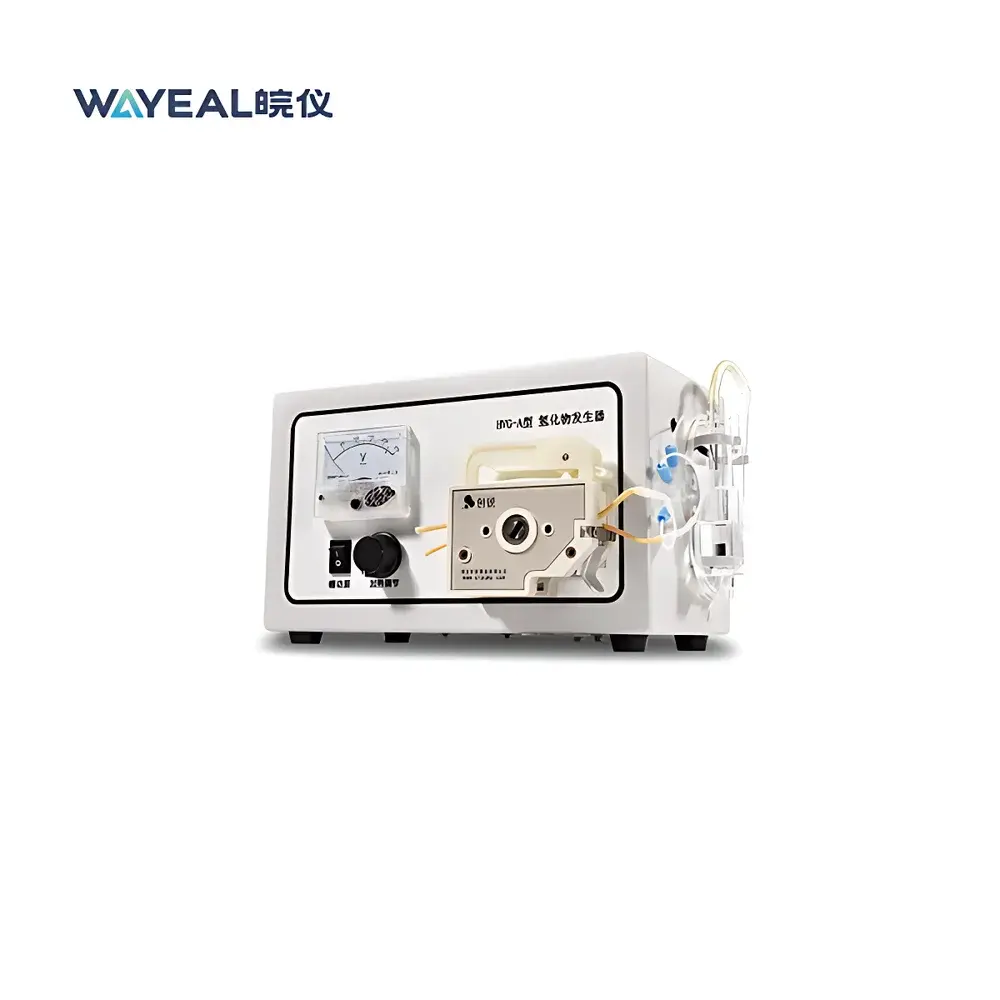
WAYEAL HVG-A Hydride Generation System
| Brand | WAYEAL |
|---|---|
| Origin | Anhui, China |
| Manufacturer Type | Direct Manufacturer |
| Regional Classification | Domestic (China) |
| Model | HVG-A |
| Pricing | Upon Request |
Overview
The WAYEAL HVG-A Hydride Generation System is a dedicated sample introduction module engineered for trace-level determination of hydride-forming elements in atomic absorption spectrometry (AAS). It operates on the principle of chemical vapor generation (CVG), where analyte species—such as arsenic (As), mercury (Hg), selenium (Se), antimony (Sb), bismuth (Bi), tellurium (Te), tin (Sn), and lead (Pb)—are reduced in acidic medium to volatile covalent hydrides (e.g., AsH₃, Hg⁰ vapor, SeH₂) or cold-vapor species. These gaseous products are swept by argon carrier gas into a quartz atomization cell positioned in the optical path of a flameless graphite furnace or quartz tube AAS system. This approach bypasses nebulization inefficiencies and matrix interferences inherent in conventional liquid sampling, delivering significantly enhanced sensitivity, lower detection limits (sub-pg/mL range for many elements), and improved precision for ultra-trace analysis in environmental, food safety, pharmaceutical, and geological applications.
Key Features
- Modular external reaction manifold: Transparent PTFE and quartz tubing allow real-time visual monitoring of hydride generation kinetics, bubble formation, and phase separation—enabling immediate troubleshooting and optimization of reaction conditions.
- Integrated quartz gas–liquid separator: Chemically inert, high-temperature resistant, and easily disassembled for thorough cleaning; minimizes carryover and ensures consistent baseline stability across sequential injections.
- 10-step programmable carrier gas flow control: Precise digital regulation of argon flow (range: 50–600 mL/min) optimizes transport efficiency and residence time in the atomizer, balancing sensitivity and signal width.
- 10-step adjustable sample introduction rate: Programmable peristaltic pump enables fine-tuned delivery (0.5–5.0 mL/min), reducing reagent consumption and sample volume requirements—particularly valuable for limited or precious matrices.
- Continuous-flow hydride generation mode: Eliminates memory effects associated with batch or pulsed systems by maintaining constant reagent/sample mixing and gas evolution, resulting in superior signal reproducibility (RSD < 1.5% over 10 replicates) and linear dynamic range exceeding three orders of magnitude.
- Universal AAS interface compatibility: Equipped with standardized gas outlet fittings (6 mm OD stainless steel tubing) and adaptable mounting brackets; validated for seamless integration with major AAS platforms including PerkinElmer AA800, Thermo Scientific iCE 3000, Shimadzu AA-6880, and GBC Avanta series.
Sample Compatibility & Compliance
The HVG-A supports aqueous samples containing hydride-forming elements at oxidation states amenable to NaBH₄ or KBH₄ reduction (e.g., As(III), Sb(III), Se(IV)). It accommodates common acid matrices (HCl, HNO₃, H₂SO₄) at concentrations up to 20% v/v and tolerates moderate levels of transition metal interference when masked with thiourea/ascorbic acid or via on-line masking. The system conforms to ASTM D6724-22 (Standard Test Method for Determination of Arsenic in Water by Hydride Generation Atomic Absorption Spectrometry) and ISO 11969:2015 (Water quality — Determination of arsenic and antimony — Hydride generation-atomic absorption spectrometric method). Its mechanical design and material selection meet GLP-compliant laboratory requirements, with full traceability of operational parameters supported through optional analog/digital I/O interfaces.
Software & Data Management
While the HVG-A operates as a hardware-integrated peripheral without embedded firmware, it is fully compatible with third-party AAS instrument control software (e.g., WinLab32, SOLAAR, AAWin). All critical operating parameters—including carrier gas flow, sample uptake rate, reaction coil temperature (ambient or thermostatically stabilized), and timing sequences—are externally controllable via TTL or 0–10 V analog signals. Audit trails for method files, calibration logs, and QC checks are maintained within the host AAS software environment, satisfying FDA 21 CFR Part 11 requirements when deployed with validated electronic signature and data integrity protocols.
Applications
- Environmental monitoring: Quantification of As, Sb, and Bi in drinking water, groundwater, and wastewater per EPA Method 200.9 and ISO 17294-2.
- Food and feed safety: Screening of inorganic arsenic in rice, seafood, and infant formula following EU Commission Regulation (EU) No 2023/915.
- Pharmaceutical excipient testing: Detection of residual catalyst metals (e.g., Sn, Pb) in APIs per USP and .
- Geochemical exploration: Rapid field-deployable screening of hydrothermal fluid samples for pathfinder elements (Te, Se, Hg) in mineral prospecting.
- Reference material certification: Primary method support for CRM characterization where hydride generation offers lowest uncertainty budget among available techniques.
FAQ
What hydride-forming elements can be reliably determined using the HVG-A?
The system is optimized for As, Se, Sb, Bi, Te, Sn, Pb, and Hg. Cd and Zn are not suitable due to thermodynamic instability of their hydrides under standard CVG conditions.
Is post-reaction cleaning automated?
No—cleaning is manual but simplified by the modular quartz gas–liquid separator and quick-release tubing connectors; typical turnaround between sample batches is under 90 seconds.
Can the HVG-A be used with graphite furnace AAS?
Yes; it is routinely coupled with electrothermal atomizers using quartz trapping tubes or integrated quartz-in-graphite atomizers, enabling sub-femtogram detection capability.
Does the system require external cooling or heating?
Reaction is exothermic and self-regulating at ambient lab temperature; optional Peltier-cooled reaction coil is available for improved precision in high-temperature environments (>30°C).
How is memory effect quantified during validation?
Memory is assessed per ICH Q2(R2) guidelines: after injecting a 10× LOD standard, three consecutive blanks are measured; signal must return to ≤3× baseline noise within 60 seconds.






