
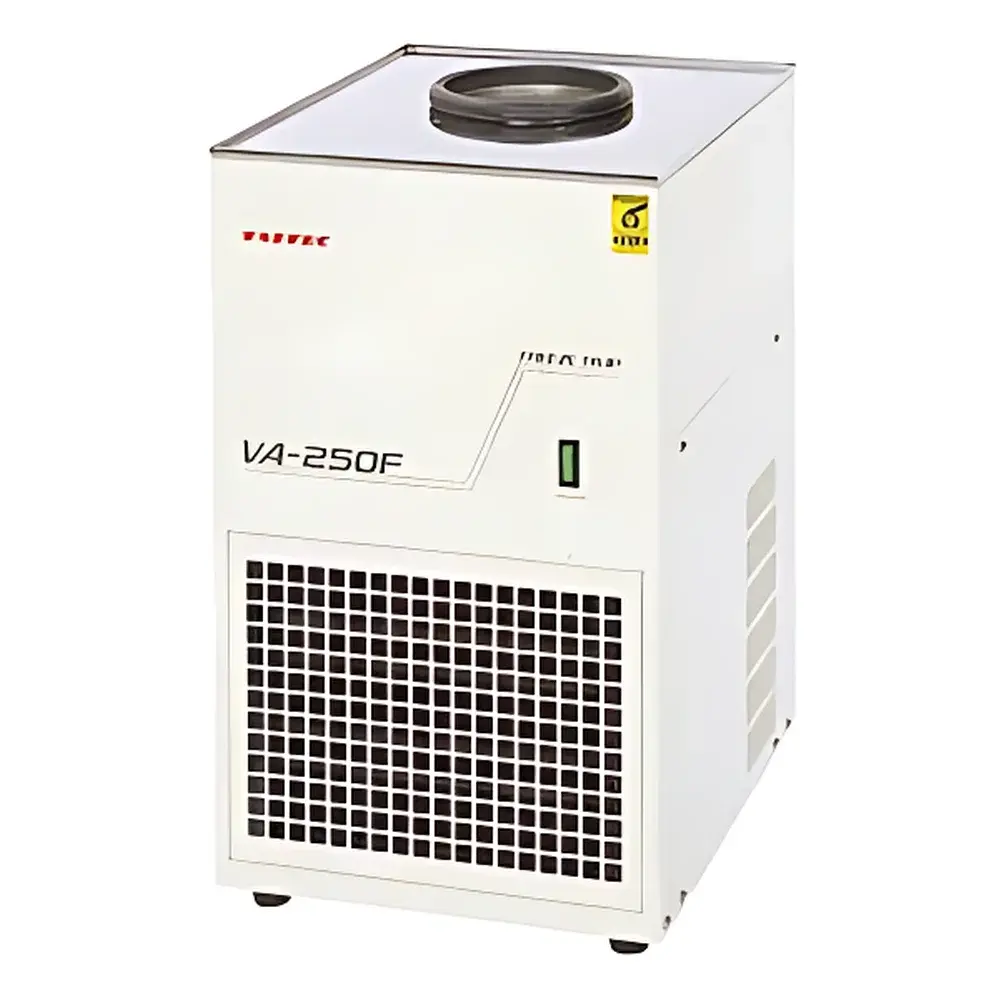
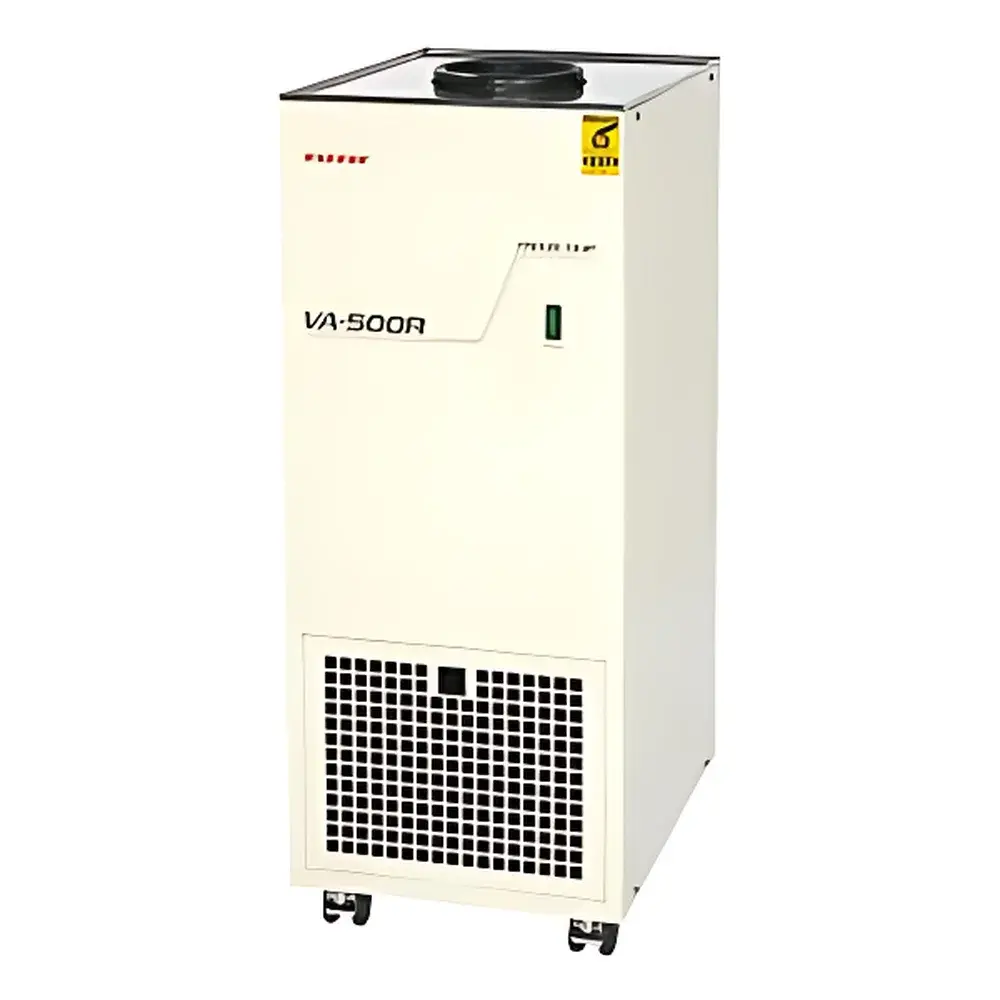
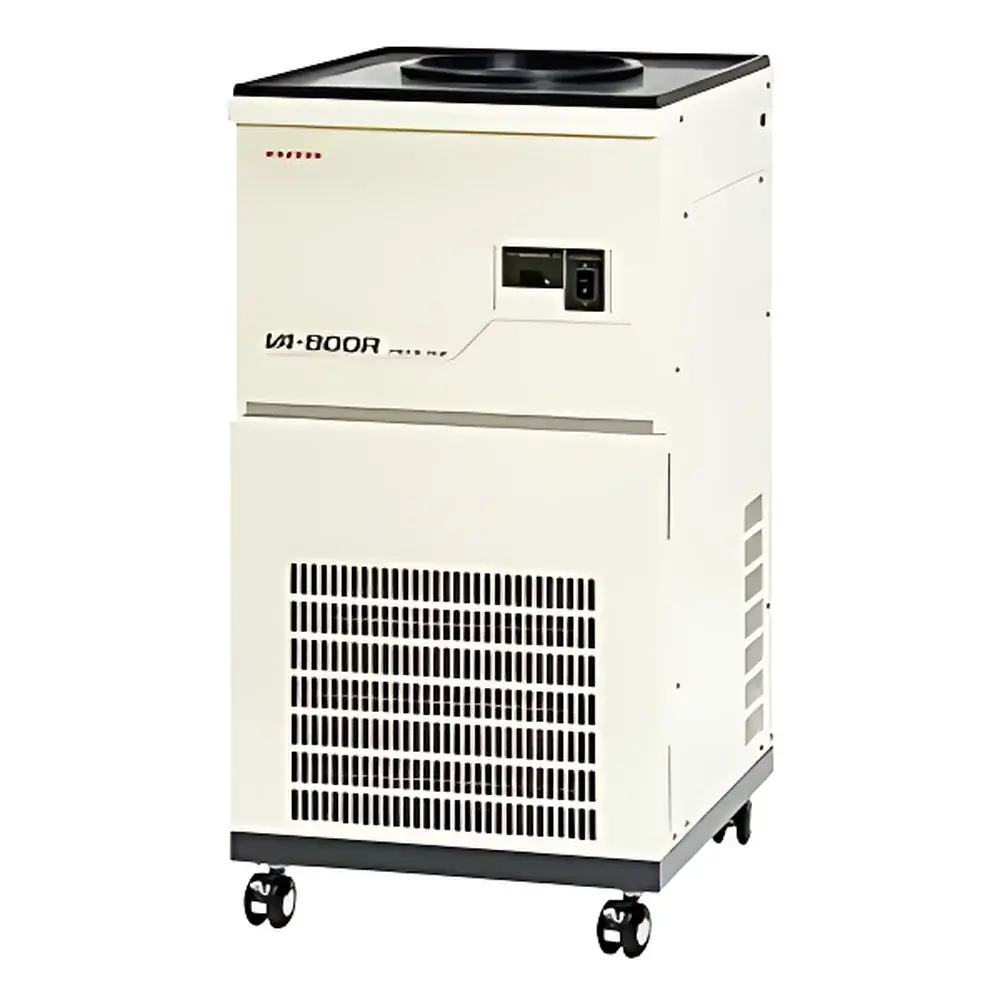
TAITEC VA-250F/500R/800R Cryogenic Cold Trap & Condensate Collector
| Brand | TAITEC |
|---|---|
| Origin | Japan |
| Model | VA-250F / VA-500R / VA-800R |
| Cooling Temperature Range | –45°C to –75°C |
| Condensate Capacity (per cycle) | ~200 mL (VA-250F) to ~1000 mL (VA-500R/800R) |
| Cooling Method | Direct-immersion refrigerated bath with internal condenser coil |
| Power Supply | AC 100 V, 5–13 A |
| Weight | 35–82 kg |
| Compliance | Designed for GLP-compliant laboratory environments |
Overview
The TAITEC VA-250F, VA-500R, and VA-800R series are precision-engineered cryogenic cold traps designed for high-efficiency vapor condensation and solvent recovery in vacuum-based sample preparation workflows. These units operate on the principle of direct-contact cryocondensation: volatile vapors—generated during centrifugal concentration, lyophilization pre-freezing, or vacuum distillation—are drawn into a refrigerated bath where they undergo phase transition upon contact with subzero surfaces. Unlike jacketed or indirect-cooling traps, the VA-series integrates the evaporator coil directly within the coolant reservoir, maximizing thermal transfer efficiency and ensuring that the effective trapping temperature closely matches the setpoint (±2°C typical deviation). This architecture delivers superior capture kinetics for polar solvents such as water and ethanol, while maintaining compatibility with aggressive organic, acidic, or alkaline vapors when used with optional borosilicate glass condensers.
Key Features
- Three scalable models (VA-250F, VA-500R, VA-800R) differentiated by bath volume (3 L to 9 L), cooling power (150 W to 400 W × 2), and ultimate temperature capability (–45°C to –75°C).
- Direct-immersion condenser design: stainless-steel coil submerged in coolant bath ensures minimal thermal lag and optimal heat exchange surface area.
- Integrated digital temperature display (standard on VA-800R; optional upgrade for VA-500R) with real-time monitoring and ±0.5°C resolution.
- Energy-efficient dual-stage refrigeration system (VA-800R): achieves –70°C in a 9 L bath using only a standard 15 A, 100 V outlet—no dedicated high-amperage circuit required.
- Modular accessory support: includes nozzle-equipped stainless-steel lids (NF-025/NF-040) for direct condensation and interchangeable glass condensers (GC-035/GC-070) for chemically aggressive vapors.
- Optional closed-loop circulation capability: when paired with an external recirculating pump (custom integration), the VA-800R functions as a –70°C ultra-low-temperature circulator for external cooling applications.
Sample Compatibility & Compliance
The VA-series accommodates diverse sample matrices across pharmaceutical, biotechnology, and academic research settings. Direct immersion mode is validated for aqueous and ethanol-based solvents; glass condenser configurations extend compatibility to chlorinated hydrocarbons, acetone, acetonitrile, HCl fumes, and NaOH vapor streams—provided operating vacuum levels remain ≥10⁻² mbar and trap temperature is maintained at least 10°C below the solvent’s freezing point. Units comply with electrical safety standards IEC 61010-1 and are constructed to support audit-ready documentation under FDA 21 CFR Part 11 when deployed with timestamped, password-protected temperature logging (via optional data interface). All models meet mechanical stability requirements for integration with TAITEC VC-series centrifugal concentrators and third-party freeze dryers operating under ISO 22042 (lyophilization equipment) and ASTM E2500 (verification of pharmaceutical process equipment).
Software & Data Management
While the VA-series operates as a standalone hardware platform without embedded firmware, the VA-800R’s digital controller supports analog output (0–5 V DC) for connection to external data acquisition systems. When integrated into validated lab networks, temperature logs can be archived via RS-485 or USB-to-serial adapters compliant with LabVIEW™, DeltaV®, or custom Python-based SCADA interfaces. Audit trails—including setpoint changes, power cycling events, and thermal deviation alerts—can be generated and exported in CSV format for inclusion in GLP/GMP batch records. No proprietary software installation is required; configuration remains accessible via front-panel keypad navigation with lockout functionality for operator-level access control.
Applications
- Centrifugal concentration enhancement: installed downstream of TAITEC VC-36R/96R/96W concentrators to increase solvent removal rate and prevent pump oil contamination.
- Pre-freezing stage for benchtop freeze dryers: serves as a rapid, low-thermal-mass freezing chamber prior to primary drying cycles.
- Vacuum distillation condensation: captures distillates in small-scale purification workflows without requiring chilled glycol loops.
- Cold finger alternative in rotary evaporation: mounted inline to reduce bumping and improve yield for heat-sensitive compounds.
- Corrosive gas scrubbing: with GC-series glass condensers, safely traps HNO₃, HF, or NH₃ vapors generated during digestion or extraction protocols.
- Low-temperature reaction bath: configured with external circulation for cryogenic synthesis at –60°C sustained over extended periods.
FAQ
What is the difference between direct-immersion and jacketed cold trap designs?
Direct-immersion traps place the refrigerant coil inside the coolant bath, delivering faster cooldown, tighter temperature control, and higher condensation efficiency—especially for high-volatility solvents. Jacketed systems cool the bath wall externally, resulting in slower response times and reduced effective trapping surface area.
Can the VA-800R be used continuously for 24 hours?
Yes—the unit is rated for continuous operation at –70°C under nominal load (≤80% condensate capacity per cycle) with adequate ventilation (minimum 15 cm clearance on all sides) and ambient temperature ≤25°C.
Is HFE-7100 or similar fluorinated solvents approved for use as bath fluid?
Yes—HFE-7100 is explicitly recommended in TAITEC technical documentation as a non-flammable, thermally stable alternative to methanol for liquid-bath operation. Its low toxicity and high dielectric strength make it suitable for Class I, Division 2 laboratory environments.
Do the glass condensers require calibration or periodic replacement?
Glass condensers are passive components with no calibration requirement. However, visual inspection for etching, microfractures, or residue buildup is recommended before each use; replacement is advised after 500 operational cycles or upon detection of structural compromise.
How does vacuum level affect condensation efficiency?
Lower absolute pressure increases vapor mean free path and reduces convective heat transfer, lowering effective condensation rate. Optimal performance is achieved at ≤1 × 10⁻² mbar; below 1 × 10⁻³ mbar, supplemental cryoshielding or staged trapping may be necessary for complete capture.



