
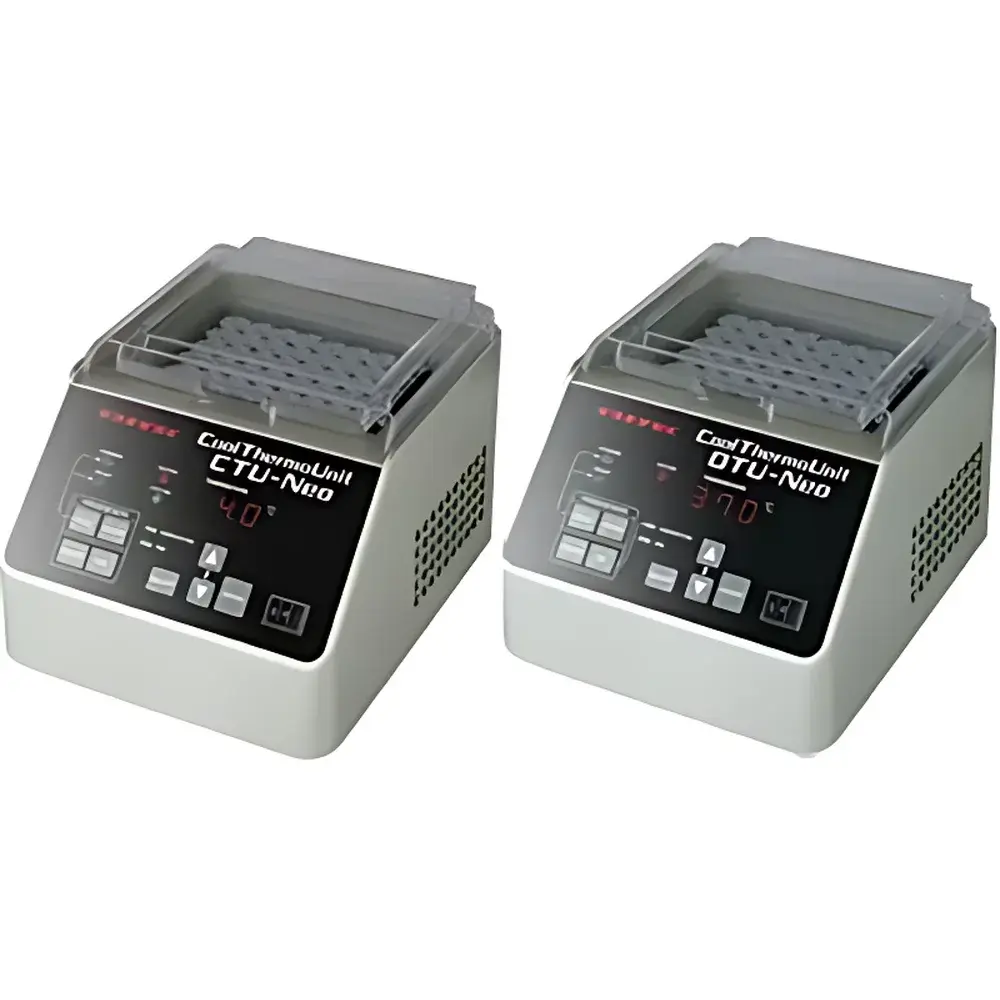
TAITEC CTU-Neo & DTU-Neo Peltier-Based Precision Metal Block Thermostats
| Brand | TAITEC |
|---|---|
| Origin | Japan |
| Model(s) | CTU-Neo, DTU-Neo |
| Temperature Range | 0°C to 105°C (CTU-Neo) |
| Temperature Accuracy | ±0.2°C |
| Temperature Ramp Time (25°C → 100°C) | ~20 min |
| Cooling/Heating Method | Thermoelectric (Peltier) |
| Display Resolution | 0.1°C |
| Power Supply | AC 100 V, 2 A |
| Dimensions | 210 × 268 × 175 mm (W × D × H) |
| Weight | ~4 kg (without blocks) |
Overview
The TAITEC CTU-Neo and DTU-Neo are compact, high-performance Peltier-driven metal block thermostats engineered for precise, rapid, and reproducible thermal control in molecular biology and enzymology workflows. Unlike conventional water or air baths, these instruments employ solid-state thermoelectric modules to deliver bidirectional temperature regulation—enabling both heating and active cooling within a single, maintenance-free architecture. The CTU-Neo achieves true sub-ambient operation down to 0°C, while the DTU-Neo is optimized for applications requiring only modest cooling (down to ambient +3°C), making it especially suitable for labs prioritizing energy efficiency without sacrificing thermal responsiveness. Both models are designed around modular aluminum heating blocks, supporting standardized microtubes (0.2–2.0 mL), centrifuge tubes (15 mL), microplates (96-well PCR plates), and custom vessels via interchangeable half-blocks or full-block configurations. Their core function is to maintain stable isothermal conditions or execute rapid, programmable temperature transitions—critical for isothermal amplification techniques such as LAMP, RCA, and whole-genome amplification (WGA), as well as enzyme-catalyzed reactions, nucleic acid denaturation/annealing, ligation, and restriction digestion.
Key Features
- Thermoelectric (Peltier) temperature control enables precise heating and active cooling without refrigerants or external chillers.
- Dual-block compatibility: Supports either one full-size aluminum block (e.g., B-1140 for 40 × 1.5 mL tubes) or two independent half-blocks (e.g., B-0648 + B-1120B), enabling simultaneous processing of two sample types with distinct thermal profiles.
- Modular block ecosystem: Over ten certified block variants available—including microtube, microcentrifuge tube, microplate, and specialty vial configurations—each engineered for optimal thermal conductivity and mechanical stability.
- Programmable delay timer (“Hold” function): Initiates timing only after reaching target temperature, ensuring accurate reaction start points for time-sensitive isothermal protocols.
- High-resolution digital display with dual-mode readout: Switches between setpoint and real-time block temperature at 0.1°C resolution.
- Comprehensive safety architecture: Integrated overtemperature cutoff, overcurrent protection, voltage surge suppression, sensor fault detection, non-volatile memory error monitoring, and dual-stage thermal safeguards (sample protection + device-level overheating prevention).
Sample Compatibility & Compliance
The CTU-Neo and DTU-Neo accommodate a wide range of laboratory consumables through TAITEC’s standardized block interface system. Half-blocks (e.g., B-0648, B-1120A/B, B-1220) support heterogeneous vessel formats—including 0.2 mL PCR tubes, 0.5 mL microtubes, 1.5–2.0 mL Eppendorf-style tubes, 15 mL conical centrifuge tubes, and 16.5 mm test tubes—while full-blocks (e.g., B-1140, B-0696) enable high-throughput processing of uniform tube arrays or standard 96-well PCR plates. All aluminum blocks are anodized for corrosion resistance and calibrated to ensure uniform thermal distribution across all wells (±0.3°C inter-well variance typical). These instruments comply with IEC 61010-1:2010 for laboratory electrical equipment safety and meet electromagnetic compatibility (EMC) requirements per EN 61326-1. While not inherently GLP/GMP-certified, their stable thermal performance, audit-ready temperature logging (via optional software), and deterministic ramp/hold behavior make them suitable for use in regulated environments where traceability and procedural consistency are required—particularly when integrated into validated workflows aligned with ISO/IEC 17025 or CLIA standards.
Software & Data Management
The CTU-Neo and DTU-Neo operate via intuitive front-panel controls with dedicated up/down keys and a single memory slot for storing frequently used setpoints. For advanced protocol management, optional TAITEC PC software (compatible with Windows 10/11) enables creation, storage, and execution of multi-step temperature programs—including ramp rates, dwell times, and looped cycles. Software-generated logs record timestamped temperature data at user-defined intervals (1–60 s), exporting to CSV for post-acquisition analysis in Excel or statistical packages. Audit trail functionality supports basic traceability, capturing operator ID (manual entry), program name, start/stop timestamps, and deviation alerts. Although native support for FDA 21 CFR Part 11 compliance (e.g., electronic signatures, role-based access) is not embedded, the instrument’s deterministic thermal behavior and exportable raw data facilitate integration into broader LIMS or ELN ecosystems where regulatory validation is managed at the system level.
Applications
- Isothermal nucleic acid amplification: LAMP, RPA, NASBA, and WGA—leveraging rapid, stable thermal equilibration to minimize cycle-to-cycle variability.
- Enzymatic reactions requiring strict temperature fidelity: DNA ligase, T4 polynucleotide kinase, reverse transcriptase, and restriction endonuclease digestions.
- Nucleic acid denaturation and hybridization: Controlled heat-induced DNA/RNA melting followed by precise annealing steps.
- Protein thermal shift assays (TSA) and enzyme activity profiling under defined thermal gradients.
- Cell lysis optimization and buffer equilibration prior to downstream purification or sequencing library prep.
- Quality control testing of temperature-sensitive reagents, including lyophilized enzymes and master mixes.
FAQ
What is the difference between the CTU-Neo and DTU-Neo models?
The CTU-Neo uses a dual-mode Peltier system capable of active cooling to 0°C, whereas the DTU-Neo is configured for heating plus limited cooling down to ambient +3°C—offering lower power consumption and reduced thermal stress on the module.
Can both half-blocks operate at different temperatures simultaneously?
No. The unit maintains a single uniform block temperature; however, two half-blocks allow concurrent processing of different tube types under identical thermal conditions.
Are calibration certificates available for these units?
Yes—NIST-traceable calibration reports (including as-found/as-left data) can be obtained from authorized TAITEC service centers upon request, typically with annual recalibration recommended.
Is the B-0696 block compatible with standard 96-well PCR plates?
Yes. The B-0696 full-block is dimensionally matched to ANSI/SBS-compliant microplates and accommodates either 96 × 0.2 mL tubes or one full PCR plate with uniform well-to-well thermal uniformity.
What maintenance is required for long-term reliability?
No routine maintenance is needed beyond periodic cleaning of block surfaces with ethanol and inspection of ventilation grilles; Peltier modules have no moving parts and rated lifetimes exceeding 50,000 operating hours under normal lab conditions.



