
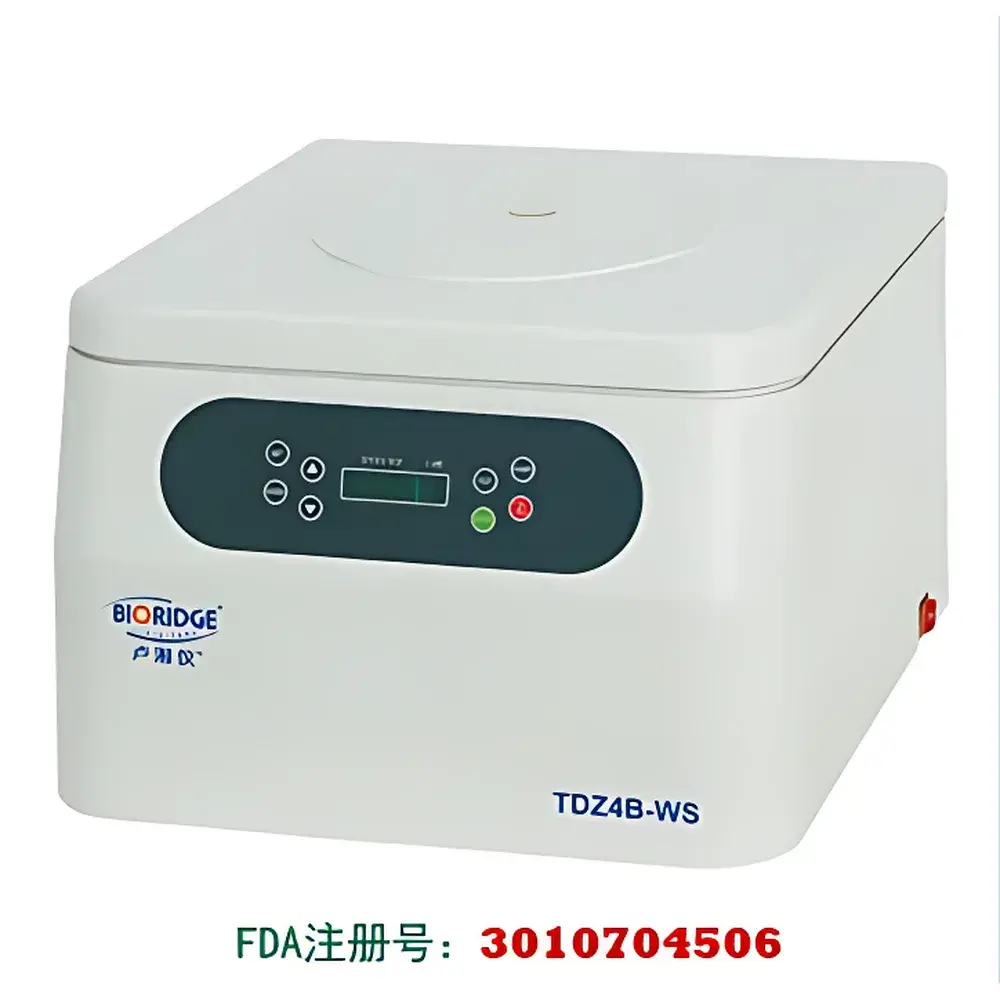
LUXIANGYI TDZ4B-WS Benchtop Low-Speed Centrifuge
| Brand | LUXIANGYI / BIORIDGE |
|---|---|
| Origin | Shanghai, China |
| Manufacturer Type | Authorized Distributor |
| Product Category | Domestic |
| Model | TDZ4B-WS |
| Instrument Type | Benchtop Centrifuge |
| Speed Range | Up to 4200 rpm |
| Max RCF | 2760 × g |
| Max Capacity | 12 × 20 mL |
| Dimensions (L×W×H) | 410 mm × 490 mm × 310 mm |
| Weight | 22 kg |
| Noise Level | <65 dB(A) |
| Power Supply | AC 220 V, 50 Hz, 5 A |
| Timer Range | 1–99 min |
| Speed Accuracy | ±50 rpm |
Overview
The LUXIANGYI TDZ4B-WS is a microprocessor-controlled, benchtop low-speed centrifuge engineered for routine separation tasks in clinical laboratories, academic research settings, and quality control environments. It operates on a brushless DC motor architecture—ensuring consistent rotational stability, extended service life, and significantly reduced acoustic emission compared to brushed motor systems. Designed for applications requiring gentle yet reliable sedimentation of cellular components, precipitated proteins, or suspended particulates, the TDZ4B-WS delivers reproducible centrifugal force profiles within the 0–2760 × g range, making it suitable for protocols involving whole blood fractionation, urine sediment processing, cell pellet harvesting, and polymer precipitation. Its fixed-angle rotor configuration supports standardized sample handling under ISO/IEC 17025-aligned workflows and complies with general safety requirements for Class II laboratory equipment per IEC 61010-1.
Key Features
- Brushless DC motor drive system ensures high torque consistency, minimal maintenance, and operational longevity.
- Intuitive touch-sensitive control panel with programmable parameter storage—enabling recall of up to 10 user-defined protocols including speed, time, and acceleration/deceleration profiles.
- Real-time dual-display interface showing simultaneous RPM and RCF values, with automatic conversion during operation and setpoint entry.
- Integrated electronic lid lock mechanism with automatic engagement upon closure and interlock verification prior to rotor acceleration.
- Comprehensive safety suite: overspeed protection, imbalance detection, lid-open emergency stop, and fault-code diagnostics displayed on the LCD screen.
- Fully stainless-steel rotor chamber and interchangeable stainless-steel rotor adapters—resistant to corrosion from common reagents including saline, ethanol, and buffered solutions.
- Acoustic optimization yields noise levels below 65 dB(A) at maximum operating speed—suitable for shared lab spaces without dedicated acoustic enclosures.
Sample Compatibility & Compliance
The TDZ4B-WS accommodates standard conical-bottom tubes (10 mL, 20 mL, and 50 mL), including polypropylene, polycarbonate, and glass variants rated for centrifugation. Compatible rotors include fixed-angle configurations supporting 12 × 20 mL, 18 × 10 mL, and 4 × 50 mL tube formats—each validated for mechanical integrity at rated speeds per ISO 15195:2021 (Laboratory medicine — Requirements for centrifuges). The instrument meets CE marking requirements under the EU Machinery Directive 2006/42/EC and electromagnetic compatibility standards EN 61326-1. While not certified for GMP-regulated production environments, its design supports GLP-compliant documentation practices when paired with external audit-trail-capable data loggers.
Software & Data Management
The TDZ4B-WS operates as a standalone instrument without proprietary software dependency. All operational parameters—including run history timestamps, final speed achieved, elapsed time, and error codes—are retained in non-volatile memory and accessible via the front-panel interface. For integration into networked laboratory information management systems (LIMS), optional RS-232 or USB-to-serial adapters enable ASCII-based data export (e.g., CSV-formatted logs) compatible with third-party scripting tools. No FDA 21 CFR Part 11 compliance features are embedded; however, manual recordkeeping of run parameters satisfies basic ISO 15189:2022 documentation expectations for non-automated analytical instrumentation.
Applications
- Clinical hematology: Separation of serum/plasma from whole blood using 10–20 mL evacuated tubes.
- Microbiology: Pellet recovery of bacterial cultures prior to DNA extraction or antibiotic susceptibility testing.
- Pharmaceutical QA/QC: Clarification of suspension formulations and excipient compatibility studies.
- Environmental testing: Sedimentation of waterborne particulates for turbidity correlation or heavy metal analysis.
- Educational labs: Teaching core principles of sedimentation velocity, relative centrifugal force calculation, and rotor dynamics.
FAQ
What is the maximum recommended tube volume for the 12-position rotor?
The 12-position rotor is rated for 20 mL conical tubes at full capacity; overfilling beyond 20 mL may compromise balance and void warranty coverage.
Does the TDZ4B-WS support refrigerated operation?
No—this model is a non-refrigerated benchtop unit. Ambient temperature operation only; not suitable for heat-labile biomolecules requiring thermal stabilization.
Can I use this centrifuge for density gradient separations?
While technically feasible with appropriate rotor geometry, the TDZ4B-WS lacks programmable deceleration ramps and brake-free coast-down functionality required for optimal gradient preservation.
Is rotor balancing mandatory before each run?
Yes—symmetrical mass distribution across opposing positions is required to prevent vibration-induced mechanical stress and ensure compliance with ISO 21501-4 vibration thresholds.
How often should the rotor be inspected for corrosion or fatigue?
Visual inspection is recommended before every use; full rotor certification (including non-destructive testing) should occur annually or after 5000 cumulative runs, whichever comes first.



