
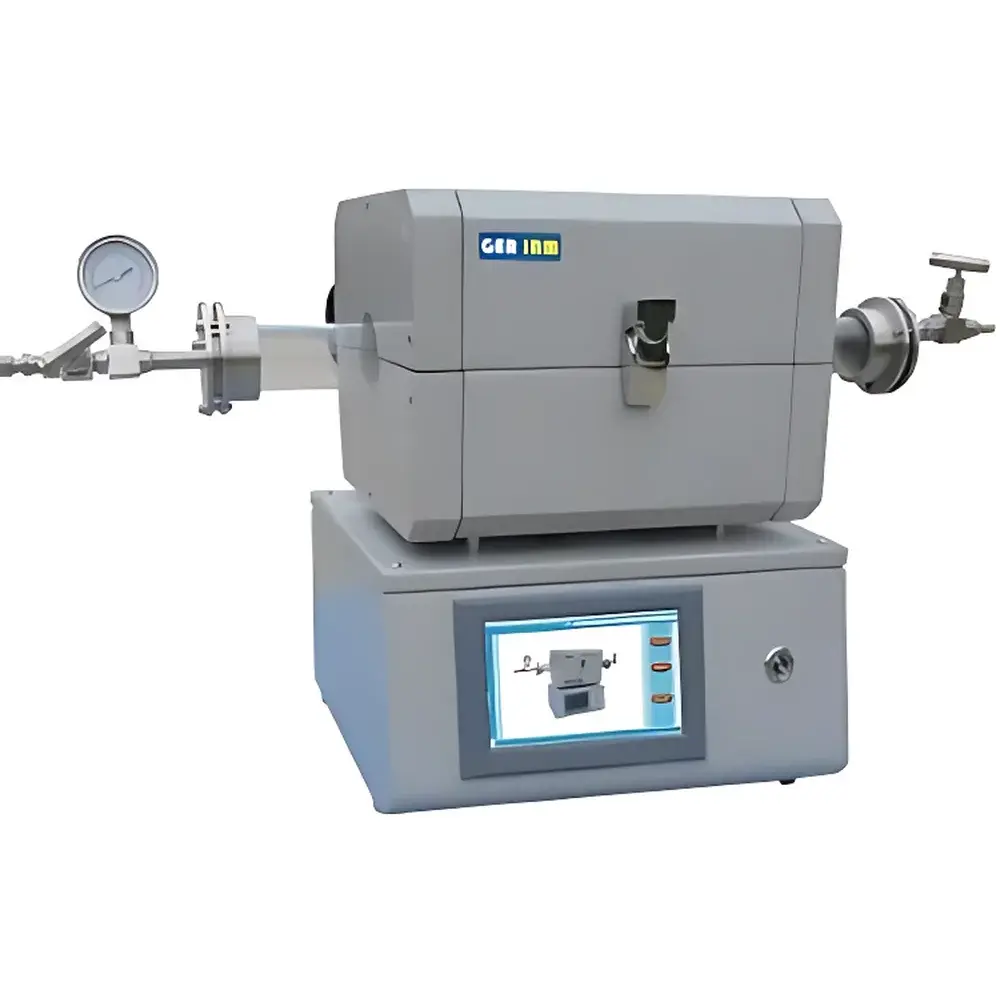
IRM TE200 Tube Furnace
| Brand | IRM |
|---|---|
| Origin | Beijing, China |
| Manufacturer Type | Direct Manufacturer |
| Region of Origin | Domestic (China) |
| Model | TE200 |
| Instrument Type | Tube Furnace |
| Maximum Temperature | 1200 °C / 1500 °C / 1700 °C (configurable by heating element & thermocouple) |
| Temperature Control Accuracy | ±1 °C |
| Max Power | 3 kW |
| Heating Time to Max Temp | 24 min |
| Heating Elements | High-quality resistance wire (1200 °C), imported SiC rods (1500 °C), or MoSi₂ rods (1700 °C) |
| Internal Chamber Dimensions | Ø50 mm × 600 mm |
| Control System | PID-based intelligent microprocessor controller |
| Tube Diameter | 60 mm |
| Display | 7-inch color LCD touchscreen |
| Programmable Profiles | 15 stored ramp-soak programs |
| Ramp Rate | Up to 20 °C/min |
| Uniformity Zone Length | 250 mm |
| Tube Material | High-purity quartz (standard) or alumina (optional) |
| Insulation | High-density ceramic fiber |
| Safety Protections | Over-temperature cutoff, over-current/over-voltage protection, thermocouple failure detection, earth leakage circuit breaker |
| Thermocouple Types | K-type (≤1200 °C), S-type (≤1500 °C), B-type (≤1700 °C) |
Overview
The IRM TE200 Tube Furnace is a precision-engineered horizontal high-temperature thermal processing system designed for controlled atmosphere and vacuum-compatible applications in materials science, catalysis research, semiconductor processing, and advanced ceramics development. Utilizing a robust double-layer concentric tube architecture with axial gas inlet/outlet ports, the furnace enables reproducible thermal treatments under inert, reducing, oxidizing, or vacuum conditions. Its core operating principle relies on resistive Joule heating via optimized heating elements—resistance wire for 1200 °C operation, silicon carbide (SiC) rods for 1500 °C capability, or molybdenum disilicide (MoSi₂) elements for sustained 1700 °C performance—each matched with appropriate thermocouple types (K, S, or B) and calibrated per ASTM E220 and IEC 60584 standards. The furnace achieves temperature stability within ±1 °C across its 250 mm uniformity zone—a specification validated under steady-state conditions per ISO 8573-1 and verified during factory calibration with NIST-traceable reference thermometers.
Key Features
- 7-inch full-color LCD touchscreen interface with intuitive graphical navigation, real-time temperature curve visualization, and dual-language support (English/Chinese firmware)
- PID-based intelligent temperature controller with auto-tuning, adaptive learning, and programmable multi-segment ramp-soak profiles (up to 15 user-defined programs)
- High-density ceramic fiber insulation (≥1400 °C rated) minimizing thermal mass and enabling rapid heating—reaching 1200 °C in ≤24 minutes with <2% energy loss to ambient
- Modular tube configuration: standard Ø60 mm outer diameter with internal Ø50 mm × 600 mm quartz tube; optional alumina or recrystallized alumina tubes for aggressive chemical environments
- Comprehensive safety architecture including independent over-temperature cut-off (setpoint +10 °C), redundant current/voltage monitoring, thermocouple break detection, and integrated 30 mA RCD protection
- Front-access flange design with O-ring sealed quartz-to-metal transition for leak rates <1×10⁻⁶ mbar·L/s (when paired with compatible vacuum pumps and fittings)
Sample Compatibility & Compliance
The TE200 accommodates diverse sample geometries—including powders, pellets, thin films, fibers, and small crucibles—within its 50 mm inner diameter tube. Quartz tubes meet USP Class VI biocompatibility requirements and are suitable for low-metal-contamination applications such as battery cathode synthesis or optical crystal annealing. Alumina tube variants comply with ASTM C20 and ISO 13384 for refractory stability under cyclic thermal stress. All electrical components conform to IEC 61000-6-3 (EMC emission limits) and IEC 61000-6-2 (immunity), while mechanical construction satisfies CE Machinery Directive 2006/42/EC. Optional data logging modules support 21 CFR Part 11-compliant audit trails when configured with password-protected user roles and electronic signature functionality.
Software & Data Management
The embedded controller supports USB export of time-stamped temperature logs (CSV format) and allows firmware updates via FAT32-formatted drives. For integration into automated lab networks, optional RS485 Modbus RTU or Ethernet TCP/IP interfaces enable bidirectional communication with SCADA systems, LIMS platforms, or custom Python/Matlab control scripts. Raw thermocouple voltage readings are digitized at 16-bit resolution with cold-junction compensation accuracy ±0.5 °C. All program executions generate timestamped metadata—including operator ID, start/stop times, deviation alerts, and final soak deviation—archivable for GLP/GMP traceability.
Applications
- Thermal annealing of transition metal oxides for solid-state battery electrode optimization
- Catalyst calcination and activation under controlled N₂/H₂/Ar atmospheres
- Graphene and CNT synthesis via chemical vapor deposition (CVD)
- Pre-sintering of ZrO₂, Al₂O₃, and Si₃N₄ green bodies prior to hot isostatic pressing
- Calibration of thermographic phosphors and pyrometric reference sources
- Thermogravimetric coupling for simultaneous mass-loss and phase-transition analysis
FAQ
What tube materials are supported, and how do I select the appropriate one?
Quartz tubes are standard for operations up to 1100 °C in oxidizing or inert atmospheres. For 1200–1500 °C applications requiring higher mechanical strength and lower alkali leaching, high-purity alumina (99.8%) is recommended. Recrystallized alumina or mullite tubes may be specified for specialized corrosion resistance.
Can the TE200 be integrated into a vacuum system?
Yes—the front flange accepts ISO-KF25 or CF35 vacuum fittings. When paired with a two-stage rotary vane pump and appropriate seals, base pressures of 10⁻² mbar are routinely achieved. For ultra-high vacuum (<10⁻⁵ mbar), a turbomolecular pump and bake-out capability are required (available as an accessory kit).
Is remote monitoring possible without physical access to the unit?
With the optional Ethernet module, users can monitor real-time temperature, program status, and alarm history via secure HTTPS web interface or RESTful API endpoints—fully compatible with LabVIEW, Node-RED, and enterprise IoT dashboards.
How is temperature uniformity verified across the 250 mm zone?
Uniformity is measured using a 5-point axial thermocouple array per ASTM E220 Annex A3. At 1200 °C, maximum deviation from setpoint across the zone is ≤±1.5 °C; at 1700 °C (with MoSi₂ elements), it remains ≤±3.0 °C—certified in the factory test report supplied with each unit.



