
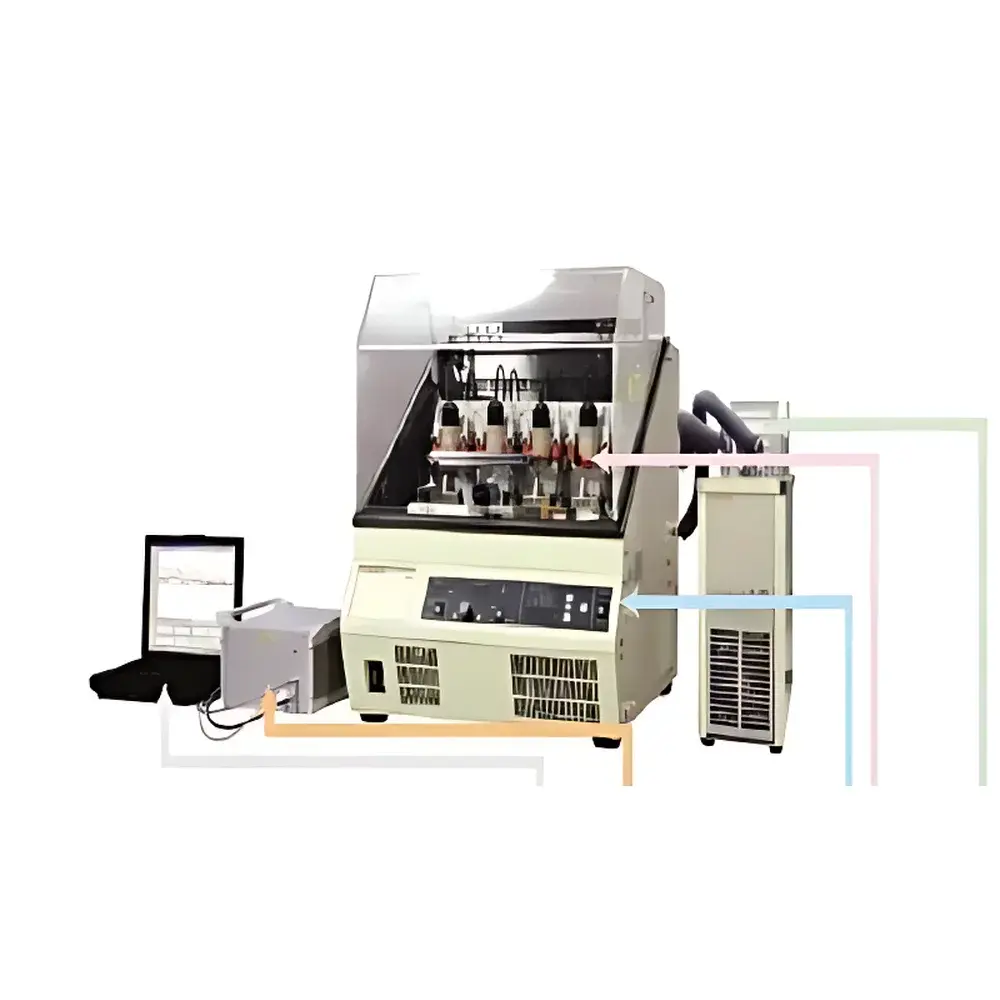
TAITEC BR-RAMOS Respiration Activity Monitoring System
| Brand | TAITEC |
|---|---|
| Origin | Japan |
| Manufacturer Status | Authorized Distributor |
| Origin Category | Imported |
| Model | BR-RAMOS |
| Instrument Type | Automated Microbial Respiration Kinetics Monitoring System |
| Throughput | 8 × 250 mL Erlenmeyer Flasks |
| Detection Limit | >0.0002 mol/h/L |
| Measurement Accuracy | <4% deviation |
| Temperature Range | +15°C to +50°C |
| Temp. Control Precision (BR-40RAM) | ±0.2°C |
| Agitation Mode | Orbital Shaking |
| Amplitude | 10–40 mm (stepless) |
| Speed | 20–200 rpm |
| Platform Dimensions | 400 × 300 mm |
| Power Supply | AC 100 V |
Overview
The TAITEC BR-RAMOS Respiration Activity Monitoring System is an engineered solution for real-time, non-invasive quantification of microbial and mammalian cell respiratory activity during shake-flask cultivation. Based on the well-established RAMOS (Respiration Activity Monitoring System) platform co-developed with RWTH Aachen University’s Department of Biochemical Engineering and HiTecZang GmbH, the BR-RAMOS implements gas-phase pressure sensing technology to determine oxygen transfer rate (OTR), carbon dioxide transfer rate (CTR), respiratory quotient (RQ), maximum specific growth rate (μmax), and volumetric mass transfer coefficient (kLa) — all in parallel across eight 250 mL culture vessels. Unlike endpoint gas analysis or offline sampling methods, BR-RAMOS enables continuous, label-free monitoring by integrating high-precision top-space pressure transducers into standard conical flasks. This approach eliminates the need for dissolved oxygen probes, exhaust gas analyzers, or metabolic labeling, while preserving physiological relevance under scalable orbital shaking conditions.
Key Features
- Simultaneous OTR and CTR measurement across eight independent 250 mL culture vessels, enabling statistically robust experimental replication and comparative strain screening.
- Orbital shaking platform (BR-40RAM) with stepless amplitude control (10–40 mm) and speed range (20–200 rpm), optimized for consistent hydrodynamic conditions matching benchtop bioreactors.
- Integrated temperature regulation (±0.2°C accuracy) within a controlled range of +15°C to +50°C; optional ZL-100 water-circulating chiller required for operation below 30°C.
- Detection limit of >0.0002 mol/h/L for OTR/CTR, supporting early-stage metabolic profiling of low-biomass cultures, slow-growing fungi, or primary mammalian cells.
- Modular architecture: RAMOS Core Unit (gas supply, pressure signal conditioning, data acquisition), RAMOS Platform (shaking table), and BR-40RAM air-jacketed incubator — each designed for interoperability and serviceability.
- Real-time calculation of derived kinetic parameters including RQ, μmax, and kLa without user-defined calibration curves, based on first-principles mass balance equations.
Sample Compatibility & Compliance
The BR-RAMOS system supports diverse biological systems, including bacterial strains (e.g., E. coli, Bacillus spp.), yeasts (S. cerevisiae, P. pastoris), filamentous fungi (Aspergillus, Trichoderma), plant suspension cultures, and adherent or suspension mammalian cell lines. Its non-invasive measurement principle ensures compatibility with antibiotic-containing media, fed-batch additives, and pH-shift protocols. The system meets requirements for GLP-compliant process characterization studies and supports audit-ready data handling when paired with validated RAMOS Software (v5.0+). While not FDA 21 CFR Part 11–certified out-of-the-box, the software architecture supports electronic signature implementation and full audit trail configuration per internal validation protocols.
Software & Data Management
RAMOS Software (Windows XP/2000/NT4.0 or later) provides instrument control, live parameter visualization, automated report generation, and export to CSV, Excel, or MATLAB-compatible formats. The interface includes configurable alarm thresholds for OTR deviation, real-time trend overlays across multiple flasks, and batch-wise comparison tools for scale-up correlation analysis. Raw pressure signals are logged at 1 Hz resolution with timestamped metadata (temperature, agitation speed, flask ID). Optional CTR module requires licensed software upgrade. All data files include embedded checksums and version-stamped acquisition settings to ensure traceability in regulated environments.
Applications
- Early identification of oxygen limitation onset during high-density microbial cultivations.
- Rapid empirical optimization of media composition, feeding strategies, and pH control regimes.
- Comparative physiological phenotyping of genetically modified strains under standardized shake-flask conditions.
- Scale-down model development for bioreactor process transfer — validated correlations between BR-RAMOS OTR profiles and 5–10 L stirred-tank reactor performance.
- Metabolic flux analysis support through synchronized OTR/CTR time-series used as constraints in constraint-based modeling (e.g., COBRA).
- Quality-by-Design (QbD) studies for fermentation process validation, including design space mapping of temperature–agitation–aeration interactions.
- Supporting USP <1117> and ISO 11133:2014 microbiological method suitability assessments via quantitative respiration kinetics.
FAQ
Is the BR-RAMOS system compatible with sterile operation?
Yes — all culture vessels use standard ISO-certified 250 mL baffled Erlenmeyer flasks with silicone septa. Gas inlet/outlet lines are fitted with 0.2 µm hydrophobic filters, and the core unit supports autoclavable gas manifolds.
Can I measure OTR and CTR simultaneously on the same flask?
Yes — dual-sensor configuration per flask enables concurrent OTR and CTR acquisition. CTR measurement requires optional software license and calibration gas verification.
What is the minimum viable biomass concentration detectable?
Detection sensitivity corresponds to ~1 × 10⁶ CFU/mL for fast-growing bacteria under optimal aeration; lower limits apply for slower metabolizers and depend on flask geometry and medium viscosity.
Does the system support custom agitation profiles (e.g., ramped speed)?
No — BR-40RAM operates at fixed speed and amplitude per experiment. Dynamic profile control requires integration with external programmable shakers via analog I/O (not included).
Is remote monitoring possible?
Yes — RAMOS Software supports TCP/IP-based network access for live dashboard viewing and secure data streaming to local servers; no cloud connectivity is embedded.




