
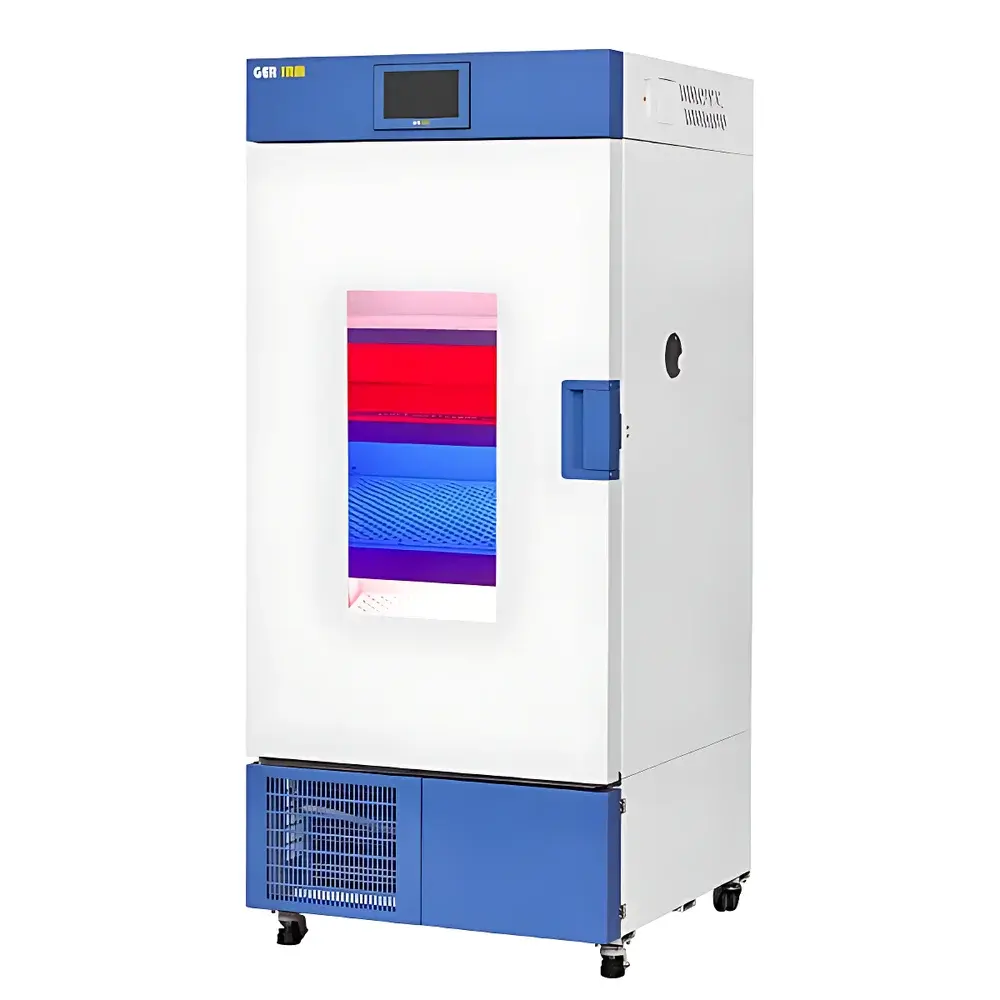
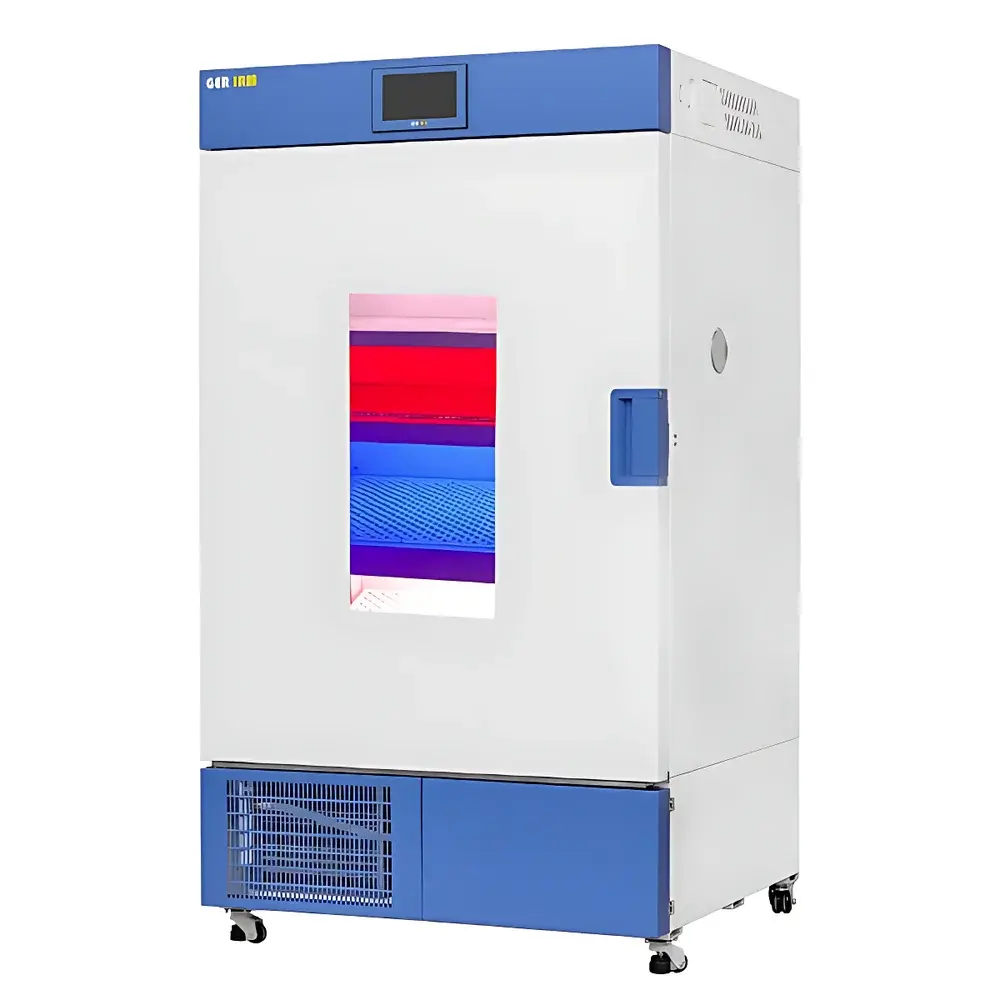
IRM IA260 Advanced Arabidopsis Growth Chamber
| Brand | IRM |
|---|---|
| Origin | Beijing, China |
| Manufacturer Type | Direct Manufacturer |
| Model | IA260 |
| Illumination Method | Shelf-Integrated LED Lighting |
| Light Source | High-Efficiency White LED Array |
| Spectral Range | Visible Spectrum (400–700 nm) |
| Temperature Range | 10–65°C (with illumination), 0–65°C (without illumination) |
| Temperature Fluctuation | ±0.3°C |
| Temperature Uniformity | ±1.0°C (at 20°C, same shelf) |
| Humidity Range | 30–95% RH (optional humidification module) |
| Photosynthetic Photon Flux Density (PPFD) | 0–500 µmol/m²/s |
| Chamber Capacity | 305 L |
| External Dimensions (W×D×H) | 780 × 790 × 1600 mm |
Overview
The IRM IA260 Advanced Arabidopsis Growth Chamber is a purpose-engineered environmental control system designed specifically for reproducible, long-term cultivation of Arabidopsis thaliana and other model plant species under tightly regulated physiological conditions. Built upon IRM’s proprietary iHACC™ (intelligent Hybrid Adaptive Climate Control) architecture, the chamber integrates high-fidelity temperature, light, humidity (optional), and CO2 (optional) regulation into a single unified platform—enabling precise simulation of diurnal cycles, seasonal transitions, and stress-response protocols. Its measurement foundation relies on real-time feedback from calibrated platinum resistance thermometers (PT100), capacitive humidity sensors traceable to NIST standards, and quantum PAR sensors compliant with ISO 17025-accredited calibration practices. The chamber operates via forced-air convection with dynamically adjustable fan speed to prevent desiccation of delicate seedlings while maintaining uniform thermal distribution across the growth volume—critical for minimizing positional bias in phenotypic assays.
Key Features
- Shelf-integrated white LED illumination delivering uniform PPFD up to 500 µmol/m²/s across the full growth area; spectral output optimized for chlorophyll absorption peaks (450 nm & 660 nm) and photomorphogenic response
- iHACC™ adaptive PID control algorithm ensuring ±0.3°C temperature stability and ≤±1.0°C spatial uniformity at 20°C—validated per ASTM E145-22 Annex A4 for environmental chambers
- Triple-tier user permission system (Operator / Supervisor / Administrator) with encrypted event logging, timestamped operation records, and full audit trail exportable via USB—supporting GLP/GMP compliance and FDA 21 CFR Part 11 readiness
- 7-inch industrial-grade capacitive touchscreen with intuitive HMI supporting programmable multi-segment cycles (1–30 steps), timed start/stop, setpoint hold, and automatic recovery after power interruption
- Integrated water management: auto-fill function, large-capacity reservoir with condensate recirculation, and anti-overflow/dry-run protection—reducing manual maintenance frequency by >70% compared to conventional humidified chambers
- Variable-speed centrifugal circulation fan with low-turbulence airflow profile—minimizing mechanical stress on developing rosettes and preventing leaf desiccation during extended photoperiods
- Comprehensive safety suite including dual independent overtemperature cut-offs, refrigerant pressure monitoring, cooling fan thermal protection, door-open detection, and ground-fault circuit interruption
Sample Compatibility & Compliance
The IA260 accommodates standard growth vessels—including Magenta boxes, square petri dishes (100 mm), deep-well plates, and hydroponic trays—within its 305 L internal volume (640 × 450 × 1060 mm). Its modular design supports interchangeable shelving configurations, enabling flexible arrangement of soil-based or agar-grown specimens. All materials in contact with the growth environment comply with USP Class VI biocompatibility requirements and are non-outgassing per ISO 10993-5. The chamber meets IEC 61000-6-3 (EMC emission) and IEC 61000-6-2 (immunity) standards. Optional CO2 control (0–5000 ppm) utilizes NDIR sensing and electrochemical actuation, certified to ISO 8573-1:2010 Class 2 for gas purity integrity.
Software & Data Management
Data acquisition and system supervision are managed through IRM’s embedded firmware v4.2, which logs all sensor readings (temperature, humidity, light intensity, fan speed, compressor status) at user-defined intervals (1 s to 60 min). Raw datasets are exportable in CSV format via USB 2.0 interface, compatible with MATLAB, Python (Pandas), and LabChart. Optional 4G LTE connectivity enables remote monitoring and control via secure HTTPS web portal or native Android/iOS application—with TLS 1.2 encryption, session timeout, and role-based UI masking. All logged events include digital signatures and tamper-evident timestamps aligned to UTC/NTP servers—fulfilling ALCOA+ principles for data integrity in regulated research environments.
Applications
- Genetic screening of Arabidopsis T-DNA insertion lines under controlled photoperiod and temperature gradients
- Phenotypic characterization of circadian clock mutants (e.g., cca1/lhy) using programmable light/dark cycling
- Drought and heat-stress response studies leveraging synchronized humidity ramping and thermal challenge profiles
- Seed germination kinetics analysis with high-resolution time-lapse imaging integration (via optional camera port)
- Pre-acclimation protocols for subsequent transfer to greenhouse or field trials—ensuring consistent developmental staging
- Training and validation of AI-driven phenotyping pipelines requiring standardized lighting and climate baselines
FAQ
What is the maximum recommended plant height for optimal light uniformity?
For uniform PPFD distribution across the entire growth plane, we recommend limiting canopy height to ≤200 mm when operating at maximum irradiance (500 µmol/m²/s). Height-sensitive experiments may utilize optional multi-tier LED arrays (up to 4 layers) to maintain photon flux consistency.
Is the chamber suitable for long-term sterile culture without contamination risk?
While the IA260 provides environmental control, it is not a laminar-flow or HEPA-filtered biosafety enclosure. For axenic culture, users must integrate external sterilization protocols (e.g., surface UV-C treatment, ethanol wipe-down, or upstream air filtration) and validate sterility per ISO 14644-1 Class 7 practices.
Can the system be integrated into an existing building management system (BMS)?
Yes—the chamber supports Modbus RTU (RS-485) and optional BACnet/IP gateways for bidirectional communication with enterprise-level HVAC and facility monitoring platforms.
Does the iHACC™ control system support custom algorithm injection?
Firmware v4.2 includes a secure API endpoint for third-party Python scripts (via USB-hosted microSD execution environment), permitting user-defined control logic—subject to IRM’s functional safety review and signature verification.
How frequently does the humidity sensor require recalibration?
Under normal operating conditions (30–95% RH, 15–35°C), the capacitive humidity sensor maintains NIST-traceable accuracy for ≥12 months; annual recalibration is recommended and supported via IRM-certified service centers.




