
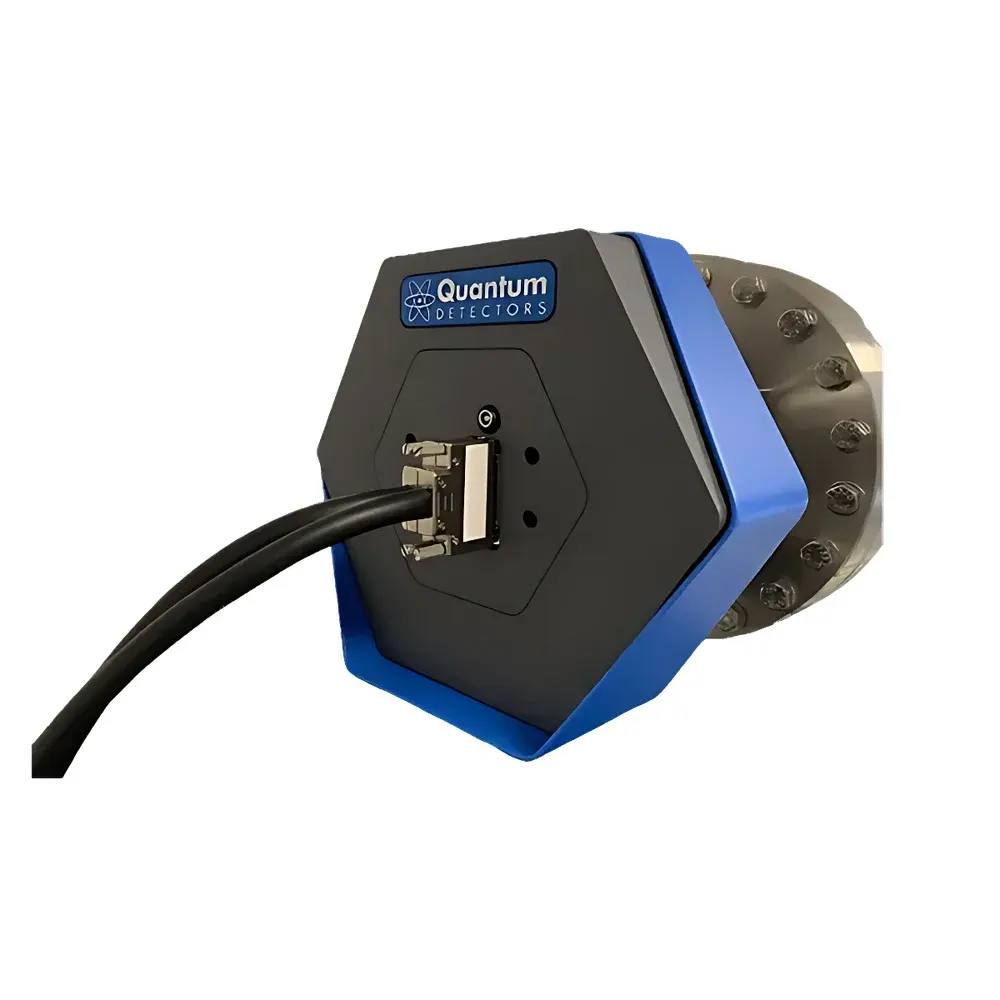
MerlinEELS Direct Electron Detection System for EELS Spectroscopy
| Brand | Quantum Detectors |
|---|---|
| Origin | United Kingdom |
| Model | MerlinEELS |
| Detector Architecture | Hybrid Pixel (4 × Medipix3 RX chips) |
| Format | 1024 × 256 pixels |
| Frame Rate | up to 3600 fps (6-bit mode, full frame) |
| Dynamic Range | >16 million counts per pixel |
| Readout Noise | 0 e⁻ rms |
| Dead Time | 0 ns (dual counter per pixel) |
| Pixel Size | 55 µm |
| Energy Thresholding | User-configurable single-electron discrimination |
| ROI Modes | 4–128 rows selectable (N × 256 px) |
| Integration | TEM-compatible with dedicated scan generator and multi-signal synchronization |
Overview
The MerlinEELS is a high-performance direct electron detection system engineered specifically for Electron Energy-Loss Spectroscopy (EELS) in transmission electron microscopy (TEM) and scanning transmission electron microscopy (STEM). Unlike conventional indirect detectors—such as scintillator-coupled CCDs or analog CMOS sensors—the MerlinEELS employs a hybrid pixel architecture based on four synchronized Medipix3 RX ASICs. This enables true single-electron counting with zero readout noise, zero dead time, and ultra-high dynamic range (>16 million counts per pixel), critical for quantitative low-dose and high-energy-loss EELS acquisition. Its design addresses two fundamental limitations in conventional EELS: signal fidelity degradation due to detector noise and temporal blurring from sample drift during spectral acquisition. By delivering frame-synchronous, noise-free electron counting at up to 3600 fps (full-frame, 6-bit mode), MerlinEELS preserves both spatial and spectral integrity across rapid acquisitions—including time-resolved spectroscopic imaging, tilt-series EELS mapping, and dose-sensitive beam-sensitive materials.
Key Features
- Zero-Noise, Zero-Dead-Time Counting: Each 55 µm pixel integrates dual independent counters; while one reads out accumulated counts, the other continues counting—ensuring no electron events are lost during readout. This eliminates pile-up artifacts and enables accurate quantification even under high-flux conditions.
- Ultra-High Dynamic Range: With >16 M counts/pixel capacity, MerlinEELS simultaneously resolves intense zero-loss peaks and weak fine-structure signals (e.g., L₃ edges of La in SrTiO₃) within a single spectrum—eliminating the need for exposure bracketing or post-acquisition normalization.
- Configurable ROI Acquisition: Users select 4 to 128 rows (in powers of two) for readout, generating N × 256-pixel images (N ∈ {4, 8, …, 128}). This accelerates STEM-EELS line scans and hyperspectral mapping without compromising spectral resolution along the dispersion axis.
- On-Chip Energy Thresholding: Every incident electron is evaluated against a user-defined energy threshold before counting. Sub-threshold events are rejected in real time—effectively eliminating dark current, stray electrons, and detector-generated noise at the hardware level.
- Dedicated Scan Generator Integration: Synchronized with TEM column electronics, the integrated scan generator supports simultaneous acquisition from multiple detectors (e.g., annular dark-field, bright-field, and EELS), enabling correlated multimodal imaging with precise timing alignment.
Sample Compatibility & Compliance
MerlinEELS is compatible with all major 200–300 kV TEM/STEM platforms equipped with standard Gatan or FEI-compatible EELS spectrometer interfaces (e.g., Gatan Enfina, Quantum ER, or CEOS corrector-integrated systems). It operates under standard high-vacuum TEM conditions (≤10⁻⁷ mbar at detector port) and requires no liquid nitrogen or external cooling. The system meets CE marking requirements for electromagnetic compatibility (EMC Directive 2014/30/EU) and low-voltage safety (LVD Directive 2014/35/EU). Data acquisition workflows support audit-trail logging and user-access controls aligned with GLP and GMP principles; raw count data is stored in open-format HDF5 files compliant with FAIR (Findable, Accessible, Interoperable, Reusable) data standards. While not FDA-certified (as a research-grade instrument), its deterministic counting behavior and traceable calibration protocols align with ISO/IEC 17025 requirements for metrological confidence in analytical electron microscopy laboratories.
Software & Data Management
The MerlinEELS is controlled via the Merlin Control Suite, a cross-platform application (Windows/Linux) supporting live histogramming, real-time threshold tuning, ROI configuration, and synchronized multi-detector triggering. All acquired data—including frame-stamped spectra, metadata (beam voltage, dispersion, aperture settings), and hardware logs—are saved in HDF5 format with embedded NeXus-compatible definitions. The software provides native export to DigitalMicrograph (.dm4), EMsoft, and HyperSpy-compatible formats, facilitating integration into established EELS processing pipelines (e.g., core-loss background removal, elemental mapping, ELNES fingerprinting). Optional Python API enables automated scripting for batch acquisition, dose-controlled acquisition, and machine-learning–driven region-of-interest targeting. Audit trails record operator ID, timestamp, parameter changes, and detector status—supporting 21 CFR Part 11–compliant environments when deployed with validated IT infrastructure.
Applications
- Atomic-resolution chemical mapping of oxide heterostructures (e.g., LaMnO₃/SrTiO₃ interfaces), resolving dopant segregation at sub-unit-cell scales via La-L₃ and Ti-K edge intensity ratios.
- Time-resolved plasmon spectroscopy in 2D materials, capturing nanosecond-scale carrier dynamics through high-frame-rate EELS series.
- Low-dose EELS of beam-sensitive organic-inorganic perovskites and MOFs, where zero-readout-noise acquisition maximizes information per incident electron.
- Quantitative valence-state analysis in transition-metal oxides using fine-structure deconvolution (e.g., Mn-L₂/L₃ branching ratio) with statistical confidence enabled by high-count statistics.
- Correlative STEM-EELS + ADF + BF imaging for structural–chemical–electronic property triangulation in catalyst nanoparticles and battery electrode interfaces.
FAQ
What vacuum interface does MerlinEELS require?
It uses a standard DN63CF flange with integrated differential pumping stage, compatible with most Gatan-type EELS spectrometer ports.
Can MerlinEELS be used for cathodoluminescence (CL) or energy-filtered TEM (EFTEM)?
No—it is optimized exclusively for parallel EELS detection; CL and EFTEM require different optical paths and pixel architectures.
Is offline recalibration required after installation?
No. Factory calibration includes pixel gain uniformity, threshold linearity, and geometric distortion correction—all stored in non-volatile memory and applied automatically on startup.
Does MerlinEELS support energy-dispersive X-ray spectroscopy (EDS) integration?
Not natively; however, its scan generator can trigger external EDS systems synchronously for correlated EELS–EDS acquisition.
What is the maximum sustainable count rate per pixel?
At 6-bit mode and full-frame readout, the system maintains linear response up to ~10⁶ electrons/pixel/second—validated per ISO 15529:2018 for electron detector linearity assessment.





