
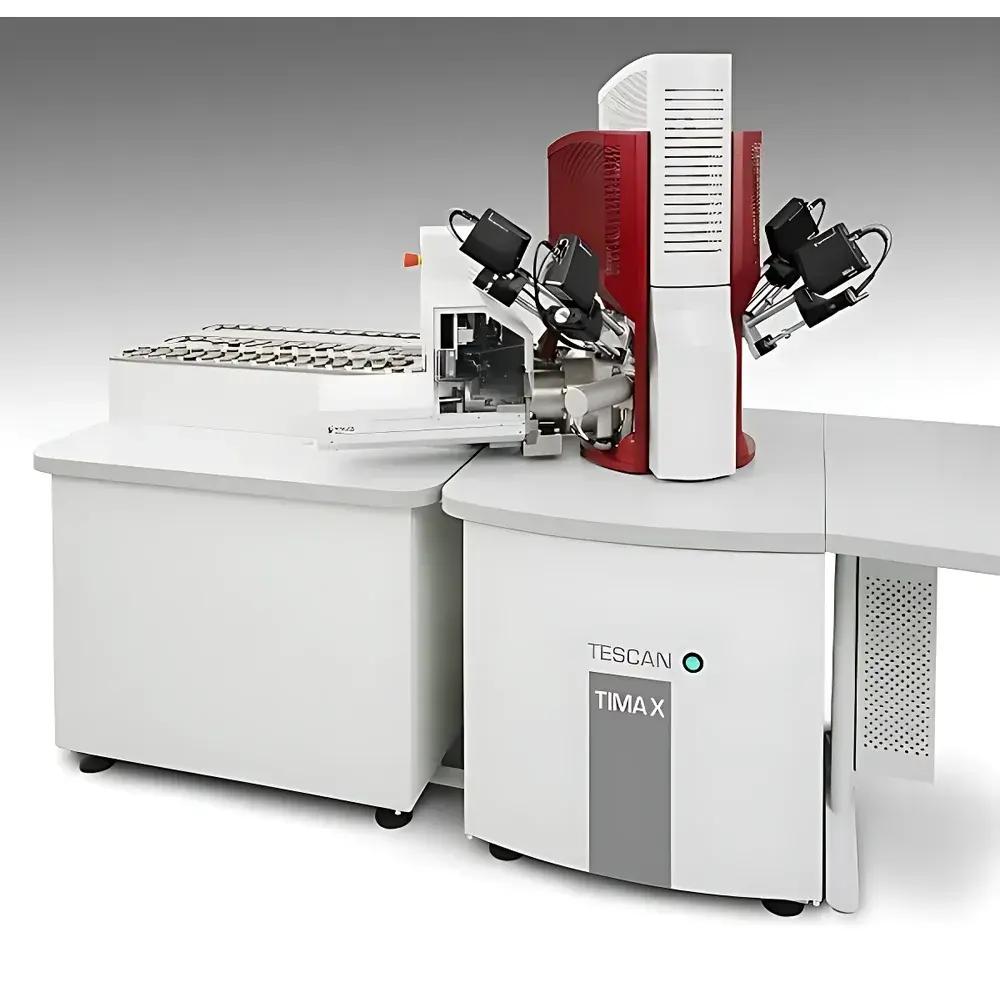
TESCAN TIMA-X Integrated Mineral Analyzer System
| Brand | TESCAN |
|---|---|
| Origin | Czech Republic |
| Manufacturer Type | Original Equipment Manufacturer (OEM) |
| Import Category | Imported Instrument |
| Model | TIMA-X |
| Electron Gun Type | Cold Field Emission |
| Secondary Electron Image Resolution | 1.2 nm @ 30 kV |
| Magnification Range | 1× to 1,000,000× |
| Accelerating Voltage | 0.2–30 kV |
| Backscattered Electron (BSE) Image Resolution | 2.0 nm @ 15 kV |
Overview
The TESCAN TIMA-X Integrated Mineral Analyzer System is a purpose-built, fully automated scanning electron microscope (SEM) platform engineered for quantitative mineralogical characterization in geological, mining, and metallurgical laboratories. Unlike conventional SEM-EDS systems, the TIMA-X integrates high-resolution imaging, energy-dispersive X-ray spectroscopy (EDS), and proprietary real-time spectral processing into a single synchronized acquisition architecture. Its core measurement principle relies on simultaneous high-speed BSE signal acquisition and full-spectrum EDS mapping—capturing elemental composition, phase identification, and spatial distribution at sub-micron resolution across large-area polished sections or bulk rock samples. Designed specifically for industrial mineral processing workflows, the TIMA-X delivers statistically robust modal mineralogy data—including mineral abundance, liberation degree, association patterns, grain size distribution, and textural classification—without manual intervention. The system operates under high-vacuum conditions as standard, with optional low-vacuum capability for semi-conductive or hydrated specimens.
Key Features
- Cold field emission (CFE) electron source ensuring exceptional beam stability, long-term current constancy, and sub-nanometer probe convergence for high-fidelity BSE/SE imaging and precise EDS quantification.
- Integrated TIMA software suite enabling fully automated stage navigation, feature-based region-of-interest (ROI) selection, and real-time phase classification using multivariate statistical analysis of EDS spectra.
- Large-volume specimen chamber accommodating up to seven 30 mm-diameter polished thin sections or bulk mounts—optimized for routine throughput in resource evaluation labs.
- Dedicated mineral sample holder with built-in calibration references: Pt Faraday cup for BSE signal normalization; certified Mn, Cu, SiO₂ (quartz), C, and Au standards for EDS detector response verification and ZAF matrix correction validation.
- Computer-controlled ultra-fast motorized stage with sub-micron positional repeatability and programmable tilt/rotation for 3D texture reconstruction and stereological analysis.
- Modular detector configuration including in-lens SE, solid-state BSE, and high-count-rate silicon drift detector (SDD) with <127 eV Mn-Kα energy resolution at 100,000 cps.
Sample Compatibility & Compliance
The TIMA-X supports standard petrographic thin sections (25–32 mm diameter), polished epoxy-mounted drill core fragments, and uncoated ore concentrates. Sample preparation follows ISO 14688-1 and ASTM D2488 guidelines for geological materials. All automated acquisition protocols are traceable and support GLP-compliant audit trails per FDA 21 CFR Part 11 when deployed with validated TIMA software version 6.5 or higher. Phase identification libraries comply with the International Mineralogical Association (IMA) nomenclature and reference standards from NIST SRM 2100 (silicate minerals) and USGS microbeam reference materials. System performance verification adheres to ISO 16700:2016 (microanalysis — EDS — quantification accuracy) and ASTM E1508-22 (quantitative elemental analysis by EDS).
Software & Data Management
TIMA software provides end-to-end workflow automation—from stage initialization and beam alignment to pixel-level phase classification and statistical reporting. Raw EDS spectra are stored in standardized *.eds format compliant with the IUPAC Spectral Data Exchange Standard. Quantitative outputs include CSV-exportable mineral abundance tables, cumulative grain size distributions (log-normal and Rosin-Rammler fits), liberation matrices, and binary association heatmaps. Data integrity is maintained via timestamped acquisition logs, user-access controls, electronic signatures, and immutable project archives. Optional integration with LIMS platforms (e.g., Thermo Fisher SampleManager, LabWare) enables direct ingestion of assay results, drill hole metadata, and process plant data for integrated resource modeling.
Applications
- Geometallurgical characterization of porphyry copper, iron oxide-copper-gold (IOCG), and rare earth element (REE) deposits.
- Process mineralogy studies supporting comminution circuit optimization, flotation reagent selection, and tailings management.
- Liberation analysis for precious metal recovery assessment—particularly in refractory gold ores where sub-micron encapsulation dictates leach efficiency.
- Mineral carbonation potential evaluation in CO₂ sequestration feasibility studies.
- Forensic geology applications including provenance analysis of construction aggregates and archaeological ceramics.
- Research-grade phase evolution mapping during high-temperature hydrothermal alteration experiments.
FAQ
What vacuum modes does the TIMA-X support?
The TIMA-X operates in high-vacuum mode as standard (base pressure ≤1×10⁻⁷ Pa); low-vacuum mode (up to 130 Pa) is available as an optional configuration for charge-prone or hydrated samples.
Can TIMA-X analyze uncoated conductive minerals?
Yes—its cold field emission source and optimized landing voltage range (0.2–30 kV) allow direct analysis of native metals, sulfides, and oxides without carbon or gold sputter coating.
How is phase identification validated?
Phase classification uses a hybrid algorithm combining spectrum matching against IMA-certified reference libraries and supervised machine learning trained on >50,000 verified mineral spectra.
Is remote operation supported?
Full remote access, including live beam control and real-time data review, is enabled via secure TLS-encrypted VNC sessions with two-factor authentication.
What maintenance intervals are recommended?
Annual preventive maintenance includes column cleaning, detector calibration, and vacuum system leak testing—aligned with TESCAN’s ISO 9001-certified service protocol.




