
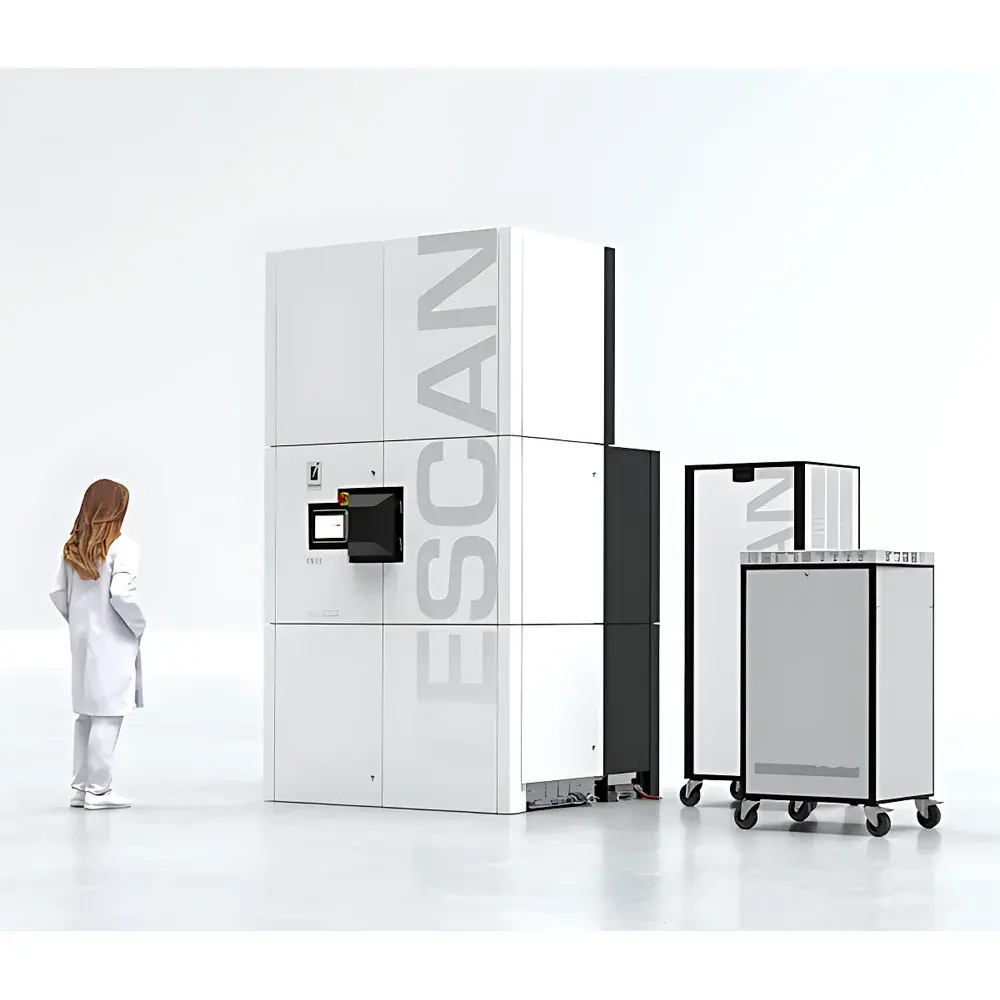
TESCAN TENSOR 4D-STEM Analytical Transmission Electron Microscope
| Brand | TESCAN |
|---|---|
| Origin | Czech Republic |
| Manufacturer Type | Original Equipment Manufacturer (OEM) |
| Origin Category | Imported Instrument |
| Model | TENSOR |
| Pricing | Available Upon Request |
Overview
The TESCAN TENSOR is a purpose-built, integrated analytical transmission electron microscope (TEM) platform engineered for advanced 4D-scanning transmission electron microscopy (4D-STEM). Designed around a mid-voltage Schottky field-emission electron gun operating at up to 200 kV, the system delivers near-ultra-high vacuum conditions in the specimen chamber (base pressure ≤10⁻⁶ Pa), enabling high-fidelity structural, chemical, and crystallographic characterization of functional materials, thin films, nanomaterials, and both natural and synthetic particulates. Unlike conventional TEM/STEM systems requiring extensive operator expertise and manual alignment, the TENSOR implements synchronized, hardware-accelerated 4D-STEM acquisition—where every probe position records a full 2D diffraction pattern—enabling quantitative phase, strain, orientation, and compositional mapping without compromising spatial resolution or data fidelity. Its architecture integrates electron optics, detectors, and real-time computation into a unified platform optimized for reproducible, high-throughput multimodal analysis under rigorous laboratory or industrial R&D environments.
Key Features
- Hybrid-pixel direct electron detection camera for high-dynamic-range, low-noise diffraction pattern acquisition with sub-millisecond frame rates
- Dual large-solid-angle windowless silicon drift detectors (SDDs) for rapid, high-count-rate energy-dispersive X-ray spectroscopy (EDS) with simultaneous spectral and spatial correlation
- High-frequency precession-enabled electron beam scanning (up to 72 kHz) to suppress dynamical diffraction effects and enhance quantitative interpretation of diffraction contrast
- Integrated electrostatic beam blanker for precise dwell-time control and dose-efficient acquisition protocols
- Modular column design featuring a robust, mid-voltage (80–200 kV) Schottky FEG source with long-term emission stability and minimal energy spread (<0.7 eV)
- Real-time 4D-STEM data streaming, on-the-fly processing, and interactive visualization via TESCAN Explore software suite
Sample Compatibility & Compliance
The TENSOR accommodates standard 3 mm TEM grids (including holey carbon, lacey carbon, and silicon nitride membranes), as well as specialized holders for in-situ heating, biasing, and cryogenic transfer. It supports both conventional bright-field (BF), annular dark-field (ADF), and high-angle annular dark-field (HAADF) STEM imaging modes, alongside lattice-resolved STEM, virtual STEM, and tomographic reconstruction workflows. The system complies with ISO 14644-1 Class 5 cleanroom requirements for column environment integrity and meets IEC 61000-6-3 electromagnetic compatibility standards. All EDS quantification routines adhere to ASTM E1508 and ISO 16700 guidelines for microanalysis, while data acquisition metadata—including beam parameters, detector settings, and vacuum logs—is structured to support GLP/GMP audit trails and FDA 21 CFR Part 11–compliant electronic record retention when deployed in regulated environments.
Software & Data Management
TESCAN Explore serves as the unified control and analysis interface, providing intuitive workflow templates for routine 4D-STEM measurements including strain mapping, orientation imaging (ASTAR-like), phase identification, and virtual detector synthesis. Raw 4D datasets (typically stored in HDF5 format) are fully compatible with open-source analytical ecosystems: native export modules enable seamless integration with HyperSpy for multivariate statistical analysis, LiberTEM for distributed GPU-accelerated processing, and y4D-STEM for custom algorithm development. Metadata embedding follows the EMDB-MS and NeXus standards, ensuring interoperability with institutional data repositories and FAIR (Findable, Accessible, Interoperable, Reusable) data management frameworks.
Applications
- Quantitative strain mapping in semiconductor heterostructures and gate-stack interfaces
- Nanoscale phase distribution analysis in battery cathode materials and solid-state electrolytes
- Crystallographic texture evolution in additively manufactured alloys
- Defect topology and dislocation core analysis in 2D transition metal dichalcogenides
- Multimodal correlative analysis combining atomic-resolution HAADF-STEM, EDS elemental maps, and 4D-STEM-based orientation contrast
- Dynamic in-situ studies of nanoparticle coalescence and grain boundary migration under controlled thermal or electrical stimuli
FAQ
What vacuum level does the specimen chamber achieve?
The sample region maintains a base pressure of ≤10⁻⁶ Pa under normal operating conditions, supported by a combination of turbomolecular and ion-getter pumping stages.
Is the TENSOR compatible with third-party EDS or EELS spectrometers?
While the system ships with dual-windowless SDDs optimized for speed and sensitivity, it provides standardized mechanical and electrical interfaces (including SEM-compatible flanges and digital trigger lines) for integration with selected external EELS spectrometers upon consultation with TESCAN Applications Engineering.
Can 4D-STEM datasets be processed offline using custom Python scripts?
Yes—raw data exports preserve full dimensional fidelity (scan x, scan y, diffraction qx, diffraction qy) in HDF5 format with embedded metadata, enabling direct loading into NumPy, Dask, or PyTorch-based pipelines.
Does the system support automated tilt-series acquisition for electron tomography?
Yes, TESCAN Explore includes preconfigured tilt-series workflows with beam-tilt compensation, fiducial tracking, and dose-symmetric acquisition schemes aligned with IMOD and TomoJ processing standards.
What training and support options are available for new users?
TESCAN offers tiered training programs: foundational operation (2-day hands-on workshop), advanced 4D-STEM analysis (3-day technical seminar), and on-site application support packages with SLA-backed response times for mission-critical research environments.





