
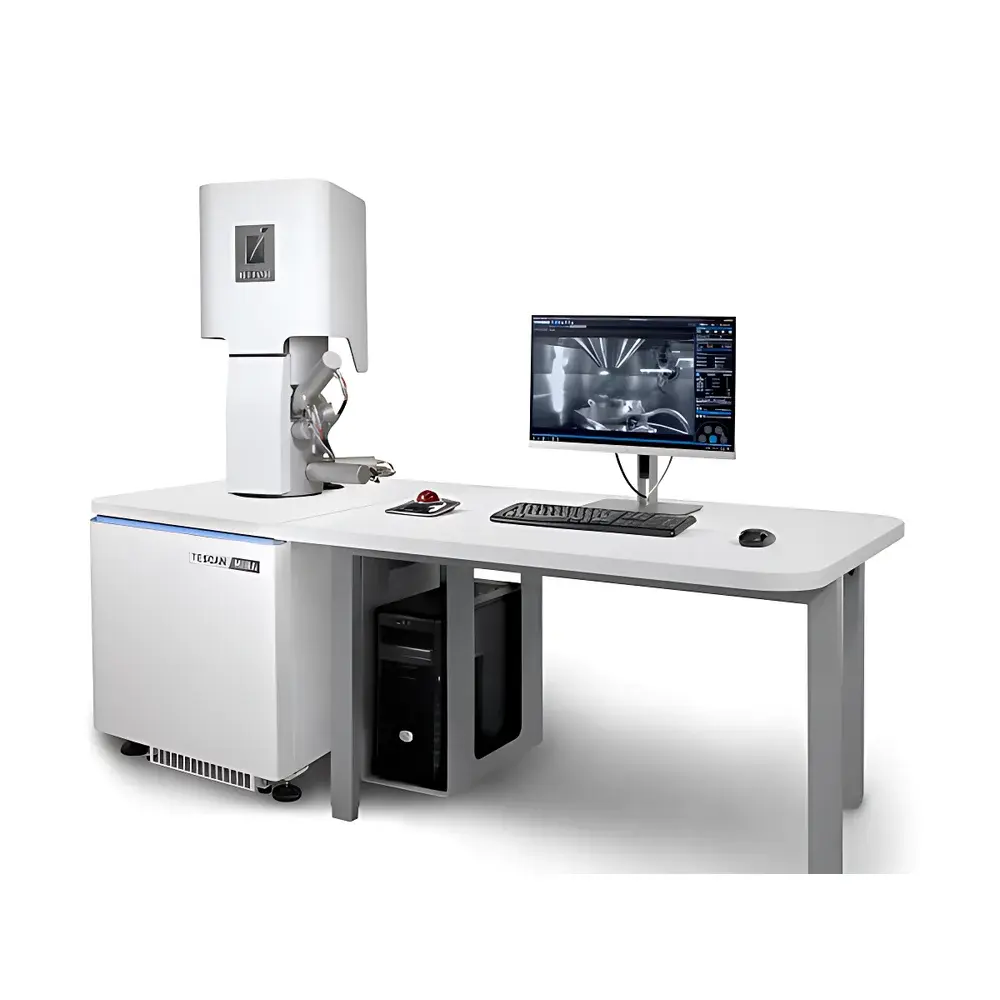
TESCAN MIRA Field Emission Scanning Electron Microscope
| Brand | TESCAN |
|---|---|
| Origin | Czech Republic |
| Manufacturer Type | Original Equipment Manufacturer (OEM) |
| Instrument Type | Floor-standing SEM |
| Electron Source | Schottky Field Emission Gun |
| Secondary Electron Resolution | 1.0 nm @ 30 kV |
| Magnification Range | 2× to 1,000,000× |
| Accelerating Voltage | 50 V–30 kV (with beam deceleration mode) |
| Backscattered Electron Resolution | 2.0 nm @ 30 kV |
Overview
The TESCAN MIRA is the fourth-generation high-performance field emission scanning electron microscope (FE-SEM), engineered for precision imaging, compositional analysis, and quantitative microstructural characterization across academic, industrial, and regulatory laboratory environments. Utilizing a high-brightness Schottky-type thermally assisted field emission electron source, the MIRA delivers exceptional beam stability, current reproducibility, and long-term emission consistency—critical for high-resolution imaging, energy-dispersive X-ray spectroscopy (EDS), electron backscatter diffraction (EBSD), and wavelength-dispersive spectrometry (WDS). Its optical architecture integrates an Intermediate Lens™ within the column, enabling sub-nanometer probe formation at high beam currents—ensuring fidelity between set and actual probe current during analytical workflows. Coupled with In-flight Beam Tracing™ technology, the system maintains real-time alignment integrity without mechanical re-centering, eliminating downtime between imaging and analytical modes.
Key Features
- Fully integrated TESCAN Essence™ software platform unifies SEM imaging and live elemental mapping in a single GUI—eliminating context switching and streamlining workflow continuity.
- Wide Field Optics™ enables seamless navigation down to 2× magnification without auxiliary optical cameras, supporting rapid region-of-interest localization and large-area survey imaging.
- SingleVac™ mode is standard—allowing direct observation of non-conductive or beam-sensitive specimens using backscattered electrons without sputter coating; optional UniVac™ extends variable pressure operation up to 700 Pa for extreme outgassing or biological samples.
- In-column SE and BSE detectors (optional) provide simultaneous acquisition of four distinct contrast signals: chamber SE, chamber BSE, in-lens SE, and in-lens BSE—enhancing topographic, atomic number, and crystallographic contrast discrimination.
- Beam deceleration technology improves low-voltage (<5 kV) resolution and surface sensitivity while minimizing charging and beam damage—particularly valuable for polymers, ceramics, and biological thin sections.
- Essence™ 3D collision avoidance model renders real-time geometric simulation of stage movement, detector positions, and sample geometry—preventing hardware collisions during automated tilt, rotation, or multi-detector alignment routines.
Sample Compatibility & Compliance
The MIRA accommodates diverse specimen types—from bulk metallic alloys and geological thin sections to hydrated biological tissues, insulating polymers, and nanomaterials. SingleVac™ and UniVac™ modes comply with ISO 16700:2016 (specimen charging mitigation) and support ASTM E1508-21 (quantitative EDS microanalysis). The system meets GLP/GMP documentation requirements through audit-trail-enabled Essence™ software, which logs all user actions, parameter changes, and acquisition metadata per FDA 21 CFR Part 11 guidelines. Optional CORAL™ module supports correlative light-electron microscopy (CLEM) workflows aligned with EMBO-endorsed life science protocols.
Software & Data Management
Essence™ provides modular, role-based interface customization—enabling novice users to operate via guided wizards while advanced users access full parameter scripting, macro automation, and batch processing. Core capabilities include: real-time EDS spectrum imaging, automatic stitching (Mosaic), LUT-based histogram equalization, calibrated distance/angle/roughness measurement, tolerance overlay tools, and offline data reprocessing via TESCAN Flow™. SharkSEM™ enables secure remote instrument control and monitoring over enterprise networks. All acquired images and spectra are stored in vendor-neutral formats (TIFF, HDF5, .emsa) compatible with third-party quantification suites (e.g., DTSA-II, AZtec, EDAX TEAM™).
Applications
The MIRA serves as a primary characterization tool in failure analysis labs (fractography, contamination identification), materials R&D (grain boundary mapping, phase distribution), semiconductor metrology (line-edge roughness, defect review), geoscience (porosity quantification, mineral phase classification), and life sciences (cell ultrastructure, immunogold labeling). Its high-current stability supports routine EBSD pattern indexing at >100 Hz frame rates and WDS trace-element detection limits below 100 ppm. The combination of Wide Field Optics™ and in-lens detectors facilitates rapid cross-sectional analysis of multilayer devices and battery electrode cross-sections.
FAQ
What vacuum modes does the MIRA support for non-conductive samples?
SingleVac™ is standard and operates at a fixed intermediate vacuum level optimized for BSE imaging of uncoated insulators. UniVac™ (optional) provides continuous pressure adjustment from 10⁻³ Pa to 700 Pa.
Is EDS integration native or add-on?
Essence™ EDS is fully embedded in the core software—no separate application launch required. Hardware synchronization ensures synchronized dwell time, beam blanking, and spectrum collection.
Can the MIRA perform automated particle analysis?
Yes—via built-in Particle Analysis module (requires optional EDS), supporting size, shape, and composition classification of >10,000 particles per session with ISO 13322-1 compliant reporting.
How does the Intermediate Lens™ improve analytical reproducibility?
It stabilizes probe current delivery under varying working distances and tilt angles—ensuring consistent excitation volume for repeatable EDS quantification and EBSD pattern quality.
What compliance standards does the software support for regulated industries?
Essence™ includes electronic signature capability, full audit trail logging, and configurable user roles—meeting FDA 21 CFR Part 11, EU Annex 11, and ISO/IEC 17025:2017 documentation requirements.







