
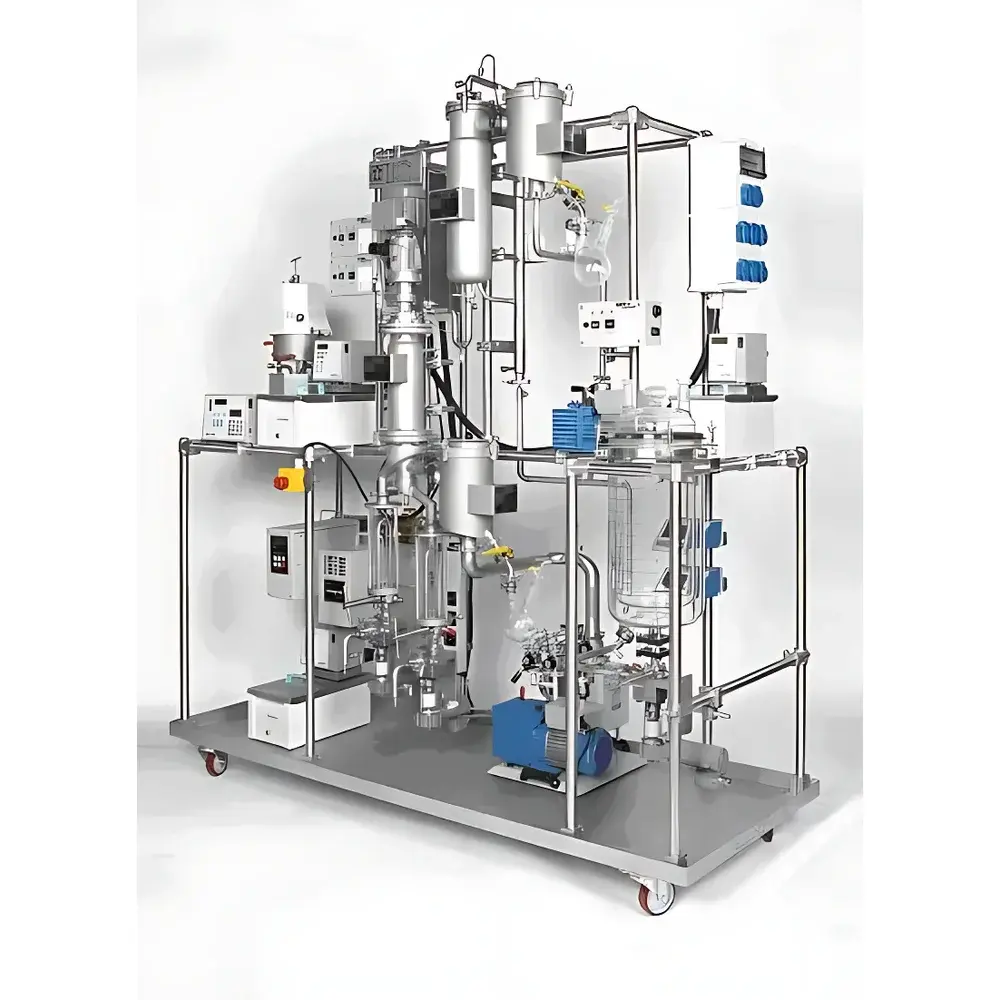
UIC EA10-KD6 Bench-Scale Short-Path Molecular Distillation System with Integrated Vacuum Degassing Unit
| Brand | UIC GmbH |
|---|---|
| Origin | Germany |
| Model | EA10-KD6 |
| Feed Rate | 3–9 kg/h |
| Effective Evaporation Area | 0.06 m² |
| Evaporator Internal Diameter | 180 mm |
| Condenser Area | 0.088 m² |
| Collectors | 3 x interchangeable receiving flasks |
| Configuration | Integrated vacuum degassing unit (pre-evaporation light-fraction removal) |
Overview
The UIC EA10-KD6 is a bench-scale short-path molecular distillation system engineered for high-purity thermal separation of thermally sensitive, high-boiling, or low-volatility compounds under high vacuum conditions (typically <0.1 Pa). Unlike conventional fractional distillation, molecular distillation operates in the free-molecule regime—where mean free path exceeds evaporator-to-condenser distance—enabling separation based on differences in molecular weight and vapor pressure rather than boiling point alone. The EA10-KD6 extends the proven KD6 platform with an integrated vacuum degassing unit upstream of the main evaporator, specifically designed to remove volatile light fractions (e.g., solvents, residual monomers, or low-MW impurities) prior to molecular distillation. This staged approach minimizes foaming, prevents condenser contamination, improves thermal stability of heat-labile feedstocks (e.g., omega-3 concentrates, vitamin E acetate, or polymer precursors), and enhances overall fraction purity and process reproducibility. Constructed entirely from AISI 316L stainless steel with electropolished internal surfaces (Ra ≤ 0.4 µm), the system complies with material compatibility requirements for pharmaceutical, nutraceutical, and fine chemical applications.
Key Features
- Integrated vacuum degassing chamber with adjustable residence time and controlled heating (up to 120 °C), enabling selective removal of volatiles before molecular distillation
- Vertically oriented falling-film evaporator with precision-engineered wiper system (PTFE-coated PEEK blades) ensuring uniform film thickness and minimal hold-up volume
- High-efficiency internal condenser with dual-zone temperature control (−20 °C to +60 °C) and real-time surface temperature monitoring
- Three-position collector carousel with motorized indexing, vacuum-tight quick-connect ports, and individual temperature monitoring per flask
- Full-spectrum vacuum architecture: primary rotary vane pump + secondary turbomolecular pump (base pressure <5×10⁻² Pa), backed by digital vacuum gauges (capacitance manometer + cold cathode gauge)
- Modular PID-controlled heating zones (evaporator wall, condenser jacket, feed line, degassing chamber) with independent setpoint and ramp/soak programming
- Explosion-proof electrical design (ATEX Zone 2 compliant) and integrated emergency shutdown logic per IEC 61508 SIL1
Sample Compatibility & Compliance
The EA10-KD6 accommodates viscous liquids (up to 5,000 mPa·s at processing temperature), suspensions with ≤5 wt% non-volatile solids, and thermally labile substances including polyunsaturated fatty acid (PUFA) esters, phospholipids, natural tocopherols, fragrance isolates, silicone oligomers, and reactive monomers. All wetted parts meet USP Class VI and FDA 21 CFR 177.1520 compliance for food-contact and pharmaceutical intermediate processing. System documentation supports GLP/GMP traceability: full audit trail (user actions, parameter changes, alarm events), electronic signatures (21 CFR Part 11 compliant via optional software module), and calibration records for all critical sensors (temperature, pressure, flow). Meets ISO 14644-1 Class 7 cleanroom compatibility when installed with HEPA-filtered purge gas lines.
Software & Data Management
Controlled via UIC’s proprietary DISTRO-SOFT v4.2 HMI interface running on embedded industrial PC (Windows IoT Enterprise), the system provides real-time visualization of 24+ process variables—including film temperature gradients, condenser ΔT, degassing chamber pressure differential, and mass flow-corrected feed rate. Data logging occurs at 1 Hz resolution with automatic CSV export and optional integration into LIMS via OPC UA (IEC 62541). Batch reports include metadata stamping (operator ID, timestamp, version-controlled SOP reference), deviation flagging (e.g., vacuum excursion >±5% setpoint), and post-run statistical summaries (recovery yield, fraction purity index derived from inline UV-Vis absorbance trends if equipped). Firmware updates are validated per IEC 62304 and delivered via encrypted USB key.
Applications
- Purification of fish oil distillates to produce ultra-high-purity EPA/DHA ethyl esters (≥95% assay, per ASTM D6866)
- Deodorization and decolorization of crude plant extracts (e.g., rosemary oleoresin, green tea polyphenols) without thermal degradation
- Removal of residual catalysts and unreacted monomers from silicone fluid synthesis intermediates
- Isolation of fragrance molecules (e.g., ionones, damascones) from botanical distillates while preserving stereoisomeric integrity
- Recovery and concentration of heat-sensitive bioactive peptides from enzymatic hydrolysates
- Recycling of specialty solvents (e.g., DMSO, NMP) from reaction mixtures with <10 ppm residue limits
FAQ
What vacuum level is required for optimal molecular distillation performance on the EA10-KD6?
The system achieves stable operation below 0.05 Pa (5×10⁻⁴ mbar) using its dual-pump configuration; this range ensures mean free path exceeds 15 cm—well above the 8 cm evaporator-to-condenser gap—maximizing molecular separation efficiency.
Can the degassing unit be bypassed for feeds with no volatile components?
Yes—the vacuum degassing chamber features a three-way divert valve allowing direct feed routing to the evaporator, enabling operational flexibility across diverse feedstock profiles.
Is the EA10-KD6 suitable for GMP manufacturing environments?
While classified as a laboratory-scale system, its construction, documentation package (including IQ/OQ templates), and 21 CFR Part 11-ready software option support qualification for pilot-scale GMP batch release of clinical trial materials.
What maintenance intervals are recommended for the wiper system and vacuum pumps?
Wiper blades require inspection every 200 operating hours and replacement every 1,000 hours; turbomolecular pump oil service is scheduled at 8,000-hour intervals, with full pump overhaul recommended at 24,000 hours per manufacturer guidelines.
Does UIC provide application development support for new feedstocks?
Yes—UIC’s Application Lab in Baden-Baden offers fee-based feasibility studies, including thermal stability screening, volatility profiling, and optimized parameter mapping using client-supplied samples.



