
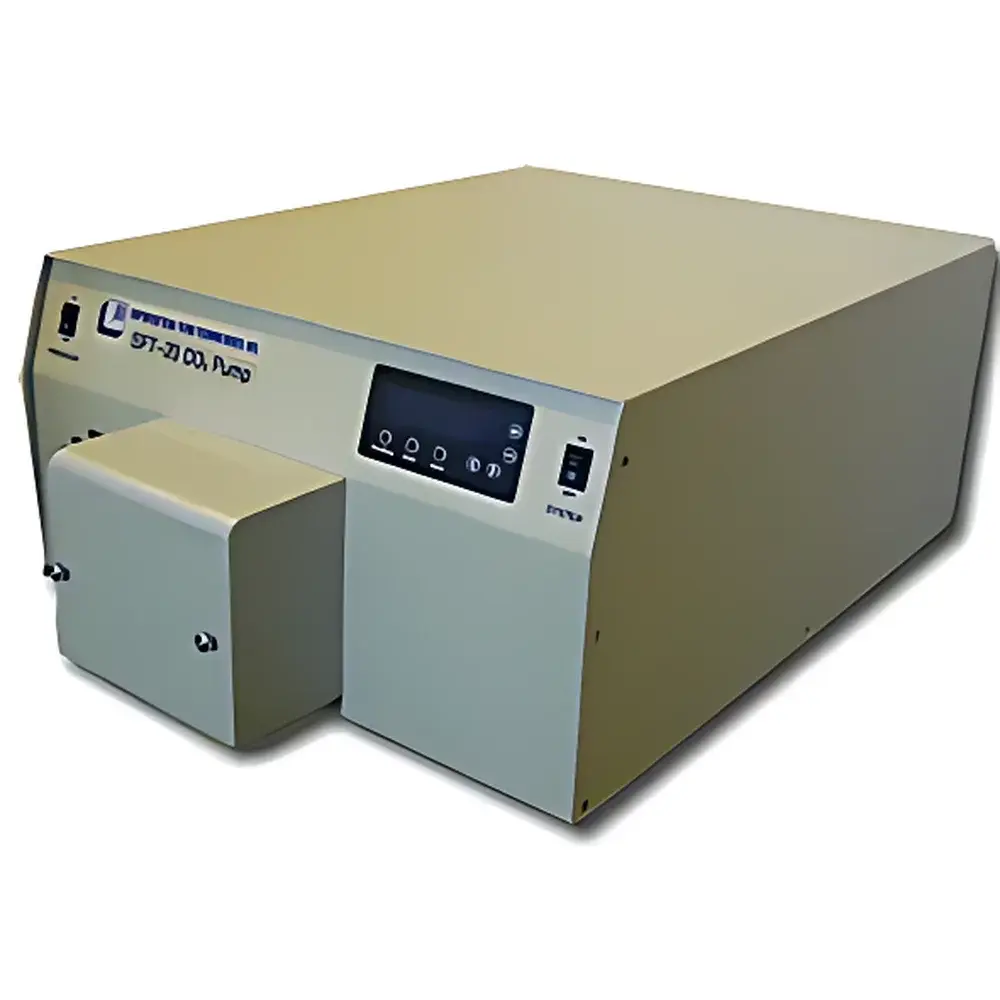
SFT Nex10 / SFT-20 / SFT-10 Supercritical Fluid Pump
| Brand | SFT |
|---|---|
| Origin | USA |
| Model | SFT-10 / SFT-20 / SFT-Nex10 |
| Flow Rate | 0.00–250.00 mL/min |
| Max Pressure | 70 MPa (10,000 psi) |
| Pressure Accuracy | ±2% of full scale |
| Flow Accuracy | ±2% (methanol), ±5% (CO₂, liquid-equivalent) |
| Flow Precision | 0.5% RSD (methanol) |
| Dimensions (SFT-20) | 25 × 46 × 56 cm |
| Weight (SFT-20) | 27 kg |
| Power | 220–240 VAC, 50–60 Hz |
Overview
The SFT Nex10, SFT-20, and SFT-10 series are precision-engineered supercritical fluid pumps designed for reliable, high-pressure delivery of carbon dioxide and co-solvent mixtures in analytical, preparative, and process-scale supercritical fluid chromatography (SFC), extraction (SFE), and reaction systems. These instruments operate on positive displacement principles using digitally controlled stepper-motor-driven plunger mechanisms, enabling stable flow generation across wide pressure ranges—from ambient to 70 MPa (10,000 psi)—without pulsation-induced system disturbances. Unlike conventional HPLC pumps, SFT pumps integrate specialized fluid-path materials (e.g., 316 stainless steel, chemically resistant elastomers) and low-dead-volume T-style pressure transducers to maintain thermodynamic stability of CO₂-based mobile phases during rapid pressure transitions. The system’s architecture supports both pure CO₂ delivery and precise co-solvent addition—enabling real-time modulation of solvent strength and selectivity in SFC method development or continuous extraction workflows.
Key Features
- Autoprime™ one-touch priming function for rapid, bubble-free system startup and solvent exchange
- Chemically inert aluminum pump head (SFT-10: 12 mL/min capacity; SFT-20/Nex10: scalable up to 250 mL/min)
- T-style pressure sensor with negligible internal volume (<5 µL), minimizing compressibility artifacts during dynamic pressure control
- Front-panel digital interface with LED display showing real-time flow rate (0.01 mL/min resolution for SFT-10; 0.1 mL/min for SFT-20) and user-defined pressure limits
- Microprocessor-based closed-loop control ensuring flow stability <0.5% RSD over 8-hour operation (verified with 99.99% methanol at 6.9 MPa)
- Integrated inlet/outlet sintered stainless-steel filters (5 µm) to protect plunger seals and check valves from particulate contamination
- Back-panel I/O suite including TTL-compatible run/stop trigger, 0–10 V analog flow setpoint input, 0–10 kHz frequency input, and RS-232 serial port for remote integration into PLC-controlled or LIMS-managed environments
- Fail-safe SPDT relay output (Form C, 0.25 A / 50 V max) activated upon pressure fault or motor stall detection
- Chemically resistant front panel and keypad rated for exposure to methanol, ethanol, acetonitrile, and other common co-solvents
Sample Compatibility & Compliance
SFT pumps are validated for use with supercritical CO₂, subcritical CO₂, and binary/multi-component fluid systems containing polar co-solvents (e.g., methanol, ethanol, isopropanol, acetone). All wetted surfaces comply with ASTM F2136-19 standards for compatibility with high-purity compressed gases and organic solvents. The pump design conforms to ISO 13849-1 (Category 3, PL d) for functional safety in laboratory automation applications. While not certified as medical devices, SFT systems support GLP-compliant workflows when paired with audit-trail-enabled software (e.g., SFT ControlSuite v4.x) that meets FDA 21 CFR Part 11 requirements for electronic records and signatures. Pressure and flow calibration protocols align with ISO/IEC 17025:2017 methodology validation guidelines.
Software & Data Management
SFT ControlSuite (v4.2+) provides native Windows-based configuration, real-time monitoring, and automated sequence execution via RS-232 or USB-to-serial emulation. The software logs timestamped pressure, flow, temperature (via optional external probe), and alarm status with configurable sampling intervals (100 ms–10 s). Audit trails include operator ID, parameter changes, and system events—exportable in CSV or XML format for regulatory submission. Remote access is supported through OPC UA server integration, enabling interoperability with LabVIEW, MATLAB, or enterprise MES platforms. Firmware updates preserve backward compatibility and include enhanced PID tuning parameters for improved transient response during gradient SFC methods.
Applications
- Preparative and analytical supercritical fluid chromatography (SFC) for chiral separations, pharmaceutical impurity profiling, and natural product purification
- Supercritical fluid extraction (SFE) of bioactive compounds (e.g., caffeine, cannabinoids, polyphenols) from botanical matrices under GMP-aligned process conditions
- In-line co-solvent blending for tunable polarity control in reaction media (e.g., asymmetric catalysis, polymerization, nanoparticle synthesis)
- High-pressure fluid delivery in accelerated solvent extraction (ASE) and supercritical antisolvent (SAS) particle formation systems
- Method transfer between analytical SFC and pilot-scale SFE platforms via identical flow/pressure fidelity and material compatibility
FAQ
What co-solvents are compatible with SFT pumps?
Methanol, ethanol, isopropanol, acetone, ethyl acetate, and dimethyl sulfoxide (DMSO) are routinely used. Compatibility with chlorinated solvents (e.g., DCM, chloroform) requires prior consultation with SFT technical support due to elastomer degradation risks.
Can the SFT-20 be integrated into an automated SFC system with a back-pressure regulator (BPR)?
Yes—the pump’s analog and digital I/O ports enable synchronized control with third-party BPRs (e.g., Jasco, Thar) via pressure feedback loops. SFT ControlSuite includes preconfigured BPR communication templates for common vendor protocols.
How is flow accuracy validated for CO₂ versus liquid solvents?
CO₂ flow accuracy is determined by gas-phase mass flow measurement upstream of the pump, followed by thermodynamic back-calculation to equivalent liquid volume at operating P/T conditions per NIST SRD 106 (REFPROP). Methanol validation follows ISO 5725-2 repeatability protocols.
Is preventive maintenance required before each run?
No scheduled pre-run maintenance is needed. However, we recommend flushing the fluid path with methanol after CO₂ operation to prevent moisture-induced corrosion, and inspecting inlet filters every 200 operational hours.
Does SFT provide calibration certificates traceable to NIST standards?
Yes—each unit ships with a factory calibration report referencing NIST-traceable pressure transducers (Fluke 700PT1) and gravimetric flow verification (Mettler Toledo XSE2001). On-site recalibration services are available globally through authorized SFT service partners.



