
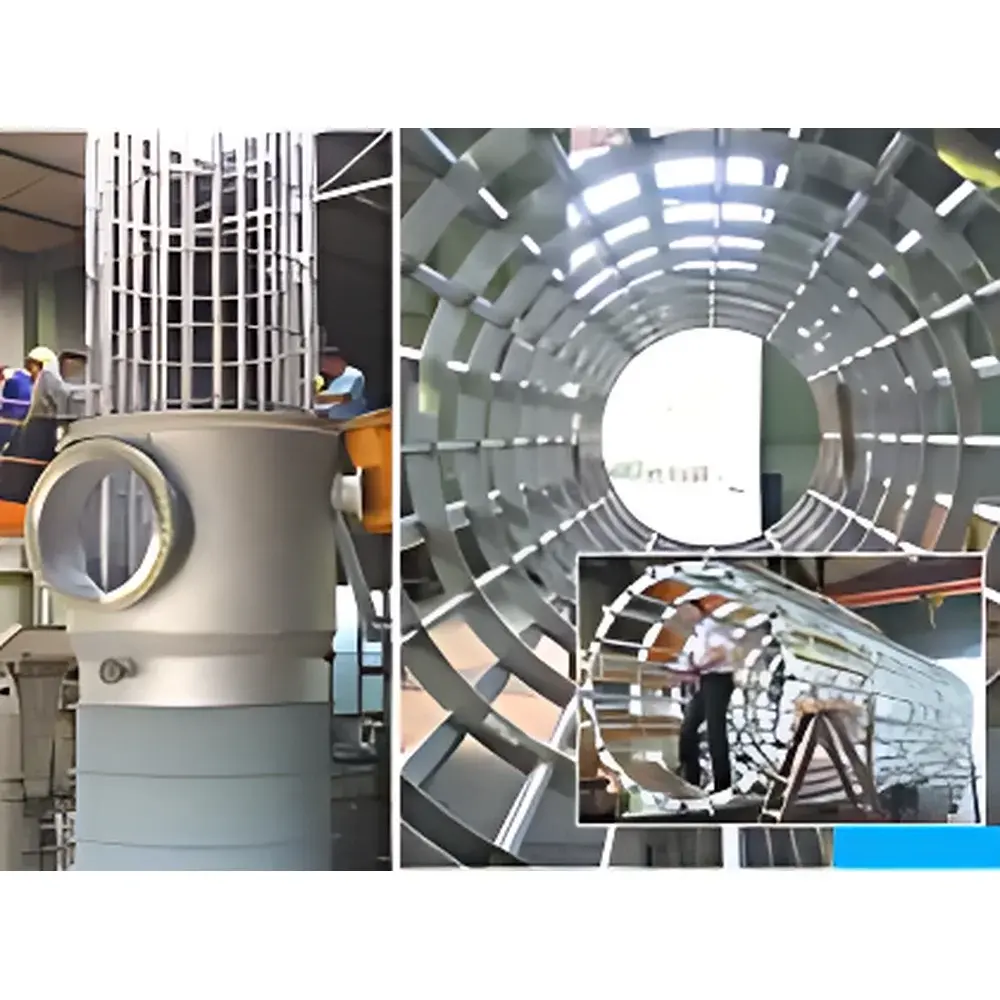
UIC RF 4500 Stainless Steel Industrial-Scale Wiped-Film Evaporator
| Brand | UIC GmbH |
|---|---|
| Origin | Germany |
| Model | RF 4500 |
| Feed Rate | 50–20,000 kg/h |
| Effective Evaporation Area | 3–100 m² |
| Evaporator Internal Diameter | 300–800 mm |
| Condenser Area | 3–100 m² |
| Collection Vessels | 3 |
| Material of Construction | ASTM A240 316 stainless steel (standard), optional titanium or Hastelloy C-276 |
| Design Standard | AD-Merkblätter, ASME Section VIII Div. 1 (upon request) |
Overview
The UIC RF 4500 is a fully engineered, industrial-scale wiped-film evaporator designed for continuous thermal separation of heat-sensitive, high-boiling, or viscous materials under reduced pressure. Operating on the principle of short-path molecular distillation combined with mechanical film formation, the system ensures minimal residence time (<30 seconds), precise temperature control, and high separation efficiency—critical for preserving labile compounds such as vitamins, phospholipids, cannabinoids, polymer additives, and specialty fragrances. Unlike batch rotary evaporators or simple falling-film units, the RF 4500 employs a dynamically scraped rotor assembly that continuously reforms a uniform, turbulent thin film across the heated cylindrical wall, enabling consistent heat transfer and vapor-phase mass transfer even with non-Newtonian or fouling-prone feeds. Its modular architecture supports integration into GMP-compliant production lines, with full traceability of process parameters including jacket temperature, feed flow rate, vacuum level, and condensate collection timing.
Key Features
- Robust 316 stainless steel construction (DIN 1.4571 / ASTM A240), compliant with FDA 21 CFR Part 11 requirements for material contact surfaces in pharmaceutical manufacturing
- Adjustable rotor speed (1–200 rpm) with torque monitoring to maintain optimal film thickness across varying viscosities (1–10,000 cP)
- Heating jacket compatible with thermal oil (up to 300 °C), saturated steam (≤10 bar g), or hot water—configured per process thermodynamics and safety classification
- Integrated vacuum system interface supporting ultimate pressures down to 0.001 mbar (1×10⁻³ mbar), with optional cold trap and secondary condenser staging
- Pressure vessel certified to AD-Merkblätter standards; ASME Section VIII Div. 1 certification available upon engineering review and client specification
- Modular collection train with three independently controlled receiving vessels, each equipped with level sensors and temperature monitoring for fractionated product recovery
Sample Compatibility & Compliance
The RF 4500 accommodates feedstocks ranging from low-viscosity solvents to highly viscous residues (e.g., spent catalyst slurries, polymer melts, or crude bio-oils). Its customizable internal surface finish (Ra ≤ 0.4 µm electropolished), rotor geometry (fixed-blade, flexible wiper, or roller-type), and feed distribution manifold allow adaptation to crystallizing, foaming, or polymerizing systems. All wetted components meet ISO 8502-3 cleanliness validation protocols. The unit is routinely deployed in facilities operating under EU GMP Annex 15, USP , and ICH Q5A/Q5D guidelines for purification process validation. Documentation packages include FAT/SAT reports, material traceability certificates (EN 10204 3.1), and weld procedure specifications (WPS/PQR) per EN ISO 15614-1.
Software & Data Management
Control is executed via a CE-certified Siemens SIMATIC S7-1500 PLC with integrated HMI, supporting deterministic real-time regulation of all critical loops (temperature, pressure, flow, speed). Historical data logging adheres to ALCOA+ principles: attributable, legible, contemporaneous, original, accurate, complete, consistent, enduring, and available. Audit trails are enabled for all parameter changes, user logins, and alarm events. Optional connectivity includes OPC UA server for MES/SCADA integration, CSV export for LIMS ingestion, and electronic signature capability aligned with 21 CFR Part 11 Subpart B requirements. Batch records can be generated automatically, including start/end timestamps, setpoint deviations, and deviation justification fields.
Applications
- Deacidification and deodorization of edible oils and fish oils (ASTM D6866-compliant for carbon-14 verification)
- Purification of active pharmaceutical ingredients (APIs) and intermediates requiring residual solvent removal below ICH Q3C thresholds
- Recovery of high-value terpenes and minor cannabinoids from botanical extracts under cGMP conditions
- Thermal stabilization and monomer removal from silicone polymers and acrylic resins
- Concentration of enzyme-containing fermentation broths without denaturation (validated at ≤60 °C, <5 mbar)
- Recycling of spent lithium-ion battery electrolytes via selective solvent recovery
FAQ
What vacuum level is required for optimal operation of the RF 4500?
Typical operating range is 0.1–10 mbar for standard molecular distillation; ultra-high vacuum (<0.01 mbar) configurations require auxiliary cryo-trapping and are specified during engineering design.
Can the RF 4500 be validated for pharmaceutical use?
Yes—UIC provides IQ/OQ documentation templates, DQ support, and qualification-ready instrumentation (e.g., Class A Pt100 RTDs, calibrated vacuum transducers per ISO 27874).
Is corrosion resistance available for aggressive halogenated feeds?
Titanium Grade 2 or Hastelloy C-276 construction is offered for chlorine- or bromine-containing streams, with corrosion rate data per ASTM G31 immersion testing.
How is cleaning-in-place (CIP) performed?
The system integrates CIP nozzles, drain valves with zero-dead-leg design, and compatibility with NaOH/HNO₃ cycles per ASME BPE-2022 surface finish standards.
What is the typical lead time for an RF 4500 configured to ASME standards?
Standard delivery is 24–28 weeks from PO acceptance; expedited engineering review and fabrication slots may reduce this by up to six weeks subject to capacity scheduling.



