
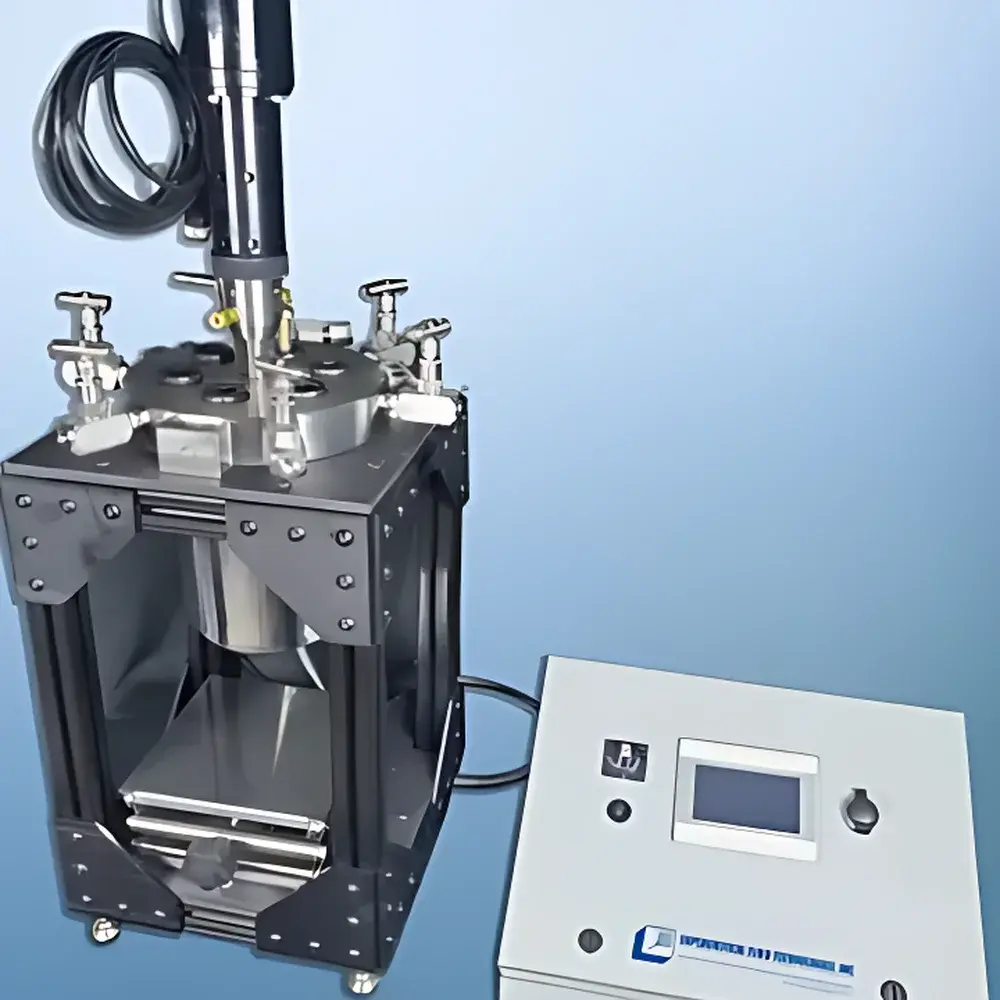
Beijing STKJ SFT Series Supercritical Carbon Dioxide Cleaning and Drying System
| Brand | STKJ |
|---|---|
| Origin | Beijing, China |
| Manufacturer Type | Authorized Distributor |
| Product Origin | Domestic (China) |
| Model | SFT |
| Max Temperature | 150 °C |
| Pressure Range | Up to 10,000 psi |
| Extraction Volume | 5–8000 mL |
| Flow Control Range | 0–2500 RPM (for optional agitator) |
| Compliance | Designed for CO₂-based supercritical fluid processing |
| Sample Types | Botanicals, pharmaceutical raw materials, microelectromechanical systems (MEMS), precision optics, porous ceramics |
Overview
The Beijing STKJ SFT Series Supercritical Carbon Dioxide Cleaning and Drying System is an engineered platform for precision supercritical fluid processing (SFP) using carbon dioxide as the primary working medium. Operating above its critical point (31.1 °C, 1070 psi), supercritical CO₂ exhibits tunable solvent strength, near-zero surface tension, high diffusivity, and complete volatility upon depressurization—enabling residue-free cleaning, gentle drying of delicate nanostructures, and selective extraction without thermal degradation. Unlike conventional solvent-based or vacuum-drying methods, this system eliminates organic solvent residues, prevents capillary-force-induced collapse in high-aspect-ratio microfeatures (e.g., MEMS cantilevers), and supports green chemistry workflows compliant with ISO 14001 and REACH substance restrictions. The system integrates a closed-loop CO₂ circulation architecture, enabling >95% CO₂ recovery per cycle when paired with optional condensation recovery modules.
Key Features
- Electric dual-piston CO₂ pump with proprietary “slow-intake/fast-discharge” fluid dynamics control—ensuring stable mass flow delivery under variable backpressure conditions; operates in both constant-pressure and constant-flow modes.
- Integrated solid-state electronic cooling system maintains pump head temperature below −4 °C, eliminating dependency on external chillers or compressed air sources—reducing infrastructure requirements and enhancing long-term operational stability.
- Independent triple-zone thermal management: real-time regulation of vessel internal temperature, dynamic/static valve housing temperature, and preheating ring temperature—minimizing thermal lag and ensuring thermodynamic equilibrium during isothermal holds.
- Precision pressure control with ±1–2 psi accuracy across full operating range (up to 10,000 psi); flow resolution of 0.01 mL/min in volumetric mode for reproducible process scaling.
- Modular reactor vessels available in standardized volumes from 5 mL to 8000 mL—validated for ASME Section VIII Div. 1 pressure boundary compliance; all wetted surfaces constructed from 316L stainless steel with electropolished finish (Ra < 0.4 µm).
- Comprehensive safety architecture including rupture disc assemblies, pressure-relief valves, audible/visual alarm system, emergency venting circuit, and redundant temperature/pressure interlocks aligned with IEC 61511 functional safety principles.
Sample Compatibility & Compliance
The SFT system accommodates heterogeneous solid matrices—including botanical powders, herbal extracts, lyophilized biologics, silicon wafers, aerogels, and porous metal-organic frameworks (MOFs)—without mechanical agitation-induced particle attrition. Optional magnetic-drive agitators (Dyna/Mag™) provide controlled mixing at 0–2500 RPM, enabling enhanced mass transfer in viscous or particulate-laden media. Sapphire viewport integration (rated for 150 °C / 10,000 psi) permits real-time visual monitoring of phase behavior and meniscus dynamics during depressurization. All control firmware and data logging functions are structured to support audit-ready documentation per FDA 21 CFR Part 11 requirements—including electronic signatures, immutable event logs, and user-access-level permissions. System design aligns with ASTM E2912 (Standard Guide for Supercritical Fluid Processing) and ISO 20483 (Supercritical fluid extraction—General principles).
Software & Data Management
The embedded controller features a 10.1″ capacitive touchscreen HMI with intuitive workflow-driven interface—supporting multi-step program sequencing (e.g., pressurization → equilibration → extraction → depressurization → purge). Process parameters—including temperature ramp rates, pressure hold durations, flow profiles, and agitator speed schedules—are stored in encrypted SQLite databases with timestamped metadata. Raw sensor data (PTT logs at 10 Hz) can be exported in CSV or HDF5 format for offline analysis in MATLAB, Python (Pandas/NumPy), or commercial statistical process control (SPC) platforms. Optional Ethernet/IP connectivity enables remote monitoring via secure TLS 1.2–enabled OPC UA server, facilitating integration into centralized laboratory information management systems (LIMS) or MES environments.
Applications
- Residue-free critical point drying (CPD) of biological specimens and MEMS/NEMS devices prior to SEM imaging.
- Decontamination and sterilization of implant-grade polymers and porous titanium scaffolds without compromising structural integrity.
- Extraction of thermolabile phytochemicals (e.g., curcuminoids, cannabinoids, terpenes) from plant matrices under oxygen-free, low-thermal-stress conditions.
- Surface cleaning of photomasks, EUV optics, and semiconductor packaging substrates—removing sub-10 nm organic contaminants without static charge accumulation.
- Impregnation of bioactive agents into cellulose nanocrystal aerogels for controlled-release pharmaceutical carriers.
FAQ
What CO₂ purity grade is recommended for analytical-grade extractions?
For pharmaceutical or regulatory submissions, ≥99.995% (Grade 5.0) CO₂ with certified trace impurity profiles (H₂O < 1 ppm, O₂ < 0.5 ppm) is advised.
Can the system operate continuously for extended cycles?
Yes—designed for unattended 72-hour operation with automated fault recovery; thermal management subsystems maintain <±0.3 °C stability over 24-hr holds.
Is validation documentation (IQ/OQ/PQ protocols) available?
STKJ provides customizable qualification templates aligned with ISO/IEC 17025 and USP <1058>, including calibration certificates for integrated PT100 sensors and pressure transducers.
What maintenance intervals are specified for the CO₂ pump?
Pump seals require replacement every 12 months or after 2000 operational hours—whichever occurs first; electronic cooling modules undergo annual thermal performance verification.
Are third-party software integrations supported?
Yes—RESTful API endpoints allow bidirectional communication with LabArchives, Benchling, and custom Python-based experiment orchestration tools.



