
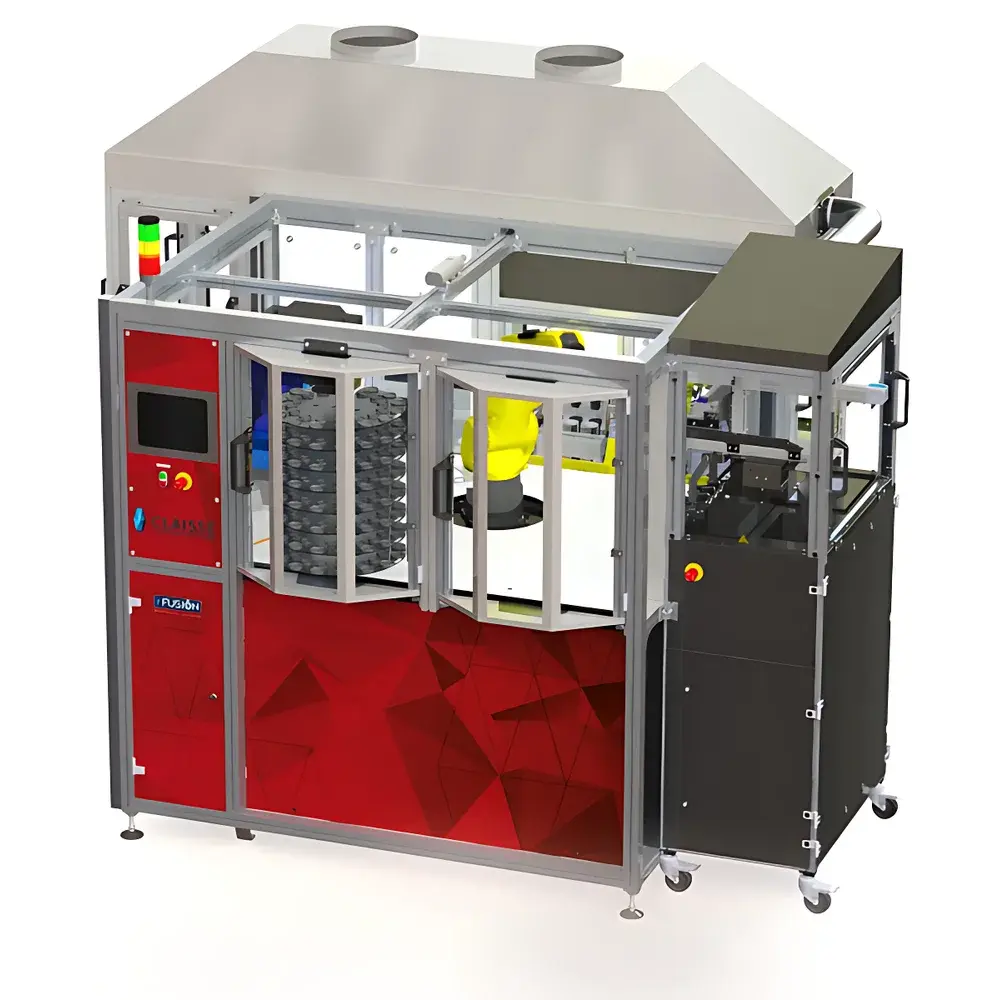

Claisse rFUSION Automated XRF Fusion Sample Preparation Production Line
| Brand | Claisse |
|---|---|
| Origin | Canada |
| Model | CLAISSE rFUSION |
| Price | USD 350,000 |
| Dimensions (L×W×D) | 213 × 195 × 190 cm × 2 units |
| Temperature Control Accuracy | ±1 °C |
| Maximum Operating Temperature | 1250 °C |
| Throughput | 24–30 samples/h |
Overview
The Claisse rFUSION Automated XRF Fusion Sample Preparation Production Line is a fully integrated, modular laboratory system engineered for high-precision, reproducible preparation of homogeneous glass discs for wavelength-dispersive (WDXRF) and energy-dispersive (EDXRF) X-ray fluorescence analysis. Based on the fundamental principle of flux fusion—where solid inorganic samples are dissolved in a molten borate-based flux (e.g., lithium tetraborate or lithium metaborate) at elevated temperatures—the rFUSION system automates the entire workflow: gravimetric sample weighing, flux dispensing, homogenization, crucible transfer, fusion, casting, and cooling. Its architecture eliminates manual handling errors, ensures stoichiometric consistency across batches, and delivers traceable, GLP-compliant sample preparation essential for regulatory-grade geochemical, metallurgical, cement, and environmental testing.
Key Features
- Modular, field-expandable design: Comprises independent rFUSION Weighing Station and rFUSION M4 Fusion Workstation modules—each operable standalone or synchronized via central HMI.
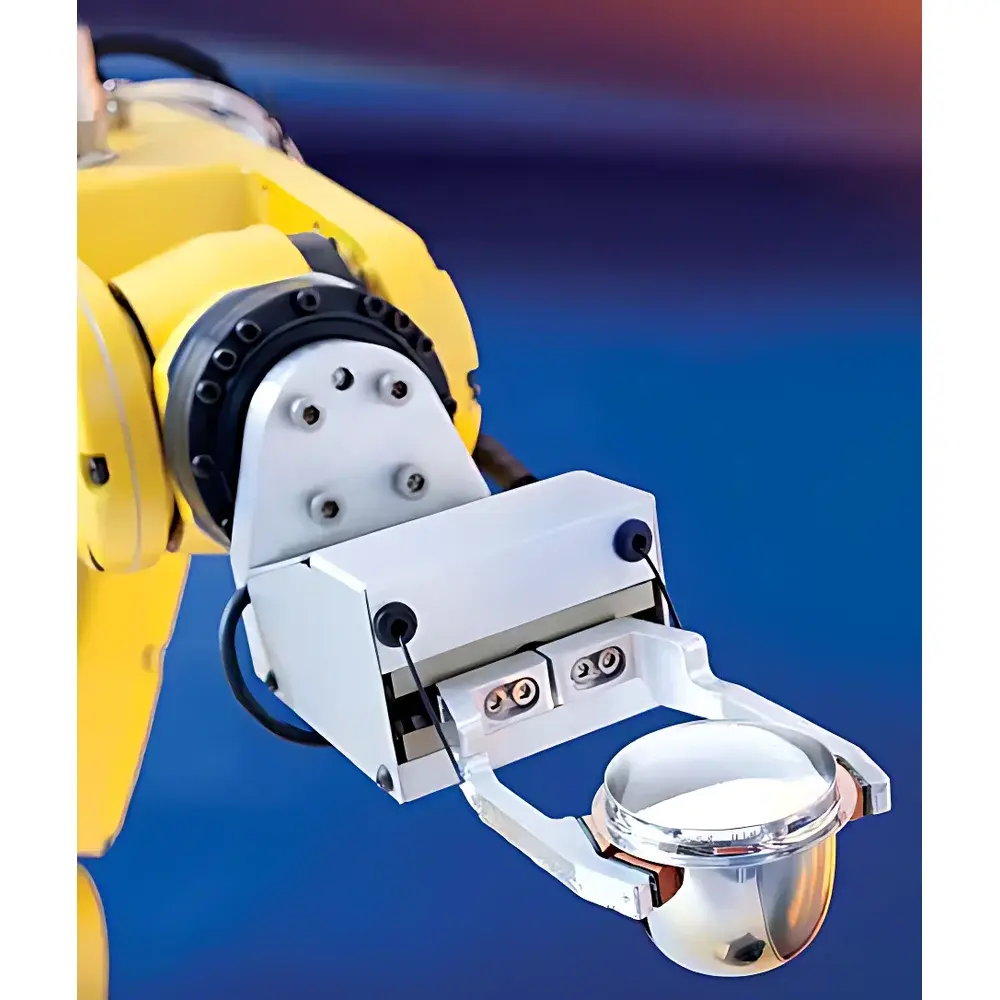
- Industrial-grade 6-axis servo robot with fiber-optic crucible detection and AI-powered 3D vision system for sub-millimeter positioning accuracy during platinum crucible handling.
- TheAnt automatic flux dispenser featuring analytical balance with 0.1 mg resolution, overload protection, and dual-axis (vertical/horizontal) weighing calibration—certified per ISO/IEC 17025 traceability requirements.
- VortexMixer programmable homogenizer ensuring uniform sample–flux blending prior to fusion, configurable by speed (rpm) and duration.
- Integrated safety architecture: Dual emergency stop buttons, interlocked access doors, light curtains, and real-time combustible gas monitoring (propane/LPG or natural gas) with automatic shutoff at ±1 psi deviation.
- HMI touchscreen interface with three-tier password-protected access (Operator, Supervisor, Service Engineer), supporting audit trail logging compliant with FDA 21 CFR Part 11 and ISO 17025 documentation standards.
Sample Compatibility & Compliance
The rFUSION system accommodates diverse inorganic matrices without hardware modification—including ores, slags, ferroalloys, cement clinker, refractories, catalysts, ceramics, and geological reference materials. All fusion protocols adhere to ASTM D5630 (ash content), ISO 8518 (cement analysis), and USP (inorganic impurities). Platinum crucibles (95% Pt / 5% Au) meet ASTM E2931 specifications for thermal stability up to 1250 °C. System validation documentation supports IQ/OQ/PQ execution under GMP/GLP environments, and full traceability of sample ID, operator, timestamp, weight values, fusion parameters, and gas pressure logs is retained for ≥10 years.
Software & Data Management
The embedded control software enables method-driven operation: users select pre-validated SOPs (e.g., “Fe-ore_Li2B4O7_1200C”) or create custom workflows with parameter constraints (temperature ramp rate, hold time, cooling profile). All process data—including raw mass readings, crucible IDs, fusion cycle timestamps, and fault diagnostics—are exported as CSV or XML files compatible with LIMS platforms (e.g., LabWare, Thermo Fisher SampleManager). Remote diagnostics via secure TLS-encrypted connection allow Claisse-certified engineers to perform firmware updates, calibration verification, and troubleshooting without onsite visits—reducing mean time to repair (MTTR) by >65% versus legacy systems.
Applications
- Geochemical exploration labs requiring ISO/IEC 17025 accreditation for certified reference material (CRM) preparation.
- Cement manufacturing QA/QC departments performing routine analysis of SiO₂, Al₂O₃, Fe₂O₃, CaO, MgO, SO₃, and alkalis per EN 196-2.
- Metallurgical laboratories processing high-silica or refractory-rich samples where incomplete dissolution compromises XRF accuracy.
- Environmental testing facilities analyzing heavy metals (Pb, As, Cd, Cr) in soil/sediment digests using fusion to overcome matrix effects.
- Nuclear fuel cycle facilities preparing UO₂/PuO₂ mixed oxide samples under inert atmosphere (optional N₂ purge integration).
FAQ
What power supply configuration is required for full system operation?
Single-phase 240 VAC, 50/60 Hz, 20 A circuit per module (Weighing Station and M4 Fusion Unit each require dedicated breakers). No compressed air, oxygen, or chilled water connections are needed.
Can the rFUSION system integrate with existing LIMS or ERP infrastructure?
Yes—via configurable ODBC/JDBC drivers and RESTful API endpoints. Audit logs, sample metadata, and fusion parameters export automatically in ISO/IEC 17025–compliant formats.
Is platinum crucible management automated?
Yes. The AI vision system identifies crucible serial numbers and tracks thermal history (cycles, max temperature exposure) to enforce replacement schedules per ASTM E2931 lifecycle guidelines.
How does the system ensure compliance with regulatory data integrity requirements?
All user actions, parameter changes, and instrument events are timestamped, digitally signed, and stored in an immutable database with role-based access control—fully satisfying FDA 21 CFR Part 11 electronic records/electronic signatures criteria.
What maintenance intervals are recommended for routine operation?
Weekly technician-performed checks (robot lubrication, gas line integrity, balance calibration verification); annual factory-certified recalibration and safety system validation.
Related Products



