
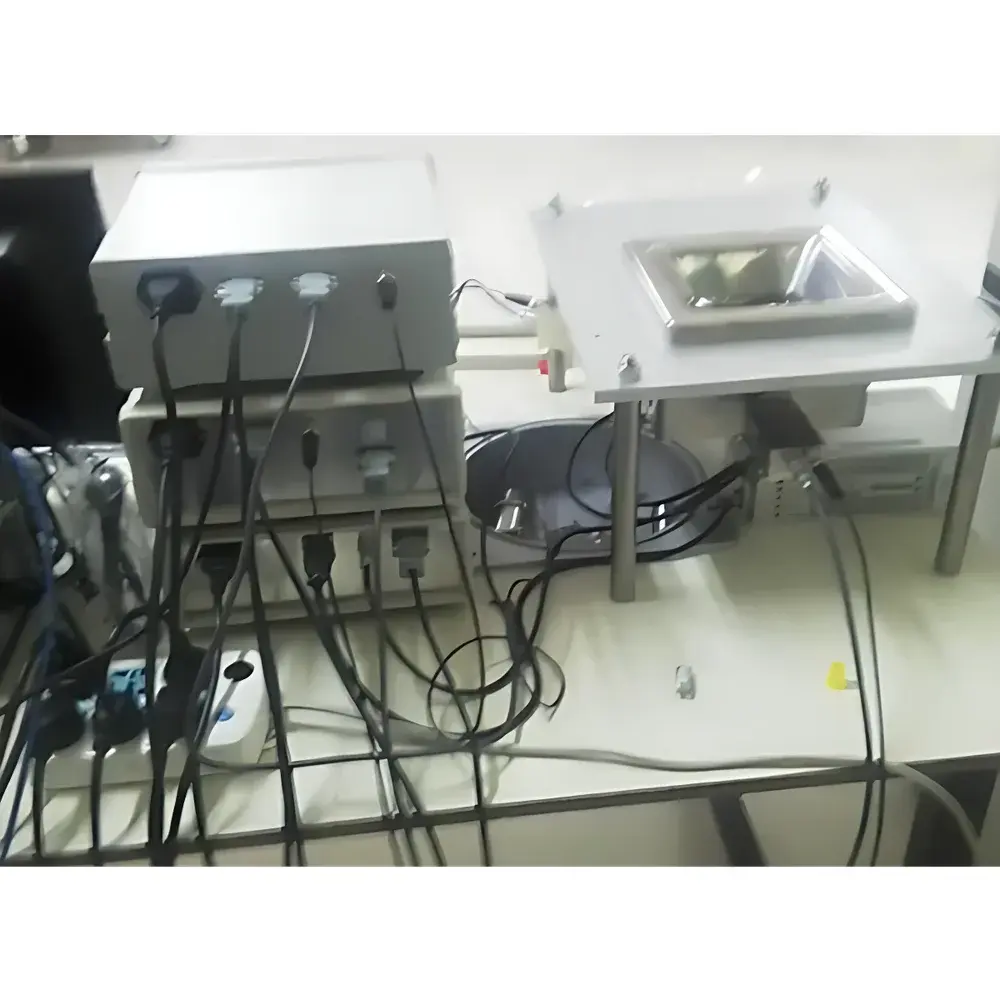
L Boundary Density Meter
| Brand | Sichuan Xinxianda |
|---|---|
| Origin | Sichuan, China |
| Manufacturer Type | Authorized Distributor |
| Country of Origin | China |
| Model | L Boundary Density Meter |
| Pricing | Upon Request |
Overview
The L Boundary Density Meter is a precision X-ray absorption-based analytical instrument engineered for non-destructive, quantitative determination of elemental concentration—specifically optimized for uranium and other high-Z elements—in liquid or homogeneous solid matrices. Unlike conventional X-ray fluorescence (XRF) spectrometers that rely on emission intensity, this system operates on the physical principle of L-edge absorption spectroscopy. When monochromatic or quasi-monochromatic X-rays traverse a sample, abrupt increases in the mass attenuation coefficient (μm) occur at energies corresponding to the binding energies of electrons in the L-shell (i.e., LI, LII, LIII absorption edges). This discontinuity—termed the L absorption edge—is element-specific and independent of chemical speciation, making it highly robust for quantification in complex matrices such as aqueous uranyl nitrate solutions, nuclear fuel cycle intermediates, or process liquors. The instrument measures transmission intensity ratios across the L-edge region (typically 10–15 keV for U, LIII ≈ 17.2 keV), enabling calculation of elemental density via Beer–Lambert law-derived calibration models. Its design emphasizes stability, repeatability, and traceability under industrial laboratory conditions.
Key Features
- Ag-anode X-ray tube with rated operating voltage up to 50 kV and current up to 5 mA, providing sufficient photon flux in the L-edge energy range
- FAST-SDD (Silicon Drift Detector) with energy resolution ≤125 eV at 5.9 keV (⁵⁵Fe), enabling precise edge-step discrimination and background subtraction
- Dedicated 2 mL precision-molded sample cell fabricated from low-Z polymer material to minimize parasitic absorption and scattering
- Dual-channel digital pulse processing architecture: fast shaping for count-rate linearity + slow shaping for optimal energy resolution, minimizing pulse pile-up and dead-time errors
- Integrated digital multichannel analyzer (MCA) with real-time spectrum acquisition, energy calibration, and spectral deconvolution routines
- Robust mechanical shielding and beam collimation to ensure measurement reproducibility (RSD < 1.2% for repeated 20 g/L U solutions)
Sample Compatibility & Compliance
The L Boundary Density Meter accepts transparent, low-turbidity liquid samples (e.g., nitric acid–based uranyl solutions, sulfate leachates) and uniformly dense solids with thickness ≤3 mm. Sample containers are standardized to 2 mL volume with ±0.02 mL tolerance; viscosity and density ranges are validated for ρ = 1.0–1.4 g/cm³ and η < 15 cP. The system complies with IEC 61000-6-3 (EMC emissions) and IEC 61000-6-2 (immunity). While not certified for Class I Division 1 hazardous locations, it meets general laboratory safety requirements per ISO/IEC 17025:2017 for method validation. Measurement protocols support traceability to NIST-traceable reference materials (e.g., CRM 112-A Uranium Solution); data integrity conforms to ALCOA+ principles. Audit trails, electronic signatures, and user-access controls can be implemented via optional software upgrades aligned with FDA 21 CFR Part 11 readiness.
Software & Data Management
The native control and analysis software is developed in ANSI C under Visual C++ 6.0, ensuring deterministic real-time performance on Windows OS platforms (Windows 7–11, 64-bit). Core modules include: serial communication interface (RS-232/USB virtual COM) for hardware synchronization; interactive spectrum display with ROI selection and edge-step fitting; automated energy calibration using known Kα/Kβ lines (e.g., Ag, Cu); batch processing for multi-sample sequence analysis; and relational database management for sample metadata, calibration curves, and QC records. Spectral data export supports ASCII (.txt), CSV, and binary .mca formats. Advanced users may access raw histogram arrays for custom modeling (e.g., linear combination fitting of edge-step amplitudes). All calibration parameters—including μm slope (a), exponent (b), and edge-energy offset—are stored with timestamped versioning and operator ID.
Applications
- Real-time concentration monitoring of uranium in nuclear fuel reprocessing streams (e.g., PUREX raffinates, scrub solutions)
- Verification of enrichment consistency in UF6 hydrolysis products and uranyl nitrate crystallization batches
- Quality control of catalysts containing heavy metals (e.g., Pt, Pb, Hg) where L-edge absorption provides superior sensitivity over K-edge for mid-Z elements
- Environmental analysis of contaminated groundwater for actinide speciation screening (U, Th, Pu) without chemical separation
- Research applications in synchrotron-absent laboratories requiring lab-scale L-edge quantification capability
FAQ
Is the L Boundary Density Meter suitable for measuring uranium in organic solvents such as TBP/kerosene mixtures?
Yes—provided the solvent exhibits minimal X-ray absorption in the 15–20 keV range and the sample cell is sealed to prevent evaporation or leakage. Calibration must be performed using matrix-matched standards.
Does the instrument require periodic recalibration with radioactive sources?
No. Energy calibration uses characteristic X-ray lines from the Ag anode (22.1 keV Ag Kα, 24.9 keV Ag Kβ); no radioactive check sources are needed.
Can it distinguish between U(IV) and U(VI) oxidation states?
No. L-edge absorption is insensitive to chemical state; it quantifies total uranium mass density regardless of valence or coordination environment.
What is the typical detection limit for uranium in aqueous solution?
Under standard 300-second acquisition and 2 mL path length, the practical limit of quantitation (LOQ) is approximately 0.5 g/L, assuming optimal geometry and detector stability.
Is remote operation supported?
Yes—via TCP/IP-enabled serial server integration; full command set is documented in the Programmer’s Manual for SCADA or LIMS interfacing.
Related Products





