
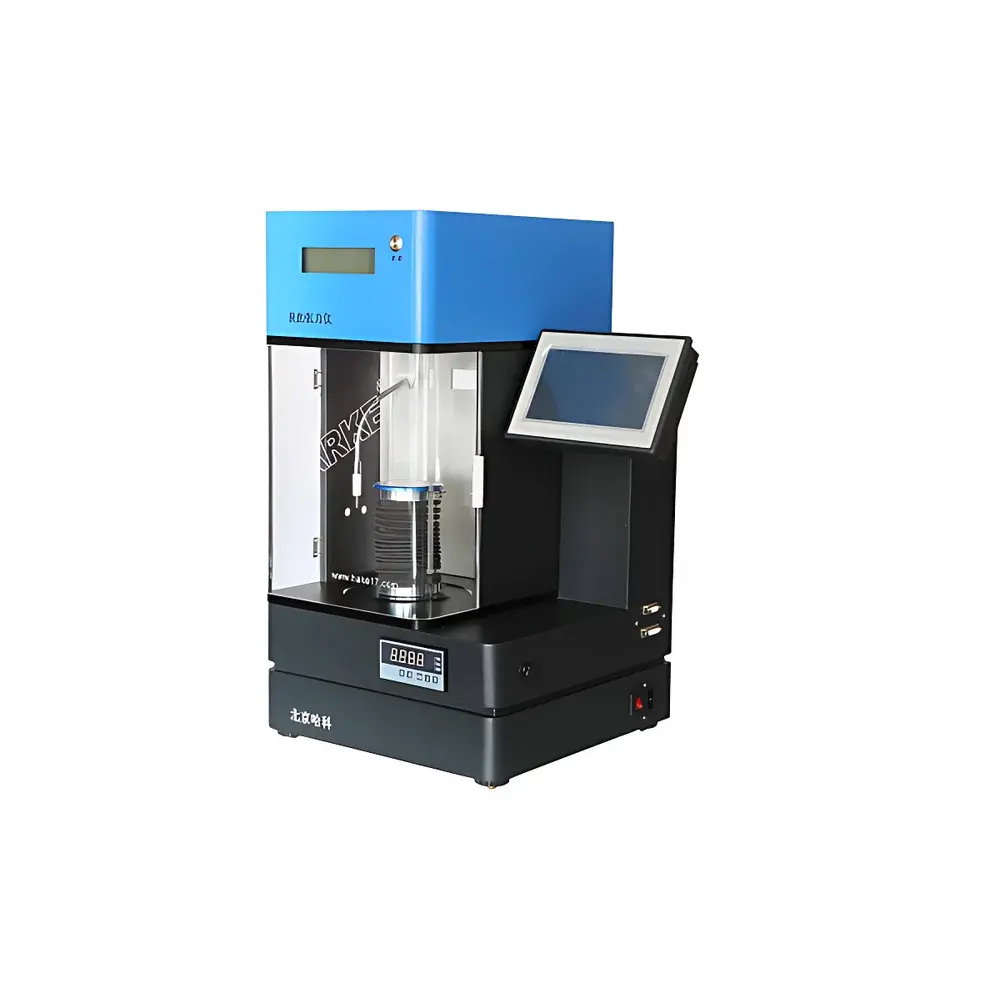
HARKE SFT-A3S Advanced Surface Tensiometer
| Brand | HARKE |
|---|---|
| Origin | Beijing, China |
| Manufacturer Type | Direct Manufacturer |
| Product Category | Domestic (China-made) |
| Model | SFT-A3S |
| Price | Upon Request |
| Surface/Interface Tension Range | 0–400 mN/m |
| Measurement Resolution | ±0.01 mN/m |
| Measurement Accuracy | ±0.1 mN/m |
| Temperature Display Range | 0–95 °C |
| Temperature Display Precision | ±0.01 °C |
| Measurement Methods | Du Noüy Ring Method & Wilhelmy Plate Method |
| Sensor Capacity | 0–120 g |
| Stage Vertical Speed | 0–10 mm/sec |
| Stage Travel Distance | 0–80 mm |
| Stage Positioning Accuracy | ±0.1 mm |
| Sample Cup Diameter | Φ50 mm |
| Software | SFT-A1 |
| Operating Temperature | Ambient |
| Dimensions (W×D×H) | 360 × 360 × 620 mm |
| Weight | 20 kg |
Overview
The HARKE SFT-A3S Advanced Surface Tensiometer is an engineered precision instrument designed for reliable, reproducible measurement of surface and interfacial tension in liquid–air and liquid–liquid systems. Based on the fundamental principles of force tensiometry—specifically the Du Noüy ring and Wilhelmy plate methods—the SFT-A3S quantifies the force required to detach a calibrated platinum ring or plate from the liquid interface. This force is directly converted into surface or interfacial tension (mN/m) using standardized geometric and wetting corrections. The instrument employs a high-stability electromagnetic balance with sub-micron resolution and active thermal drift compensation, ensuring consistent performance across extended operation cycles and ambient temperature fluctuations. Its dual-method capability supports method validation, cross-verification, and compliance with multiple international test protocols—making it suitable for QC laboratories, R&D departments, and regulatory environments requiring traceable, auditable measurements.
Key Features
- High-precision electromagnetic force sensor with 0.01 mN/m display resolution and ±0.1 mN/m absolute accuracy across the full 0–400 mN/m range
- Dual-method support: fully independent, software-switchable Du Noüy ring and Wilhelmy plate modules—both compliant with ISO 1409, ISO 6295, GB/T 6541, and SH/T 1156
- 5-inch capacitive touchscreen interface with real-time visualization of dynamic tension curves, peak detection, equilibrium tension, and temperature-compensated values
- Motorized Z-axis stage with programmable speed (0–10 mm/sec), 80 mm travel range, and ±0.1 mm positioning repeatability—driven by a low-noise ball-screw mechanism
- Integrated temperature monitoring (0–95 °C, ±0.01 °C) with automatic correction to standard reference conditions (e.g., 20 °C) using water or ethanol as calibration references
- One-touch tare function with zero-point stabilization and digital anti-drift logic—eliminating manual offset adjustments during sequential measurements
- Full-range calibration suite: certified weight-based force calibration, pure water (72.75 mN/m at 20 °C), and ethanol (22.39 mN/m at 20 °C) reference standards
- Modular sample holder design with quick-release platinum accessories and standardized Φ50 mm sample cup geometry for interchangeability and cleaning efficiency
Sample Compatibility & Compliance
The SFT-A3S accommodates a broad spectrum of liquid-phase samples—including surfactant solutions, polymer melts, crude oils, emulsions, biological fluids, and ionic liquids—without modification to core hardware. Its open-platform mechanical architecture allows integration with environmental chambers or external thermostats for controlled-temperature testing. All measurement routines adhere to internationally recognized standards: ISO 1409 (plastics/rubber dispersions), ISO 6295 (petroleum products), ASTM D971 (oil–water interfacial tension), GB/T 22237 (surfactants), and SH/T 1156 (synthetic latex). Instrument documentation includes traceable calibration certificates, uncertainty budgets per ISO/IEC 17025 guidelines, and audit-ready logs compatible with GLP/GMP workflows.
Software & Data Management
The included SFT-A1 acquisition and analysis software runs on Windows OS and provides full control over measurement parameters, real-time curve plotting, automatic peak identification, and batch data export (CSV, TXT, XLSX). It supports FDA 21 CFR Part 11-compliant user access levels, electronic signatures, and immutable audit trails—including timestamped metadata for operator ID, calibration status, environmental conditions, and raw sensor output. Optional advanced modules enable statistical process control (SPC), trend analysis across time-series datasets, and automated report generation aligned with internal SOPs or external regulatory submissions.
Applications
- Quality control of surfactants, detergents, and wetting agents in chemical manufacturing
- Stability assessment of oil-in-water and water-in-oil emulsions in food, pharmaceutical, and cosmetic formulations
- Interfacial tension profiling for enhanced oil recovery (EOR) screening and reservoir fluid characterization
- Surface energy estimation of coating formulations via contact angle correlation
- Adsorption kinetics modeling using dynamic surface tension measurements at variable time scales
- Regulatory testing for USP , EP 2.9.33, and pharmacopeial monographs requiring interfacial property verification
FAQ
What measurement principles does the SFT-A3S support?
It implements both the Du Noüy ring method (ISO 6295, GB/T 6541) and Wilhelmy plate method (ISO 1409, ASTM D1331), with automatic method selection and geometry-specific correction algorithms.
Is temperature control built into the instrument?
The SFT-A3S features integrated high-resolution temperature sensing (±0.01 °C) and automatic thermal compensation—but does not include active heating/cooling; external Peltier or water-jacketed cells may be coupled via optional adapters.
Can the system meet 21 CFR Part 11 requirements?
Yes—when used with the validated SFT-A1 software package, it provides role-based access control, electronic signatures, and tamper-evident audit trails for regulated laboratory environments.
How is calibration verified and documented?
Calibration is performed using NIST-traceable weights and certified reference liquids (water, ethanol); all calibration events are logged with operator ID, date, and deviation metrics—exportable for QA review.
What maintenance is required for long-term accuracy?
Routine cleaning of platinum accessories, periodic verification with reference liquids, and annual sensor linearity checks using certified mass standards are recommended per ISO/IEC 17025 maintenance schedules.
Related Products



