
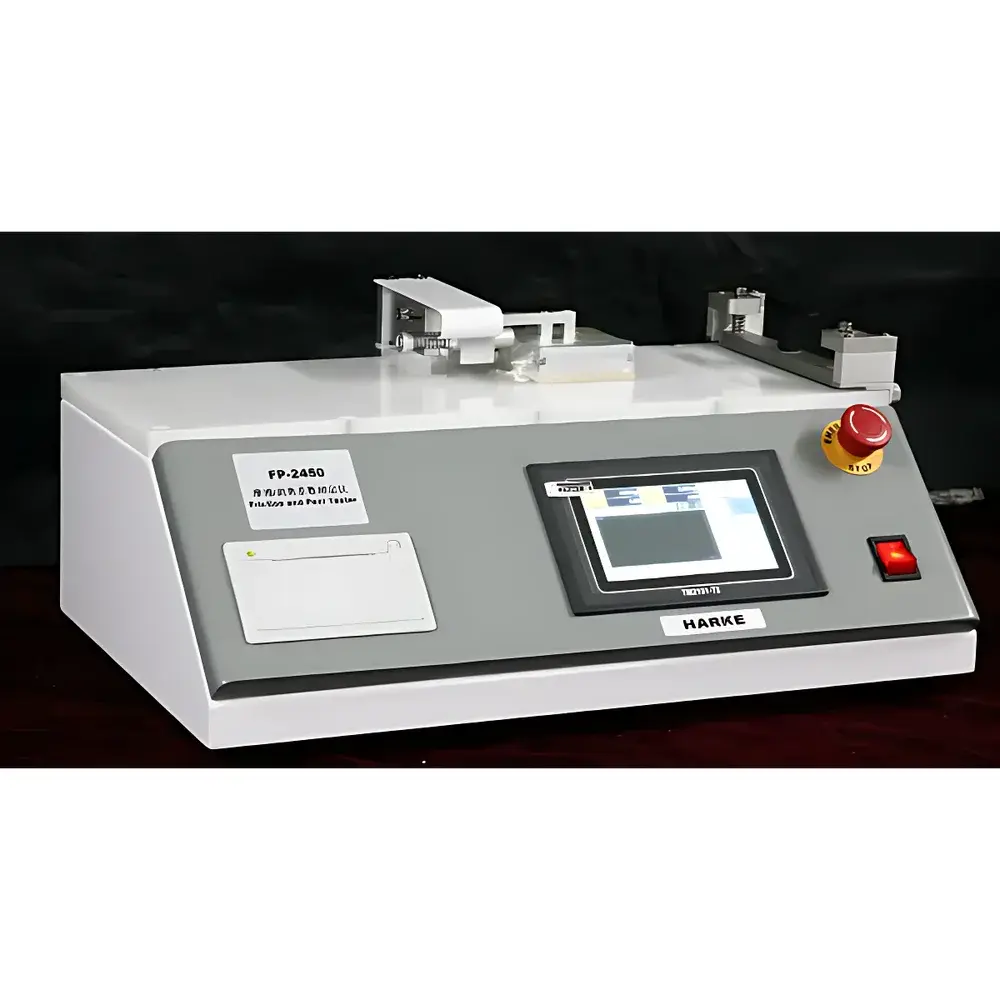
HARKE FP-2450 Coefficient of Friction & Peel Tester
| Brand | HARKE |
|---|---|
| Model | FP-2450 |
| Type | End-face Tribological Tester |
| Force Range Options | 5 N, 10 N, 20 N, 30 N |
| Force Accuracy | ±0.05% FS |
| Stroke | 300 mm |
| Slider Mass | 200 g |
| Test Speed | 0–100 mm/min (infinitely variable) |
| Specimen Thickness Capacity | 0–30 mm |
| Power Supply | AC 220 V, 50 Hz |
| Power Consumption | 30 W |
| Dimensions (L×W×H) | 480 × 310 × 220 mm |
| Net Weight | 42 kg |
| Compliance | GB 10006, ISO 8295 |
Overview
The HARKE FP-2450 Coefficient of Friction & Peel Tester is an engineered precision instrument designed for quantitative evaluation of interfacial tribological behavior between solid surfaces under controlled normal load and relative motion. It operates on the fundamental principle of measuring the tangential resistance force required to initiate (static friction) or sustain (kinetic friction) sliding between two contacting materials, as well as the peeling force required to separate adhered laminates—enabling standardized determination of both static (μs) and kinetic (μk) coefficients of friction, and peel strength (N/mm). The system implements a horizontal end-face configuration in accordance with ISO 8295 and GB 10006, where a standardized 200 g slider traverses across a fixed specimen at programmable linear velocity. Its modular force transducer architecture supports multiple full-scale ranges (5 N to 30 N), ensuring optimal signal-to-noise ratio across diverse material classes—from low-force polymer films to high-resistance industrial composites.
Key Features
- Embedded real-time control system enabling remote firmware updates, diagnostic logging, and secure maintenance access via standard Ethernet or RS232 interfaces
- Dual-mode tribological testing: simultaneous or independent static friction onset detection, kinetic friction profiling, and 90°/180° peel testing—all within a single platform
- High-resolution force measurement using calibrated strain-gauge load cells with ≤0.05% full-scale accuracy and thermal drift compensation
- Microstepping servo-driven actuation system delivering smooth, jitter-free motion across the full 0–100 mm/min speed range with <±0.1 mm/min repeatability
- 10.1-inch TFT color touchscreen HMI with intuitive graphical workflow navigation, real-time curve overlay, and parameter lockout for SOP compliance
- Patented film-clamping mechanism accommodating specimens from 0 to 30 mm thickness without manual recalibration or mechanical reconfiguration
- Integrated thermal- and electrical-safety interlocks, including over-travel limit switches, software-enforced force ceilings, and hardware-based emergency stop circuitry
- Onboard data historian with timestamped test records, exportable in CSV and PDF formats; optional thermal mini-printer for immediate hardcopy output
Sample Compatibility & Compliance
The FP-2450 accommodates a broad spectrum of planar and semi-rigid substrates, including but not limited to polymeric films (BOPP, PET, PE), metallic foils (aluminum, copper), paperboard, laminated packaging structures, elastomeric components (tires, wiper blades), biomedical surfaces (urethral catheters, synthetic epidermis), and engineering composites (brake linings, carbon rods). All test protocols adhere strictly to ISO 8295 (Plastics — Film and sheeting — Determination of coefficient of friction) and GB/T 10006 (Chinese national standard equivalent), ensuring international method equivalence. The instrument’s mechanical design and calibration traceability support audit readiness for GLP and GMP environments, with documentation alignment to ISO/IEC 17025 requirements for testing laboratories.
Software & Data Management
The proprietary HKCOF software suite provides full test lifecycle management: method definition (speed, dwell time, preload, cycle count), automated result calculation (μs, μk, average peel force, standard deviation), statistical summary reports, and trend analysis across batches. Data integrity safeguards include user-level access control, electronic signatures, and immutable audit trails compliant with FDA 21 CFR Part 11 principles. Raw force–displacement datasets are stored with metadata (operator ID, environmental conditions, calibration certificate ID), and export functions support LIMS integration via ODBC or RESTful API endpoints.
Applications
- Quality assurance of flexible packaging: verifying slip performance of food-grade films to prevent jamming in high-speed filling lines
- R&D of automotive interior trim: quantifying tactile response and abrasion resistance of PVC/TPU laminates under varying humidity conditions
- Medical device development: evaluating surface lubricity of guidewires and catheter shafts per ISO 10993-6 biocompatibility guidelines
- Printing and converting industry: optimizing ink adhesion and substrate handling by correlating COF with corona treatment levels
- Academic tribology research: generating comparative friction maps for nanocomposite coatings under controlled normal stress and sliding velocity
- Regulatory submission support: generating GLP-compliant test reports for FDA premarket notifications (510(k)) or EU MDR technical documentation
FAQ
What standards does the FP-2450 comply with for friction testing?
It conforms to ISO 8295 and GB/T 10006 for coefficient of friction measurement, and supports peel test configurations aligned with ASTM D903 and ISO 8510-2.
Can the system be integrated into an existing laboratory network?
Yes—it features native TCP/IP and RS232 communication ports, and HKCOF software supports OPC UA and MODBUS RTU protocols for SCADA and MES interoperability.
Is calibration traceable to national metrology institutes?
All force sensors are factory-calibrated against NIST-traceable deadweight standards, with optional annual recalibration services and certificate issuance.
Does the instrument support multi-specimen sequential testing?
Yes—the software enables batch mode execution with automatic slider repositioning and specimen indexing via external I/O triggers or barcode scanning.
What safety certifications does the FP-2450 hold?
It meets CE marking requirements (EMC Directive 2014/30/EU and Low Voltage Directive 2014/35/EU), and carries CB Scheme certification for global market access.



