
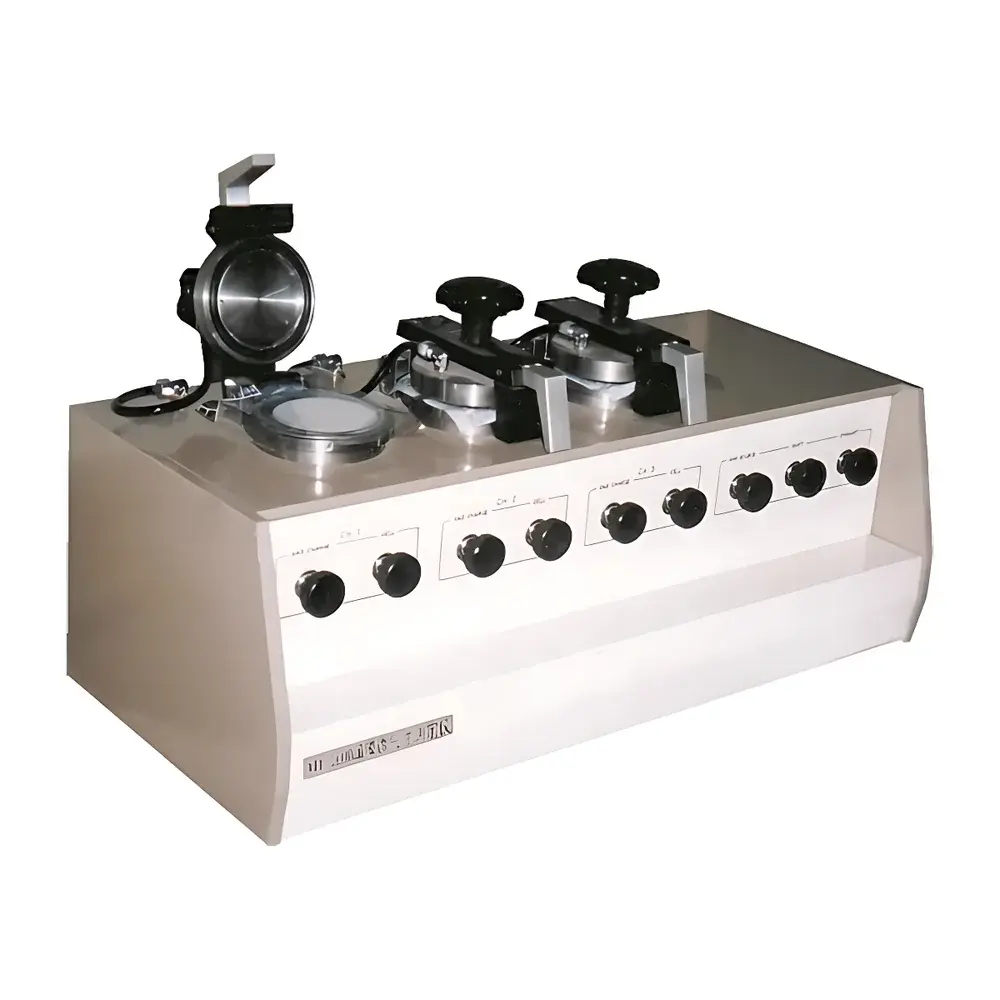
HARKE HK-O-3 Oxygen Transmission Rate (OTR) Tester for Composite Films
| Brand | HARKE |
|---|---|
| Model | HK-O-3 |
| Type | Gas Permeability Tester (O₂, CO₂, N₂, Air, He) |
| Origin | Beijing, China |
| Manufacturer | HARKE Instrument Co., Ltd. |
| Power Supply | AC 220 V, 50 Hz |
| Dimensions (L×W×H) | 730 × 590 × 350 mm |
| Net Weight | 56 kg |
| Test Area | 50 cm² |
| Sample Thickness Limit | ≤5 mm |
| Temperature Range | 5–95 °C (±0.1 °C accuracy) |
| Humidity Control | 0 %RH, 35–90 %RH, 100 %RH (±1 %RH accuracy) |
| OTR Range (Film) | 0.01–6500 cm³/m²·d (standard), 0.05–65000 cm³/m²·d (optional) |
| OTR Range (Container) | 0.0001–65 cm³/pkg·d (standard) |
| Resolution (Film) | 0.001 cm³/m²·d |
| Resolution (Container) | 0.00001 cm³/pkg·d |
| Sample Capacity | 1–3 independent stations |
| Carrier Gas | 99.999% high-purity N₂ (user-supplied) |
| Carrier Flow | 0–200 mL/min |
| Gas Inlet | 1/8″ stainless steel tubing |
| Test Gases | O₂, CO₂, N₂, air, He (user-supplied) |
| Sample Format | Flat films (≥150 mm × 94 mm or circular), containers (≤Φ120 mm × 400 mm H) |
Overview
The HARKE HK-O-3 Oxygen Transmission Rate (OTR) Tester is a gravimetric and coulometric sensor-based instrument engineered for precise, standardized measurement of oxygen permeation through flexible packaging materials—including multilayer composite films, laminates, coated papers, and rigid or semi-rigid containers. It operates on the principle of dynamic gas transmission under controlled temperature and relative humidity conditions, in accordance with ASTM D3985, ISO 15105-2, ISO 2556, GB/T 1038, and YBB 00082003. The system utilizes a dual-chamber differential pressure configuration: one side maintains a defined O₂ concentration (typically ambient air or calibrated O₂/N₂ mix), while the other side is purged with ultra-high-purity nitrogen to create a driving force across the test specimen. A high-sensitivity electrochemical oxygen sensor quantifies the transmitted O₂ flux in real time, enabling trace-level detection down to 0.00001 cm³/pkg·d for container formats and 0.001 cm³/m²·d for planar films.
Key Features
- Triple-range OTR capability: standard (0.01–6500 cm³/m²·d), extended (0.05–65000 cm³/m²·d), and ultra-low container mode (0.0001–65 cm³/pkg·d)
- Independent triple-test station design—enables concurrent evaluation of up to three specimens under identical environmental conditions, improving throughput and statistical robustness
- Precision climate control: programmable temperature range from 5 °C to 95 °C (±0.1 °C stability) and multi-point RH regulation (0 %RH, 35–90 %RH, 100 %RH; ±1 %RH accuracy)
- Modular gas handling architecture supporting O₂, CO₂, N₂, air, and helium—compatible with user-supplied gas sources meeting ISO 8573-1 Class 1 purity requirements
- Standardized 50 cm² test area with adaptable fixtures for flat films (≥150 mm × 94 mm or circular), containers (≤Φ120 mm × 400 mm H), and irregular geometries via custom gasketing
- Integrated carrier gas flow control (0–200 mL/min) with mass flow monitoring and automatic leak-check routines prior to each test cycle
- Robust stainless-steel construction and sealed sensor chamber conforming to IP54 ingress protection for laboratory and QC environment durability
Sample Compatibility & Compliance
The HK-O-3 accommodates a broad spectrum of industrial substrates without modification. Its mechanical and pneumatic interface supports thicknesses up to 5 mm and diverse physical forms—including thermoplastic films (PET/AL/PE, BOPP/CPP), biodegradable matrices (starch-based, PLA, PHA), metallized papers (tobacco packaging foils), liquid carton board (Tetra Pak®-type laminates), fluoropolymer-coated textiles (PTFE fiberglass fabrics), elastomeric tubes (cosmetic squeeze tubes, toothpaste laminates), and rubber components (tire innerliners). All testing protocols align with Good Laboratory Practice (GLP) documentation standards. Audit-ready data logs include full environmental metadata (T/RH timestamps), sensor calibration history, and operator ID—supporting compliance with FDA 21 CFR Part 11 when paired with HARKE’s optional validated software suite.
Software & Data Management
HARKE OTR Control v3.2 software provides ISO/IEC 17025-aligned test method configuration, automated report generation (PDF/CSV), and raw-data export with embedded metadata tags (test date, operator, instrument ID, calibration certificate ID). The system implements role-based access control, electronic signatures, and immutable audit trails for all test modifications. Data integrity safeguards include automatic checksum verification, cyclic redundancy checks on stored datasets, and optional integration with LIMS platforms via ASTM E1384-compliant XML schema. All calibration events—span gas verification, zero-gas validation, and sensor response linearity checks—are timestamped and archived with pass/fail status per ISO/IEC 17025 Clause 6.5.2.
Applications
- Pharmaceutical packaging: barrier validation of blister lidding foils, cold-form foil, and sachet films per USP and EP 2.9.17
- Food packaging R&D: shelf-life modeling of modified atmosphere packaging (MAP) films using OTR-derived kinetic degradation constants
- Aerospace component testing: helium permeation rate assessment of inflatable decelerators and crew module airbags per NASA-STD-6002
- Sustainable packaging development: comparative OTR profiling of compostable films under elevated humidity (90 %RH) to simulate end-of-life conditions
- Automotive material qualification: oxygen diffusion analysis in tire innerliner compounds (butyl rubber, halobutyl blends) per SAE J1716
- Electronics encapsulation: moisture-oxygen synergistic barrier performance of thin-film OLED packaging substrates
FAQ
What gases can be tested besides oxygen?
The HK-O-3 supports quantitative permeation measurement of CO₂, N₂, air, and helium—provided appropriate certified reference gases and sensor modules are installed. Helium testing requires optional thermal conductivity detector (TCD) upgrade.
Is the system compliant with ASTM D3985 and ISO 15105-2?
Yes—the instrument’s sensor geometry, flow dynamics, and calibration traceability meet all mandatory clauses of both standards. Full conformance documentation is included with each delivery.
Can container testing be performed without custom fixtures?
Standard cylindrical and rectangular container holders are supplied. Non-standard geometries require application-specific fixture design, which HARKE offers as an engineering service.
What maintenance intervals are recommended for the oxygen sensor?
Electrochemical O₂ sensors require annual recalibration and replacement every 24 months under typical lab usage (≤8 h/day). Sensor life is logged automatically in the software.
Does the system support GLP-compliant electronic records?
When operated with HARKE OTR Control v3.2 and enabled audit-trail settings, the system satisfies ALCOA+ principles (Attributable, Legible, Contemporaneous, Original, Accurate, Complete, Consistent, Enduring, Available) per PIC/S Annex 11.




