
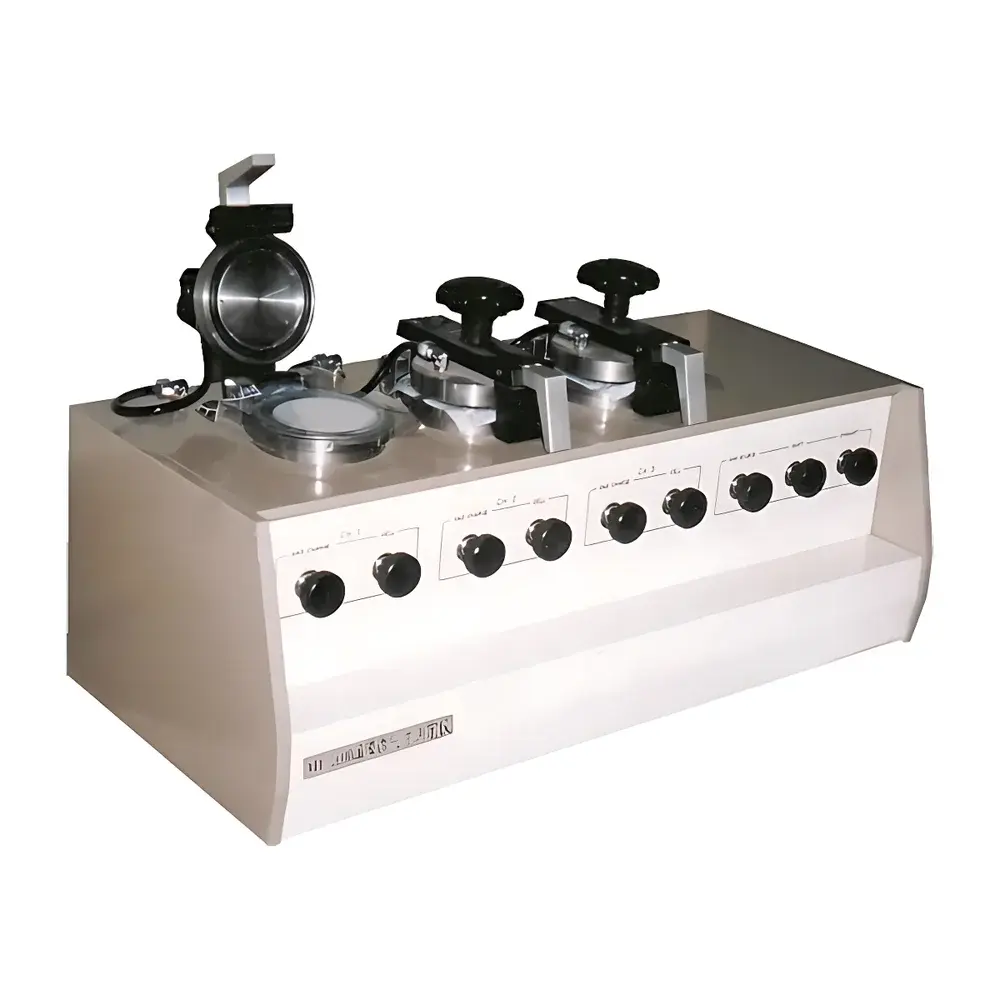
HARKE HK-T03 Oxygen Transmission Rate (OTR) Analyzer
| Brand | HARKE |
|---|---|
| Model | HK-T03 |
| Type | Vacuum-Method Gas Permeability Tester for Films and Containers |
| Measurement Principle | Coulometric Sensor Detection (ASTM D3985 / ISO 15105-2 Compliant) |
| OTR Range (Film) | 0.01–6500 cm³/m²·d (Standard), 0.05–65,000 cm³/m²·d (Optional) |
| OTR Range (Container) | 0.0001–65 cm³/pkg·d (Standard) |
| Resolution (Film) | 0.001 cm³/m²·d |
| Resolution (Container) | 0.00001 cm³/pkg·d |
| Temperature Control Range | 5–95 °C (External Chiller Required) |
| Temp. Accuracy | ±0.1 °C |
| Humidity Control | 0% RH, 35–90% RH, 100% RH |
| RH Accuracy | ±1% RH |
| Test Area | 50 cm² |
| Sample Thickness Limit | ≤5 mm |
| Sample Dimensions (Film) | ≥150 mm × 94 mm or circular |
| (Container) | ≤Φ120 mm × 400 mm (H) |
| Carrier Gas | 99.999% high-purity N₂ |
| Carrier Flow Rate | 0–200 mL/min |
| Power Supply | AC 220 V, 50 Hz |
| Dimensions (L×D×H) | 330 × 600 × 330 mm |
| Net Weight | 28 kg |
| Gas Compatibility | O₂, CO₂, N₂, air, He, H₂, CH₄, C₃H₈, C₄H₁₀, NH₃ (hazardous gases require pre-installation safety review) |
Overview
The HARKE HK-T03 Oxygen Transmission Rate (OTR) Analyzer is a precision vacuum-pressure differential instrument engineered for quantitative determination of oxygen permeation through polymeric films, laminates, coated substrates, rigid containers, and high-barrier packaging structures. It operates on the principle of coulometric detection in accordance with ASTM D3985 (Standard Test Method for Oxygen Gas Transmission Rate Through Plastic Film and Sheeting Using a Coulometric Sensor) and ISO 15105-2 (Plastics — Film and sheeting — Determination of gas transmission rate — Part 2: Isostatic method). In this method, a test specimen separates two chambers: a dry nitrogen carrier gas stream on the upstream side and an oxygen-permeating environment on the downstream side. As O₂ molecules diffuse across the sample under controlled temperature and humidity gradients, they are swept by high-purity N₂ to a built-in coulometric sensor, which generates an electrical current proportional to O₂ concentration—enabling direct, real-time quantification of transmission rate with trace-level sensitivity.
Key Features
- Vacuum-based differential pressure architecture ensures high measurement reproducibility and eliminates convective interference common in ambient-pressure systems.
- Dual-range OTR capability supports both ultra-high-barrier materials (e.g., AlOx-coated PET, SiOx-laminates, metallized foils) and highly permeable substrates (e.g., LDPE, PP, biodegradable films) without hardware modification.
- Independent environmental control: precise temperature regulation (±0.1 °C) from 5 °C to 95 °C and programmable relative humidity levels (0%, 35–90%, or 100% RH) enable standardized testing per ASTM F1249, ISO 2556, and GB/T 1038.
- Modular test chamber design accommodates flat film specimens (≥150 mm × 94 mm) and rigid or semi-rigid containers (up to Φ120 mm × 400 mm height), supporting regulatory-compliant container OTR validation required for pharmaceutical blister packs and sterile barrier systems.
- Integrated coulometric O₂ sensor with auto-zero calibration and drift compensation ensures long-term stability and compliance with GLP data integrity requirements.
- Gas manifold compatible with multiple non-reactive and reactive test gases—including CO₂, He, H₂, CH₄, NH₃—subject to pre-installation hazard assessment and optional purge/safety interlock integration.
Sample Compatibility & Compliance
The HK-T03 accepts diverse packaging formats including aluminum foil composites, PVDC-coated films, PVC hard sheets, PET thermoforms, coextruded IV bags, paper-plastic laminates, cast films, synthetic skins, aerospace-grade composites, battery separators, microporous membranes, elastomeric seals, and tobacco packaging foils. All test protocols align with international standards governing barrier performance evaluation: ASTM D3985 (OTR), ASTM F1249 (water vapor transmission), ISO 15105-2 (gas permeability), ISO 2556 (O₂ permeability under atmospheric conditions), and Chinese national standard GB/T 1038. For pharmaceutical packaging, the system supports IQ/OQ documentation packages and can be configured for 21 CFR Part 11-compliant audit trails when paired with HARKE’s validated LabControl™ software suite.
Software & Data Management
HARKE LabControl™ v4.2 provides full instrument control, automated parameter sequencing (temperature ramping, RH cycling, multi-point OTR profiling), real-time curve visualization, and export-ready reporting in PDF, CSV, and XML formats. The software includes built-in calculation modules for derived parameters—diffusion coefficient (D), solubility coefficient (S), and permeability coefficient (P)—based on Fickian analysis and time-lag methodology per ISO 15105-1. All raw sensor outputs, environmental logs, and user actions are timestamped and stored with immutable audit trails, satisfying GMP/GLP documentation requirements for QC laboratories conducting packaging validation per ICH Q5C and USP .
Applications
This analyzer serves critical roles in R&D labs developing next-generation barrier coatings, quality control departments verifying shelf-life predictions for food and pharmaceutical products, regulatory affairs teams compiling submission dossiers for FDA 510(k) or EMA CPMP documents, and sustainability engineers evaluating oxygen ingress in compostable and mono-material packaging. Typical use cases include: accelerated aging correlation studies between OTR and product oxidation kinetics; comparative evaluation of plasma-enhanced ALD coatings versus conventional metallization; validation of seal integrity in cold-formed aluminum blisters; and permeation screening of solid-state battery separator films under variable thermal stress.
FAQ
Does the HK-T03 support simultaneous multi-gas testing?
No—each test run is configured for a single permeant gas. Switching gases requires manual purging, sensor recalibration, and system equilibration.
Is external chiller integration mandatory for operation at 5 °C or 95 °C?
Yes. The standard unit does not include active thermoelectric or refrigerated cooling; temperature extremes require connection to an external recirculating chiller or heating bath.
Can the system be validated for GMP environments?
Yes—when deployed with HARKE’s IQ/OQ protocol package and LabControl™ software configured for electronic signatures and audit trail logging, it meets core elements of Annex 11 and 21 CFR Part 11.
What safety provisions exist for flammable or toxic test gases?
Hazardous gas operation requires pre-delivery engineering review, installation of explosion-proof fittings, gas-specific sensor calibration, and integration with facility exhaust and leak-detection systems—details must be specified during quotation.
Is container testing performed under vacuum or positive pressure?
Container OTR testing follows the vacuum method: the interior is evacuated while the exterior is exposed to O₂-saturated environment; permeated gas is carried to the sensor via nitrogen sweep flow.




