
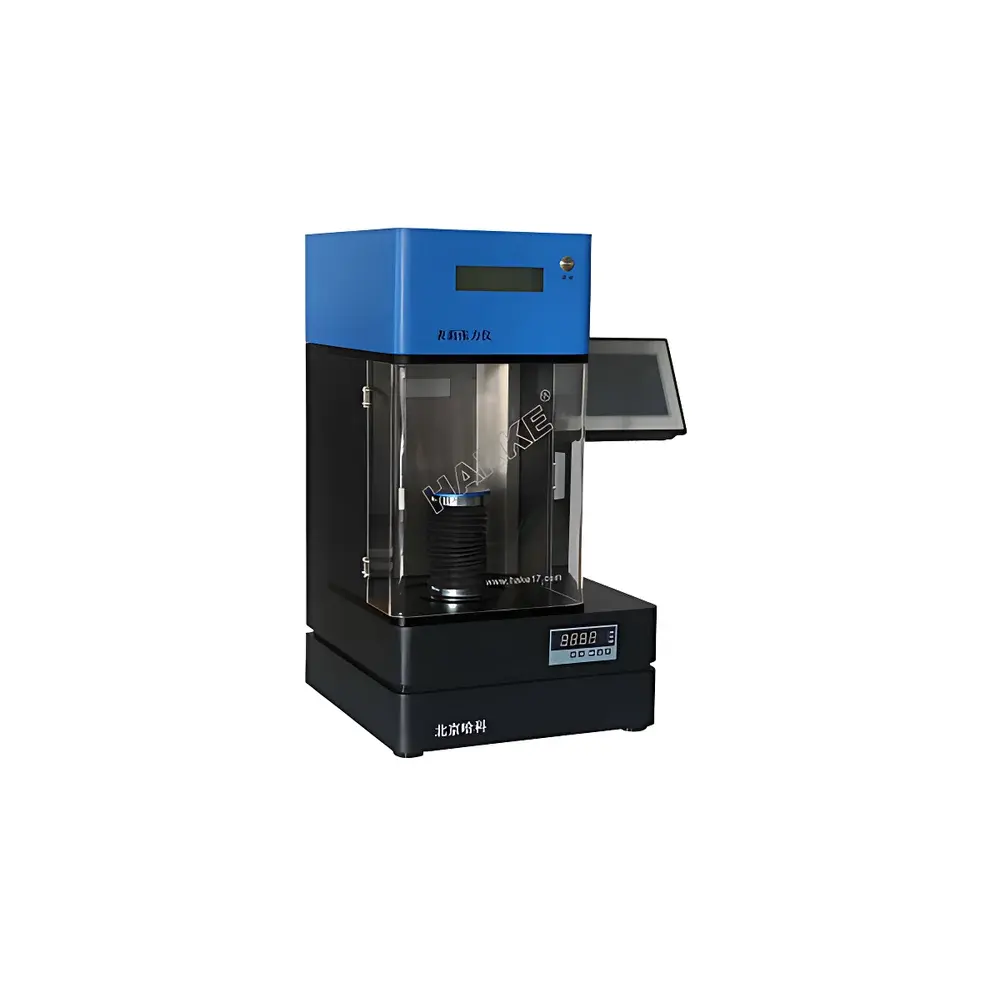
HARKE SFT-A2 Advanced Surface Tensiometer
| Brand | HARKE |
|---|---|
| Model | SFT-A2 |
| Measurement Range | 0–400 mN/m |
| Resolution | ±0.01 mN/m |
| Accuracy | ±0.1 mN/m |
| Temperature Display Range | 0–100 °C |
| Temperature Display Accuracy | ±1 °C |
| Temperature Sensing Resolution | 0.01 °C |
| Measurement Methods | Wilhelmy Plate (Whitey Plate), Du Noüy Ring |
| Sample Stage Vertical Travel | 0–50 mm |
| Stage Positioning Repeatability | ±0.5 µm |
| Data Acquisition Rate | Up to 23 Hz |
| Operating System | 7-inch Color WinCE Embedded Interface |
| Connectivity | USB 2.0, External Mouse Support |
| Power Supply | 220 V AC, 3 A |
| Dimensions (L×W×H) | 330 × 350 × 580 mm |
| Weight | 20 kg |
Overview
The HARKE SFT-A2 Advanced Surface Tensiometer is an electromechanical instrument engineered for high-precision measurement of surface tension and interfacial tension using the standardized Wilhelmy plate and Du Noüy ring methods. It operates on the principle of force balance: when a calibrated platinum plate or ring contacts and detaches from a liquid interface, the vertical force exerted by surface tension is measured via a high-sensitivity electromagnetic force transducer. This method conforms to ASTM D971, ISO 6295, and ISO 1409 standards for liquid surface and interfacial property characterization. Designed for laboratory environments requiring reproducibility in formulation development, quality control, and colloidal stability assessment, the SFT-A2 integrates real-time force sensing with thermally monitored sample positioning—enabling quantitative analysis of surfactant efficiency, emulsion stability, wetting behavior, and critical micelle concentration (CMC) determination.
Key Features
- High-resolution force detection system with ±0.01 mN/m resolution and ±0.1 mN/m accuracy across the full 0–400 mN/m range
- Automated sample stage with 0–50 mm vertical travel, ±0.5 µm repeatability, and programmable speed control for optimized immersion/detachment profiles
- Integrated temperature monitoring subsystem with ±1 °C display accuracy and 0.01 °C internal sensing resolution; software-synchronized thermal readout independent of mechanical actuation
- 7-inch color WinCE-based embedded touchscreen interface supporting direct parameter configuration, real-time curve visualization, and one-touch auto-zero calibration
- USB 2.0 interface enabling seamless data export to external storage devices and compatibility with external input peripherals including mice and keyboards
- Dual-method capability: fully automated Wilhelmy plate mode for surface tension and interfacial tension, plus manual Du Noüy ring mode for comparative validation and non-standard interfaces
- Electronic meniscus detection algorithm that identifies liquid level position in real time using capacitive sensor feedback—eliminating operator-dependent leveling errors
Sample Compatibility & Compliance
The SFT-A2 accommodates aqueous, organic, and mixed-phase liquids—including polymer solutions, surfactant micellar systems, crude oil/water interfaces, and pharmaceutical emulsions—within standard laboratory glassware (e.g., 50–100 mL beakers). Its platinum plate and ring accessories comply with ASTM D1331 and ISO 1409 material specifications for inertness and dimensional tolerance. All firmware and data handling protocols support GLP-compliant operation: audit trails are maintained for calibration events, user logins, and test method selections. While the instrument itself does not require FDA 21 CFR Part 11 certification (as it is not a regulated clinical device), its data export structure (CSV/Origin-compatible) facilitates integration into validated LIMS or electronic lab notebook (ELN) platforms used in GMP-regulated environments.
Software & Data Management
The embedded WinCE operating system hosts HARKE’s proprietary A3/A4/A5 surface tension analysis suite, which implements three distinct evaluation algorithms for dynamic and equilibrium measurements. Real-time force curves are plotted at up to 23 Hz sampling frequency, with automatic baseline correction and peak-force identification. Test results—including surface tension (mN/m), interfacial tension (mN/m), mass (g), and temperature (°C)—are stored in a relational database with timestamp, operator ID, and method metadata. Historical datasets can be filtered by date range, sample ID, or test type; all entries support batch export to Origin-compatible XY plot files or CSV for statistical post-processing. Software updates are delivered via USB flash drive without requiring PC connectivity.
Applications
- Surfactant screening and CMC determination in detergent, agrochemical, and personal care formulations
- Interfacial tension mapping for enhanced oil recovery (EOR) fluid design
- Quality assurance of coating and ink formulations where wetting and spreading behavior govern performance
- Stability assessment of nanoemulsions, liposomes, and microcapsules in pharmaceutical development
- Surface energy estimation of solid substrates using contact angle–surface tension correlations
- Educational use in physical chemistry and colloid science laboratories for teaching interfacial thermodynamics
FAQ
What measurement standards does the SFT-A2 comply with?
ASTM D971 (interfacial tension of petroleum products), ASTM D1331 (surface tension of coatings), ISO 6295 (surface tension of detergents), and ISO 1409 (plastics—determination of surface tension of polymer melts).
Can the instrument measure interfacial tension between two immiscible liquids?
Yes—the Wilhelmy plate method supports both air–liquid and liquid–liquid interfacial tension measurements, provided the denser phase serves as the subphase and the plate is cleaned between tests.
Is temperature control built into the instrument?
The SFT-A2 includes precision temperature sensing and display but does not integrate active heating/cooling. For thermostatic testing, users must pair it with an external Peltier stage or water-jacketed trough.
How is calibration performed?
Calibration uses certified reference liquids (e.g., ultrapure water at 20 °C = 72.75 mN/m) and mechanical zeroing via the one-touch auto-zero function prior to each test sequence.
Does the software support multi-user access with role-based permissions?
No—the embedded OS supports single-user operation only; however, all test records include operator ID fields for traceability in shared-lab deployments.



