
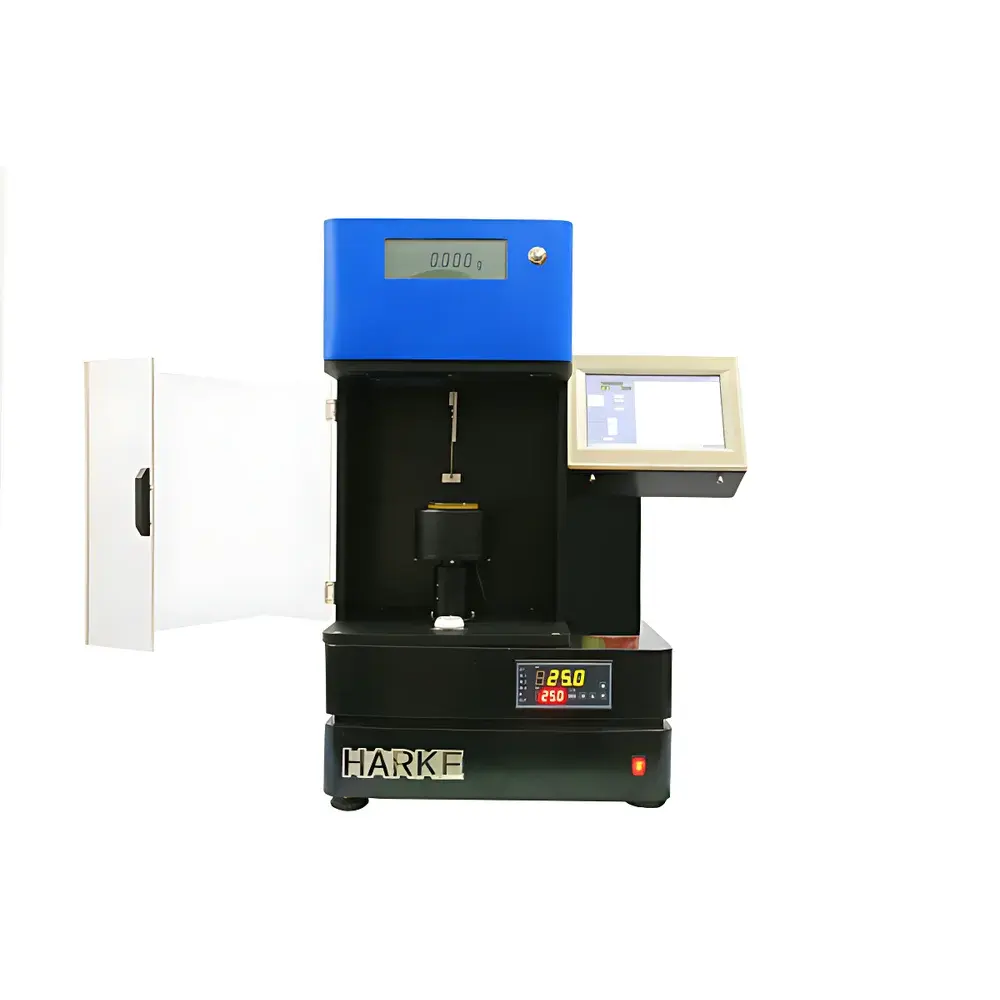
HARKE HARKE-SFT-SK Dedicated Lubricating Oil Surface Tensiometer
| Brand | HARKE |
|---|---|
| Model | HARKE-SFT-SK |
| Origin | Beijing, China |
| Manufacturer | HARKE (OEM Producer) |
| Measurement Principle | Du Noüy Ring Method & Wilhelmy Plate Method |
| Measurement Range | 0–400 mN/m |
| Resolution | 0.01 mN/m |
| Accuracy | ±0.1 mN/m |
| Temperature Display Range | 0–95 °C |
| Temperature Accuracy | ±0.1 °C |
| Sensor Capacity | 0–120 g |
| Stage Travel Speed | 0–10 mm/sec |
| Stage Travel Distance | 0–80 mm |
| Stage Positioning Accuracy | ±0.1 mm |
| Sample Cup Diameter | Φ50 mm |
| Software | SFT-Al |
| Compliance | GB/T 6541–1986, ISO 1409:1995, GB/T 22237–2008, SH/T 1156–1995, ISO 6295:1983 |
Overview
The HARKE HARKE-SFT-SK Dedicated Lubricating Oil Surface Tensiometer is an engineered precision instrument designed specifically for the quantitative determination of surface and interfacial tension in lubricating oils, base stocks, additives, and related petroleum-derived formulations. It operates on two internationally standardized physical principles: the Du Noüy ring method (ISO 6295, GB/T 6541) and the Wilhelmy plate method (ISO 1409, GB/T 22237), both grounded in classical capillary force measurement theory. The system employs a high-stability electromagnetic balance with real-time dynamic compensation, enabling direct force-to-tension conversion without empirical scaling factors. Its dedicated calibration architecture—supporting certified weight, pure water (72.75 mN/m at 20 °C), and ethanol (22.39 mN/m at 20 °C) reference points—ensures metrological traceability across the full 0–400 mN/m range. Designed for routine QC labs in lubricant manufacturing, R&D centers, and third-party testing facilities, the instrument delivers repeatable measurements under variable thermal conditions, with automatic temperature compensation algorithms referenced to standard liquids.
Key Features
- High-resolution electromagnetic force sensor with 0.01 mN/m display resolution and ±0.1 mN/m measurement accuracy, validated per ISO/IEC 17025 calibration protocols
- Dual-method capability: interchangeable platinum ring and platinum plate probes, each pre-calibrated and mechanically indexed for zero-realignment installation
- Motorized vertical stage with precision ball-screw drive, offering programmable lift speeds (0–10 mm/sec) and sub-0.1 mm positional repeatability over 80 mm travel
- 5-inch capacitive touchscreen interface displaying real-time tension curve, peak tension lock, equivalent tension, ambient temperature, and auto-compensated 20 °C reference value
- Integrated thermal compensation engine using water/ethanol as primary standards; automatically adjusts raw tension values to standardized 20 °C equivalents per ASTM D971 and ISO 6295 conventions
- One-touch tare function with digital stabilization logic—eliminates zero drift during prolonged measurements or ambient thermal fluctuation
- Modular probe mounting bracket allowing rapid, tool-free exchange of platinum components; includes dedicated calibration jig for onsite force verification using NIST-traceable weights
Sample Compatibility & Compliance
The HARKE-SFT-SK is optimized for low-volatility, high-viscosity fluids typical of mineral oils, synthetic esters, polyalphaolefins (PAOs), and additive packages containing anti-wear agents (e.g., ZDDP), detergents, and dispersants. Its extended measurement range (0–400 mN/m) accommodates both neat base oils (typically 28–32 mN/m) and oil–water interface systems where interfacial tension may drop below 5 mN/m. The instrument meets the procedural requirements of multiple international standards governing lubricant characterization, including GB/T 6541–1986 (petroleum product oil–water interfacial tension), ISO 6295:1983 (same), ISO 1409:1995 (polymer dispersions), and SH/T 1156–1995 (synthetic latex emulsions). All measurement workflows support GLP-compliant documentation when used with optional SFT-Al software and audit-trail-enabled configurations.
Software & Data Management
The optional SFT-Al acquisition and analysis software provides full instrument control, real-time curve visualization, automated peak detection, and batch reporting. It supports CSV and PDF export with embedded metadata (operator ID, timestamp, calibration status, environmental temperature, method selected). When deployed in regulated environments, SFT-Al can be configured to comply with FDA 21 CFR Part 11 requirements—including electronic signatures, user access levels, and immutable audit trails—upon validation by the end-user’s QA department. Raw force-vs.-distance datasets are retained for reprocessing, and calibration logs are time-stamped and digitally signed to satisfy ISO/IEC 17025 clause 7.7 traceability mandates.
Applications
- Quality control of finished lubricants and base oil batches against internal specifications and OEM technical data sheets
- Formulation development of multifunctional additives affecting interfacial activity, such as demulsifiers, emulsifiers, and corrosion inhibitors
- Stability assessment of oil-in-water or water-in-oil emulsions used in metalworking fluids and hydraulic systems
- Monitoring oxidative degradation via time-dependent surface tension shifts in aged oil samples
- Interfacial tension mapping for compatibility evaluation between lubricants and elastomeric seals (e.g., nitrile, FKM)
- Supporting ASTM D971 and IP 60 test methods for determining interfacial tension of insulating oils versus moisture-contaminated water
FAQ
Does the HARKE-SFT-SK support both surface and interfacial tension measurements?
Yes—it measures surface tension of pure liquids and interfacial tension at oil–water, oil–aqueous additive, or oil–polymer solution interfaces using either the ring or plate method.
Is temperature control integrated into the instrument?
The unit features precise temperature sensing (±0.1 °C) and automatic compensation but does not include active heating/cooling; external thermostatted baths or Peltier stages are recommended for controlled-temperature studies.
Can the instrument be validated for GMP/GLP compliance?
Yes—when paired with SFT-Al software, documented calibration records, and a qualified user procedure, it supports full IQ/OQ/PQ validation per ISO 17025 and pharmaceutical quality systems.
What maintenance is required for the platinum probes?
Platinum rings and plates must be cleaned ultrasonically in ethanol or acetone after each use and annealed periodically to remove organic residues; HARKE provides cleaning protocols and annealing guidelines in the operator manual.
Is remote operation supported?
SFT-Al enables Ethernet-based remote monitoring and control; however, physical sample loading and probe handling remain manual operations requiring local operator presence.



