
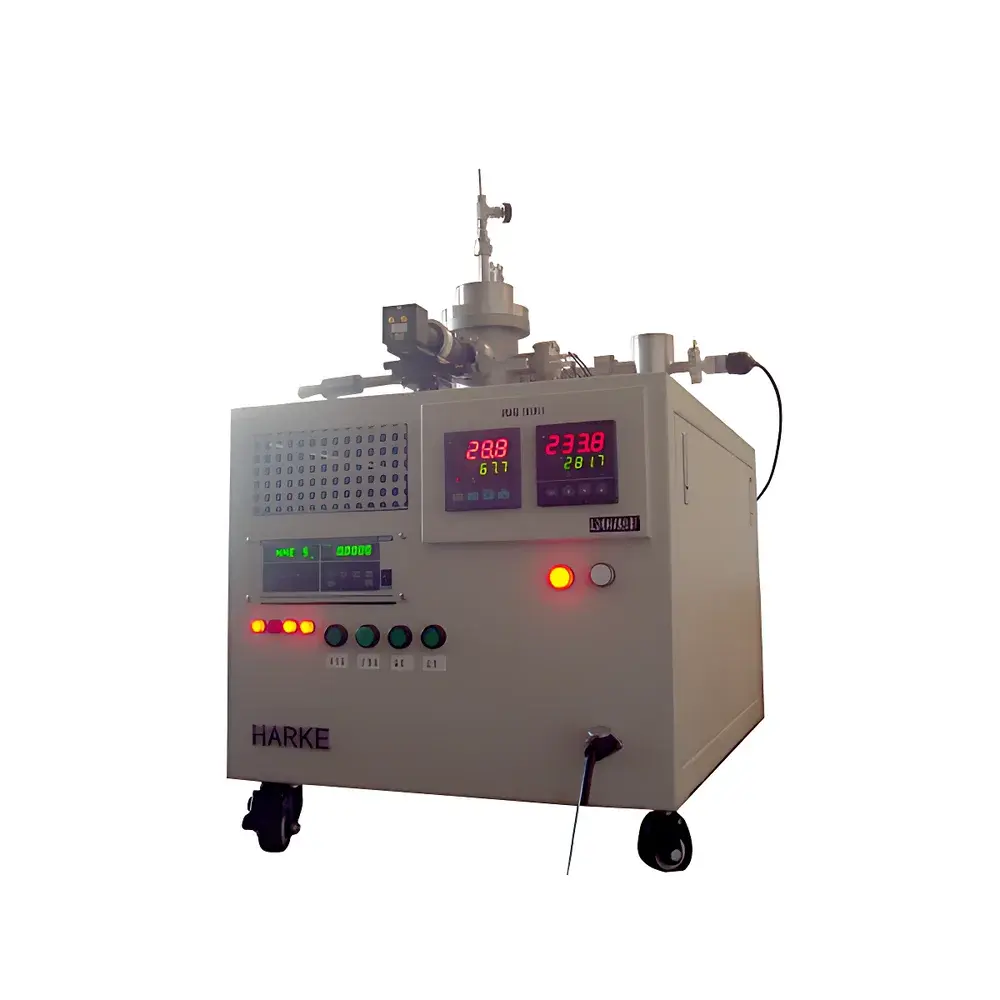
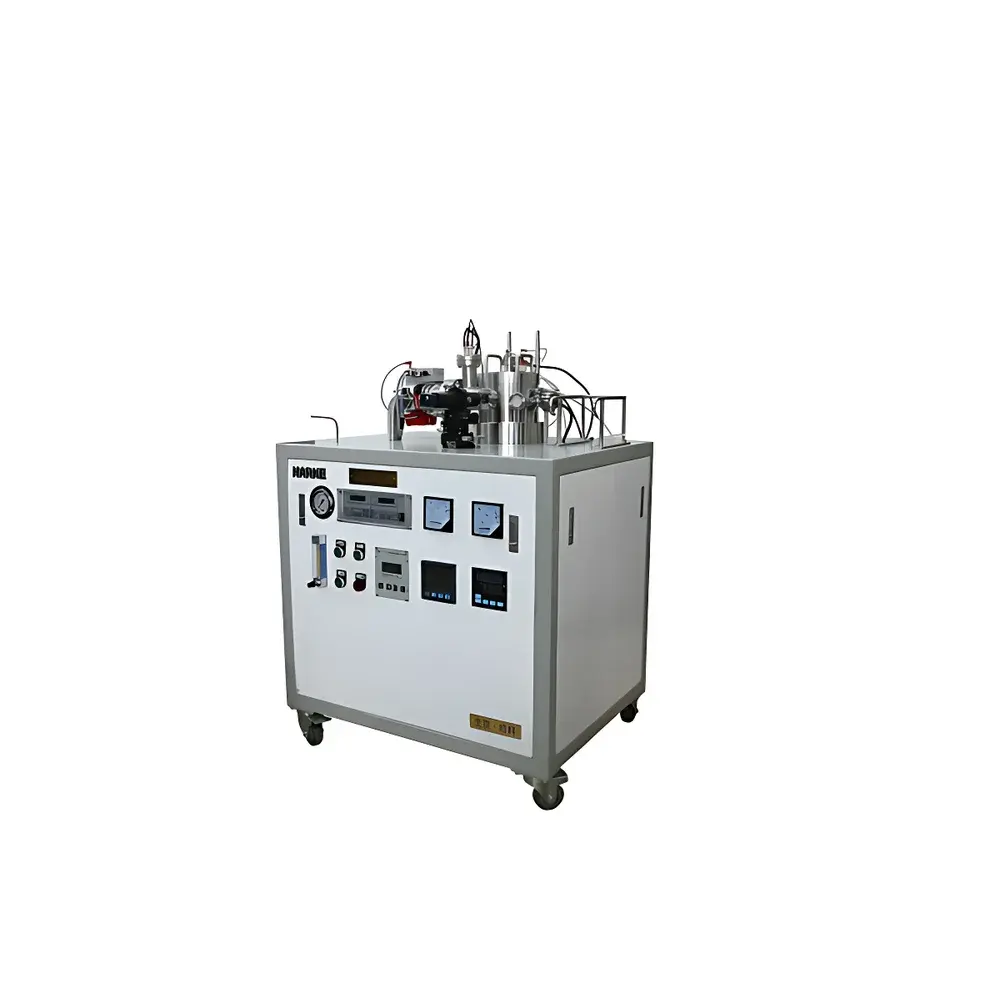
HARKE HTV1801 High-Temperature & High-Vacuum Contact Angle Goniometer
| Brand | HARKE |
|---|---|
| Origin | Beijing, China |
| Manufacturer Type | Direct Manufacturer |
| Product Category | Domestic |
| Model | HARKE-HTV1801 |
| Instrument Type | Benchtop Laboratory System |
| Contact Angle Measurement Range | 0–180° |
| Contact Angle Accuracy | ±0.1° |
| Sample Stage Dimensions | 40 × 40 mm |
| Optical Magnification | 0.7×–5× (Stepped Zoom Lens) |
| Surface/Interfacial Tension Range | 0–5000 mN/m |
| Surface/Interfacial Tension Resolution | 0.01 mN/m |
| Maximum Operating Temperature | Up to 1500 °C |
| Ultimate Vacuum Level | 1 × 10⁻⁵ Pa |
| Measurement Method | Sessile Drop |
| Power Supply | 220 V / 30 A / 50 Hz |
| Overall Dimensions (W × D × H) | 600 × 800 × 1200 mm |
| Net Weight | 100 kg |
| Software | HARKE-HTV1.0 |
| Imaging System | USB 3.0 Digital Camera |
| Lens Travel Stroke | 200 mm |
Overview
The HARKE HTV1801 High-Temperature & High-Vacuum Contact Angle Goniometer is an engineered solution for quantitative interfacial characterization under extreme thermal and environmental conditions. It operates on the principle of optical sessile drop analysis, where high-resolution imaging captures the silhouette of a liquid droplet deposited on a solid substrate at elevated temperatures and controlled vacuum levels. The system reconstructs the droplet profile using advanced edge-detection algorithms and calculates contact angle via tangent-fitting or ellipse-based geometric modeling. Unlike ambient-only goniometers, the HTV1801 integrates a low-back-pressure, oil-free molecular pumping station and a multi-zone resistive heating furnace capable of sustained operation up to 1500 °C under vacuum down to 1 × 10⁻⁵ Pa—enabling studies of molten metals, refractory ceramics, oxide scales, and reactive alloys without oxidation or volatile contamination. Its design adheres to fundamental requirements for thermodynamic consistency in surface energy derivation (e.g., Owens–Wendt, Fowkes, or van Oss–Chaudhury–Good models), making it suitable for both academic metallurgy research and industrial R&D in aerospace, nuclear materials, and additive manufacturing.
Key Features
- Integrated high-vacuum chamber with dual-stage pumping: primary mechanical pump + turbo-molecular pump (oil-free, no backstreaming)
- Precision multi-segment temperature controller (imported) with ±1 °C thermal uniformity across 40 × 40 mm sample stage
- Stepped optical zoom lens (0.7×–5×) with motorized focus and calibrated magnification steps for pixel-to-length traceability
- USB 3.0 high-speed digital camera (≥60 fps at full resolution) synchronized with real-time thermal logging
- Laser-assisted droplet positioning and automated stage alignment for repeatable dispensing geometry
- Three-axis micrometer-adjustable sample stage (X/Y/Z) with fine-tuned leveling capability
- Dual-mode illumination: coaxial LED ring light + oblique directional source for optimal contrast on reflective or translucent substrates
- Compliance-ready software architecture supporting audit trails, user access levels, and electronic signature protocols per FDA 21 CFR Part 11 guidelines
Sample Compatibility & Compliance
The HARKE HTV1801 accommodates flat, polished, or as-sintered specimens up to 40 × 40 mm and 20 mm thick—including metallic alloys (Ni-based superalloys, Ti-6Al-4V, stainless steels), ceramic substrates (Al₂O₃, SiC, ZrO₂), and composite coatings. Samples are mounted on a water-cooled copper holder to isolate thermal load from the optical path. Vacuum integrity ensures compatibility with oxygen-sensitive systems (e.g., molten aluminum, lithium-containing electrolytes) and enables vapor-phase equilibrium measurements. The instrument meets ISO 19403-2 (contact angle determination), ASTM D7334 (surface energy of plastics), and supports GLP/GMP-aligned workflows through HARKE-HTV1.0 software’s built-in calibration verification logs, timestamped measurement records, and exportable XML/CSV data packages traceable to NIST-traceable reference standards.
Software & Data Management
HARKE-HTV1.0 software provides fully integrated control of temperature ramping, vacuum sequencing, image acquisition, and interfacial parameter computation. It features real-time overlay of droplet contour, dynamic contact angle tracking (advancing/receding), and batch processing for time-resolved wettability evolution. Surface energy components (dispersive, polar, Lewis acid–base) are computed using user-selectable models with uncertainty propagation based on contact angle standard deviation. All raw images, metadata (temperature, pressure, time), and processed results are stored in a structured local database with optional network backup. Export formats include PNG/TIFF (annotated images), PDF (report templates), and Excel-compatible CSV files containing full parameter sets. Audit trail functionality records operator ID, session start/end timestamps, parameter modifications, and software version—ensuring compliance with regulatory documentation requirements.
Applications
- High-temperature wettability assessment of brazing filler metals on aerospace-grade substrates
- Oxidation kinetics and scale adhesion evaluation via in-situ contact angle change during isothermal holds
- Interfacial tension measurement of molten salt systems for next-generation nuclear reactors
- Surface energy mapping of laser-clad or plasma-sprayed coatings under simulated service conditions
- Reactive wetting behavior of liquid metals on ceramic molds in investment casting processes
- Thermodynamic stability analysis of solid–liquid interfaces in battery electrode sintering
FAQ
What heating method does the HTV1801 use, and how is temperature uniformity ensured?
The system employs a low-voltage, high-current resistive heating configuration with segmented furnace zones and PID-controlled feedback from multiple embedded thermocouples (Type S). Uniformity of ±1 °C over the central 30 × 30 mm region is verified via infrared thermography prior to shipment.
Can the instrument measure dynamic contact angles (advancing and receding)?
Yes—via programmable syringe pump integration (optional accessory) enabling automated volume modulation while maintaining thermal/vacuum stability; advancing and receding angles are extracted from sequential frames using edge-tracking interpolation.
Is the software compatible with LIMS or enterprise data management platforms?
HARKE-HTV1.0 supports ODBC-compliant database connectivity and includes a RESTful API for scheduled data push to external repositories, facilitating integration with laboratory information management systems.
What safety interlocks are implemented for high-temperature and vacuum operation?
Hardware-level interlocks include overtemperature cutoff (dual independent sensors), vacuum loss shutdown, cooling water flow monitoring, and door-open emergency power cut-off—all compliant with IEC 61010-1 safety standards.
Does the system support interfacial tension calculation for non-aqueous or high-viscosity liquids?
Yes—the software applies the Young–Laplace equation-based axisymmetric drop shape analysis (ADSA) algorithm, validated for liquids with viscosities up to 1000 mPa·s and surface tensions ranging from 1 to 5000 mN/m.



