
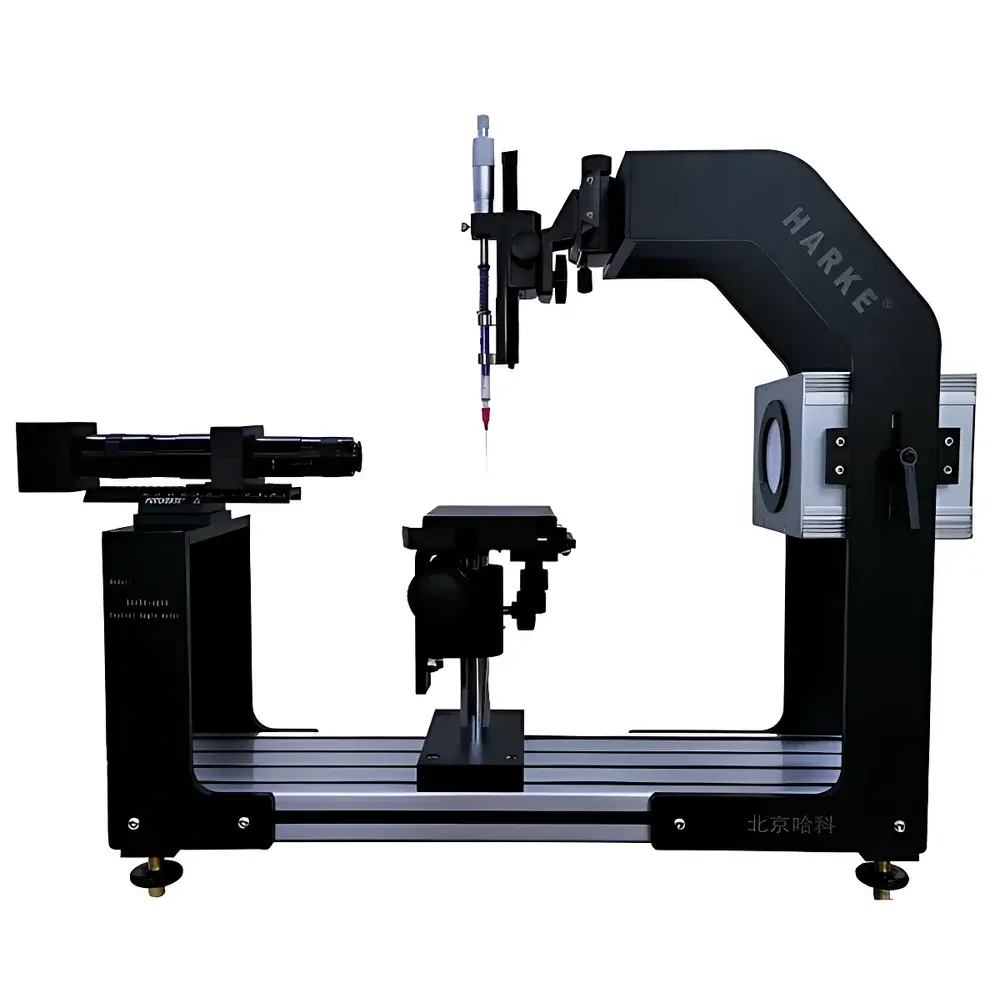
HARKE HARKE-10C Video-Based Optical Contact Angle Goniometer
| Brand | HARKE |
|---|---|
| Model | HARKE-10C |
| Origin | Beijing, China |
| Manufacturer Type | Direct Manufacturer |
| Instrument Category | Domestic |
| Instrument Type | Benchtop Dynamic Contact Angle Analyzer |
| Contact Angle Measurement Range | 0–180° |
| Contact Angle Accuracy | ±0.1° |
| Sample Stage Dimensions | 400 mm × 400 mm |
| Optical Magnification | 0.7× to 4.5× |
| Surface/Interfacial Tension Range | 0–1000 mN/m |
| Surface/Interfacial Tension Resolution | 0.01–2000 mN/m |
| Imaging System | USB 3.0 Camera, 30 fps (optional up to 1000 fps) |
| Software | SPCA 1.0 |
| Measurement Methods | Circle, Ellipse, Height-Width, Young-Laplace Fitting, and 5 additional algorithms |
| Droplet Dispensing Precision | ±0.1 mm |
| Vertical Lens Travel | 30 mm |
| Power Supply | 220 V, 3 A, 50 Hz |
| Weight | 30 kg |
| Footprint | 300 mm × 760 mm |
Overview
The HARKE HARKE-10C Video-Based Optical Contact Angle Goniometer is a benchtop, fully automated instrument engineered for high-reproducibility quantitative analysis of solid–liquid–gas interfacial phenomena. It operates on the principle of optical goniometry—capturing high-resolution side-view silhouettes of sessile, pendant, or captive droplets using a calibrated telecentric imaging system, followed by pixel-level contour extraction and geometric or physically constrained fitting (e.g., Young–Laplace equation). This enables precise determination of contact angle (θ), surface free energy (SFE), interfacial tension (IFT), adhesion work, wettability hysteresis, and dynamic wetting kinetics. Designed for ISO 19403-2 (contact angle), ISO 19403-3 (surface free energy), and ASTM D7334 (surface energy of polymer films) compliance, the HARKE-10C supports both static and dynamic measurement protocols—including advancing/receding angle acquisition via automated syringe displacement, tilting-stage-based roll-off angle quantification, and time-resolved absorption profiling over porous or fibrous substrates.
Key Features
- Benchtop modular architecture with rigid aluminum frame and vibration-damped optical baseplate for stable micro-scale imaging
- Motorized XYZ sample stage (400 mm × 400 mm active area) with ±0.1 mm repeatability and programmable positioning
- High-fidelity optical path: fixed-focus telecentric lens system with 0.7×–4.5× stepwise magnification and integrated coaxial LED illumination
- USB 3.0 monochrome CMOS camera (1920 × 1080 resolution) capable of 30 fps standard capture; optional high-speed modules support 100–1000 fps for rapid dynamic events
- Fully automated liquid dispensing unit with stepper-driven syringe pump, sub-microliter volume control, and real-time pressure feedback
- Integrated motorized tilt stage (±90° range, 0.01° angular resolution) for sliding angle, roll-off angle, and dynamic contact angle mapping
- SPCA 1.0 software suite with dual-mode operation: manual ROI selection and AI-assisted droplet boundary detection using edge-gradient thresholding
Sample Compatibility & Compliance
The HARKE-10C accommodates flat, curved, textured, and heterogeneous surfaces—including glass, silicon wafers, polymer films, metal foils, textiles, powders (via compressed pellet method), and superhydrophobic/superhydrophilic coatings. Its large sample stage permits full-wafer or multi-sample array evaluation without repositioning. The system complies with GLP documentation requirements through audit-trail-enabled software logging (user ID, timestamp, parameter set, raw image hash, and result metadata). All measurement algorithms are traceable to NIST-calibrated reference standards (e.g., diethylene glycol, water, ethylene glycol), and surface energy calculations follow Owens–Wendt–Rabel–Kaelble (OWRK) and Wu harmonic mean models per ISO 14210 and ASTM D7490. Optional accessories extend functionality to submerged captive bubble analysis, fiber contact angle measurement, and temperature-controlled environmental chamber integration (−10°C to 80°C).
Software & Data Management
SPCA 1.0 is a Windows-native application developed in accordance with FDA 21 CFR Part 11 principles for electronic records and signatures. It features role-based access control, encrypted project databases, and immutable result export in CSV, PDF, and TIFF formats with embedded EXIF metadata (camera settings, calibration coefficients, operator ID). Batch processing mode allows sequential analysis of up to 99 droplets per sample, with automatic outlier rejection based on user-defined confidence thresholds (e.g., contour fit R² > 0.995). Time-lapse modules generate θ(t) curves with synchronized video annotation, while surface energy reports include polar/dispersive component breakdowns, error propagation estimates, and comparative statistical overlays across multiple samples.
Applications
- Quality assurance of plasma-treated polymer surfaces in medical device manufacturing (ISO 10993-1)
- Optimization of anti-fouling coatings for semiconductor photomasks and display glass substrates
- Characterization of inkjet printability and droplet spreading dynamics on functionalized paper or PET film
- Surface cleanliness verification in aerospace component cleaning validation (ASTM D2651)
- Quantitative assessment of hydrophobic recovery in aged silicone elastomers
- Interfacial thermodynamics modeling of surfactant adsorption at oil–water interfaces
- Adhesion prediction for adhesive tape bonding strength via work-of-adhesion correlation
- Dynamic wettability screening of battery separator membranes under electrolyte immersion
FAQ
What measurement methods does the HARKE-10C support?
The instrument implements eight validated algorithms: circle fitting, ellipse fitting, height-width method, Young–Laplace curve fitting, tangent method, baseline correction, axisymmetric drop shape analysis (ADSA), and modified polynomial contour interpolation—all selectable per measurement protocol.
Can the system measure contact angles on rough or porous surfaces?
Yes—via captive bubble mode (with optional immersion cell) and time-resolved sessile drop absorption analysis; surface heterogeneity is assessed using local contact angle distribution histograms and standard deviation metrics.
Is the software compliant with regulatory data integrity requirements?
SPCA 1.0 includes electronic signature capability, audit trail generation, and secure database encryption aligned with 21 CFR Part 11 Annex 11 and EU GMP Annex 11 expectations.
What is the minimum resolvable contact angle increment?
The system achieves angular resolution of 0.01°, with measurement uncertainty of ±0.1° under ISO 19403-2 conditions (standard test liquids, ambient temperature stability ±0.5°C).
Does the HARKE-10C support interfacial tension measurement of liquid–liquid systems?
Yes—using pendant drop analysis for immiscible pairs (e.g., hexane/water, toluene/aqueous surfactant), with density input required for accurate Laplace-based calculation.



