
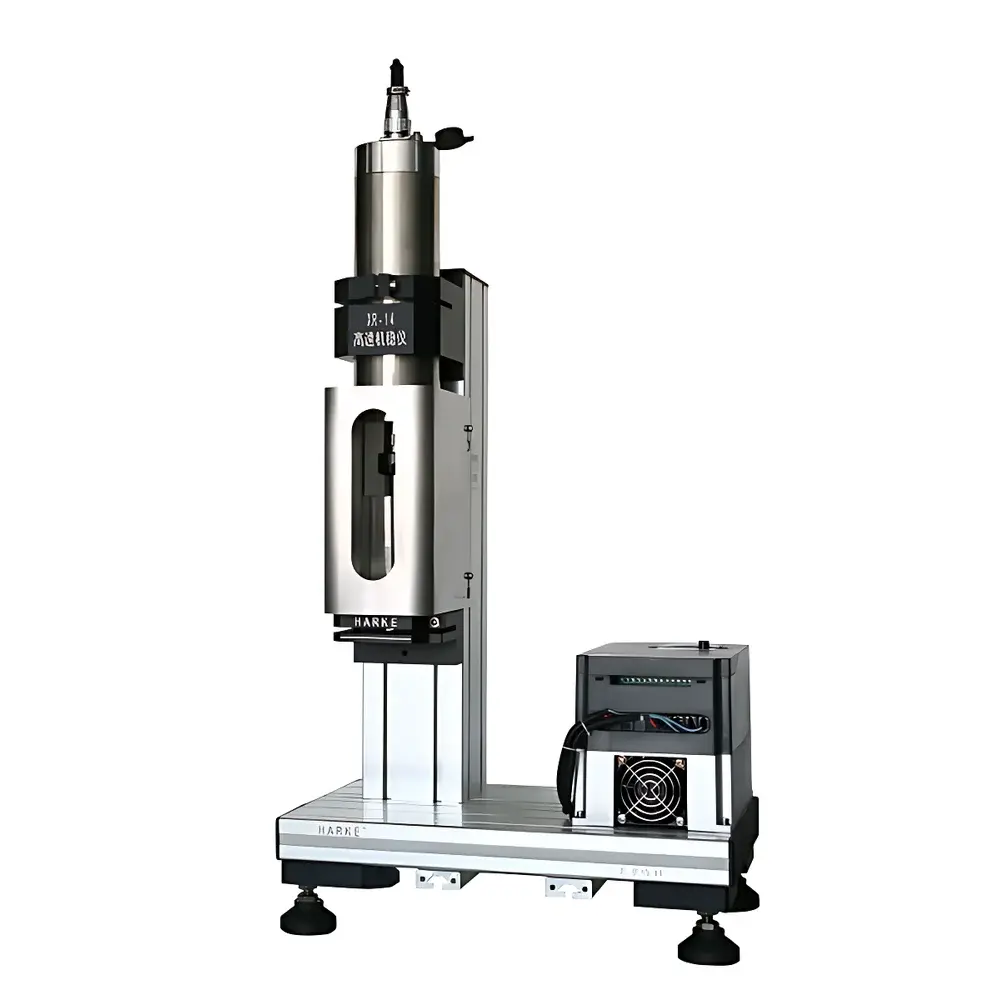
HARKE XR-14 High-Speed Mechanical Stability Tester for Latex
| Brand | HARKE |
|---|---|
| Model | XR-14 |
| Application | Mechanical stability testing of natural and synthetic latex |
| Compliance | ISO 2006 |
| Speed Range | 3,000–20,000 rpm (preset at 14,000 ± 200 rpm) |
| Speed Stability | ≤ ±100 rpm at 14,000 rpm |
| Stirring Disc Dimensions | Natural latex disc: Ø20.83 ± 0.03 mm × 1.57 ± 0.05 mm |
| Synthetic latex disc | Ø36.12 ± 0.03 mm × 1.58 ± 0.05 mm |
| Sample Container | ID 58 ± 0.25 mm × H 127 mm, wall thickness 2.5 mm |
| Disc-to-Bottom Distance | 13 ± 1 mm |
| Power Supply | 220 V ± 10%, 5 A |
| Operating Temperature | 10–40 °C |
| pH Compatibility | 1–14 |
| Cooling Option | Optional circulating water jacket (inlet/outlet ports provided) |
Overview
The HARKE XR-14 High-Speed Mechanical Stability Tester is an engineered solution for quantifying the colloidal stability of natural and synthetic latex dispersions under controlled high-shear conditions. It operates on the principle of standardized mechanical agitation—rotating a precision-machined metal disc within a defined geometry of latex sample to induce destabilization via hydrodynamic shear stress. The resulting coagulum formation, measured gravimetrically or turbidimetrically post-test per ISO 2006, serves as a direct indicator of formulation robustness, surfactant efficacy, and processing resilience. Designed specifically for R&D laboratories, quality control units, and raw material suppliers in the rubber and polymer industries, the XR-14 delivers repeatable, traceable, and method-compliant results essential for GLP-aligned product development and batch release.
Key Features
- High-fidelity speed control: Frequency-inverter-driven synchronous motor maintains setpoint accuracy within ±100 rpm at 14,000 rpm—critical for inter-laboratory reproducibility.
- Dual-disc configuration: Interchangeable stirring discs calibrated to ISO 2006 tolerances—Ø20.83 ± 0.03 mm × 1.57 ± 0.05 mm for natural rubber latex (NRL), and Ø36.12 ± 0.03 mm × 1.58 ± 0.05 mm for synthetic variants—ensuring geometric fidelity across test matrices.
- Precision sample containment: Cylindrical glass vessel with strict dimensional control (ID 58 ± 0.25 mm, height 127 mm, wall thickness 2.5 mm) and fixed disc-to-bottom clearance (13 ± 1 mm) minimizes boundary effects and ensures uniform shear field development.
- Thermal management interface: Dual quick-connect ports enable integration with external recirculating chillers—mandatory for extended-duration tests where motor surface temperature exceeds 60 °C.
- Operator safety architecture: Integrated polycarbonate guard with interlock detection prevents operation unless fully seated; mechanical lock-down system secures both container and shaft assembly to eliminate eccentric impact risk during 20,000 rpm operation.
- Electrical compliance: Designed to IEC 61000-4 electromagnetic compatibility standards; input power conditioning accommodates ±10% line voltage fluctuation without performance drift.
Sample Compatibility & Compliance
The XR-14 is validated for use with aqueous colloidal dispersions exhibiting pH 1–14, including ammonia-stabilized natural rubber latex, carboxylated styrene-butadiene rubber (XSBR), nitrile rubber (NBR), and chloroprene (CR) lattices. Its mechanical design and material selection—stainless steel shaft, anodized aluminum housing, and borosilicate glass vessel—resist chemical degradation from common latex additives (e.g., fatty acid soaps, nonionic surfactants, zinc oxide). The instrument conforms fully to ISO 2006:2018 “Rubber latex — Determination of mechanical stability”, including all geometric, rotational, and timing requirements. While not inherently 21 CFR Part 11 compliant, audit-ready operation is supported through manual logbook documentation aligned with ISO/IEC 17025 and ASTM D1076 practices.
Software & Data Management
The XR-14 operates as a standalone hardware platform with analog-digital hybrid control: a front-panel frequency inverter provides real-time rpm setpoint entry (3,000–20,000 rpm in 1-rpm increments), while LED-based speed feedback enables immediate verification against handheld tachometer readings. No embedded firmware or proprietary software is required—eliminating validation overhead for regulated environments. All operational parameters (set rpm, runtime, disc type, ambient temperature) are recorded manually in laboratory notebooks or LIMS-integrated electronic logs. For automated data capture, users may integrate third-party USB tachometers or optical sensors with time-stamped acquisition software compliant with FDA 21 CFR Part 11 Annex 11 requirements.
Applications
- Formulation screening: Comparative assessment of emulsifier systems, stabilizer packages, and antioxidant blends in synthetic latex synthesis.
- Batch consistency monitoring: Routine mechanical stability checks on incoming NRL shipments to detect premature aging or contamination-induced coagulation.
- Process optimization: Correlation of shear history (rpm × duration) with final film integrity in dipped goods manufacturing (gloves, catheters, balloons).
- Regulatory submission support: Generation of ISO 2006-compliant datasets for medical device raw material dossiers (ISO 10993-1, USP residual solvent assessments).
- Failure analysis: Root-cause investigation of coagulum formation during calendering or extrusion by simulating shear profiles in controlled benchtop conditions.
FAQ
What standards does the XR-14 comply with?
The instrument meets all physical and operational requirements specified in ISO 2006:2018 for mechanical stability testing of rubber latex.
Can the XR-14 be used for non-latex colloids?
While mechanically capable, its validation scope is limited to natural and synthetic rubber lattices per ISO 2006; application to other dispersions requires user-established correlation protocols.
Is calibration certification included?
HARKE provides factory-assembled verification reports confirming disc dimensions, container geometry, and speed stability at 14,000 rpm; third-party calibration services are available upon request.
How is speed accuracy verified during routine use?
Users must perform periodic verification using a Class 1 optical tachometer aligned with reflective tape applied to the drive shaft—per ISO 2006 Section 6.2.
Does the instrument support automated timing or data export?
No. Timing is controlled externally (stopwatch or programmable timer); data recording remains manual or LIMS-integrated to preserve audit trail integrity.





