
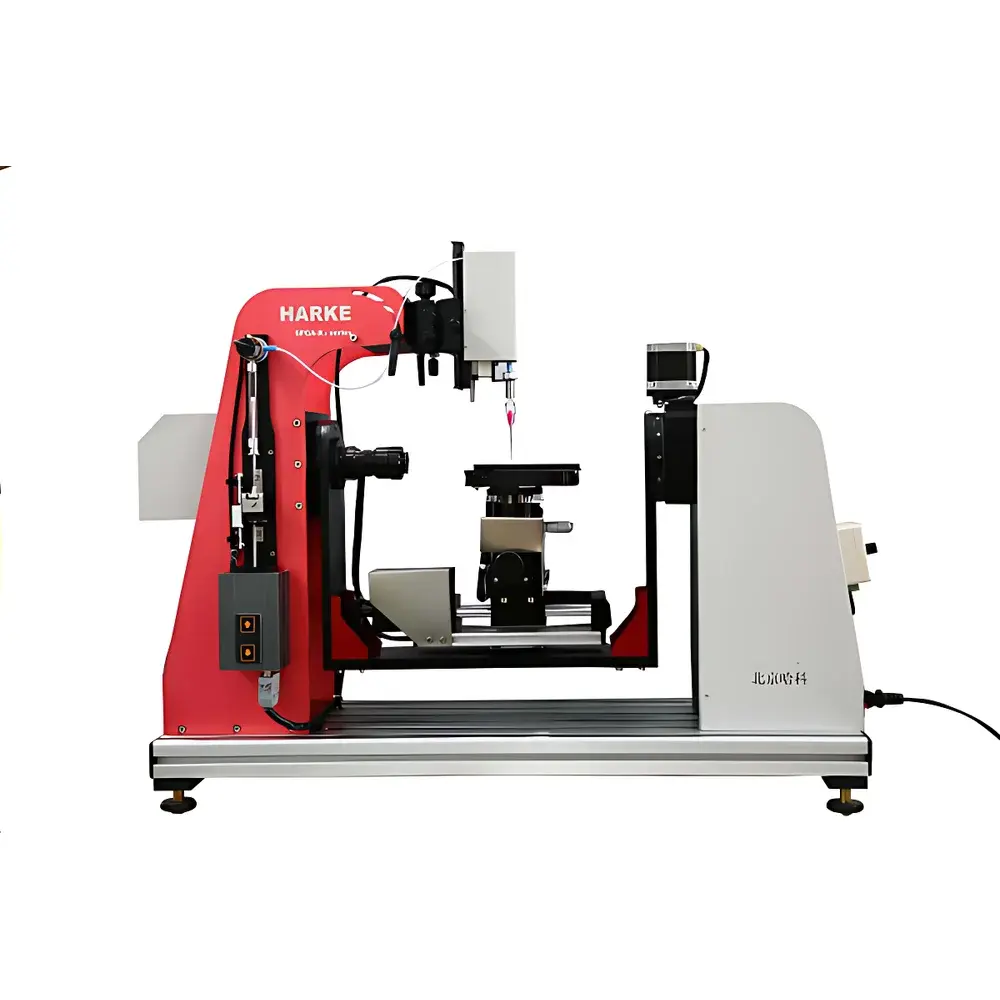
HARKE SPCA-X3 Dynamic Contact Angle Analyzer
| Brand | HARKE |
|---|---|
| Model | SPCA-X3 |
| Type | Benchtop Dynamic Contact Angle Analyzer |
| Contact Angle Range | 0–180° |
| Contact Angle Measurement Accuracy | ±0.1° |
| Contact Angle Display Resolution | ±0.01° |
| Sample Stage Dimensions | 100 mm × 120 mm |
| Optical Zoom | 0.7×–5× Fixed-Position Zoom Lens |
| Surface/Interfacial Tension Range | 0–1000 mN/m |
| Surface/Interfacial Tension Resolution | 0.01 mN/m |
| Video Capture | USB 3.0 Camera, 40 fps (optional: 100/300/1000+ fps) |
| Stage & Syringe Translation Precision | ±0.1 mm |
| Lens Vertical Travel | 30 mm |
| Instrument Dimensions | 300 mm × 760 mm (W × H) |
| Weight | 30 kg |
| Power Supply | 220 V, 3 A, 50 Hz |
| Operating Temperature | Ambient |
| Software | SPCA 1.0 |
| Measurement Methods | Circle, Ellipse, Height-Width, and 5 additional geometric fitting algorithms (total 8) |
| Supported Techniques | Sessile Drop, Captive Bubble, Immersion, Expansion–Contraction, Tilting Plate (Roll-off), Wilhelmy Plate (optional), Pendant Drop (for interfacial tension) |
Overview
The HARKE SPCA-X3 Dynamic Contact Angle Analyzer is a precision-engineered benchtop instrument designed for quantitative characterization of solid–liquid and liquid–liquid interfacial behavior under static and dynamic conditions. Based on high-resolution optical imaging and automated image analysis, the system implements the sessile drop, captive bubble, tilting plate (roll-off), and expansion–contraction methodologies to determine advancing, receding, and sliding contact angles—key parameters in wettability assessment, surface energy calculation, and interfacial thermodynamics. The instrument operates on the principle of digital silhouette edge detection, where real-time video capture (up to 1000 fps optional) enables time-resolved analysis of droplet shape evolution during controlled substrate motion or liquid volume modulation. Its modular architecture supports both routine QC testing and advanced research in colloid and interface science, compliant with standardized test protocols referenced in ISO 19403 (Contact angle measurement), ASTM D7490 (Contact angle of coatings), and GB/T 24368–2009 (Glass surface hydrophobic contaminant detection).
Key Features
- Benchtop design with rigid aluminum alloy frame and vibration-damped optical baseplate for high reproducibility in ambient lab environments
- Motorized XYZ translation stages with ±0.1 mm positioning repeatability for precise sample alignment and multi-point mapping
- 0.7×–5× fixed-position zoom lens with parfocal calibration ensures consistent magnification across measurement sequences without refocusing drift
- USB 3.0 high-speed camera (standard 40 fps; upgradeable to 100/300/1000+ fps) synchronized with automated syringe pump control for millisecond-scale dynamic event capture
- SPCA 1.0 software suite with eight built-in droplet contour fitting algorithms—including circle, ellipse, height-width, and Young–Laplace iterative fitting—for robust analysis across low- and high-contact-angle regimes
- Integrated Wilhelmy plate and pendant drop modules (optional) extend capability to surface/interfacial tension quantification from 0 to 1000 mN/m at 0.01 mN/m resolution
- Automated sequence scripting supports unattended operation: timed droplet deposition, stage tilt ramping, volume-controlled expansion/contraction cycles, and batch-wise data export
Sample Compatibility & Compliance
The SPCA-X3 accommodates flat, curved, porous, fibrous, and particulate substrates within its 100 mm × 120 mm stage area. Compatible samples include polymer films, metallic foils, ceramic tiles, paperboard, wood veneers, carbon fibers, and powder compacts (via compressed pellet method). Surface roughness up to Ra = 10 µm and sample thickness up to 30 mm are supported with adjustable lens travel (30 mm vertical range). All measurement workflows adhere to GLP documentation standards: audit trails record operator ID, timestamp, instrument configuration, raw image metadata, and algorithm selection. Data files comply with ASTM E2500–21 for instrument qualification and support FDA 21 CFR Part 11–compliant electronic signatures when deployed with validated networked deployment.
Software & Data Management
SPCA 1.0 is a Windows-based application engineered for traceable, repeatable interfacial analysis. It features dual-mode acquisition (single-shot and time-lapse), real-time contact angle trend plotting, and automated baseline correction for tilted or non-uniform substrates. Raw images are saved in lossless TIFF format with embedded EXIF metadata (exposure, gain, lens position, timestamp). Processed results—including θA, θR, Δθ, sliding angle, surface free energy components (Owens–Wendt, Wu, van Oss), and interfacial tension values—are exported in CSV, PDF, and XML formats compatible with LIMS and ELN systems. Software validation packages (IQ/OQ/PQ templates) and change control logs are provided for regulated environments.
Applications
- Quality control of hydrophobic/hydrophilic coatings in medical device manufacturing (e.g., catheter surface modification)
- Surface energy mapping of plasma-treated polymer films for adhesive bonding optimization
- Dynamic wettability screening of battery separator membranes under electrolyte immersion
- Colloidal stability prediction via contact angle hysteresis analysis of functionalized nanoparticles
- Wood pulp fiber surface chemistry evaluation for papermaking process refinement
- Carbon electrode wettability assessment in fuel cell R&D using expansion–contraction cycling
- Regulatory submission support for ISO 10993–biocompatibility surface characterization dossiers
FAQ
What contact angle methods does the SPCA-X3 support?
Sessile drop, captive bubble, immersion, tilting plate (roll-off), expansion–contraction, and optional Wilhelmy plate and pendant drop techniques.
Can the system calculate solid surface free energy?
Yes—using Owens–Wendt, Wu, or van Oss–Chaudhury–Good models, provided contact angle data from at least two probe liquids are input.
Is the software compliant with 21 CFR Part 11 requirements?
The SPCA 1.0 software supports electronic signatures, audit trail generation, and user access controls; full Part 11 compliance requires site-specific validation per your SOPs.
What is the minimum measurable contact angle hysteresis?
With standard 40 fps acquisition and ±0.1° measurement accuracy, hysteresis as low as 0.3° is reliably resolved under optimized lighting and substrate conditions.
Does the instrument support temperature-controlled measurements?
The base model operates at ambient temperature; environmental chamber integration (–20°C to +80°C) is available as a custom option with thermal-stage retrofit.



