
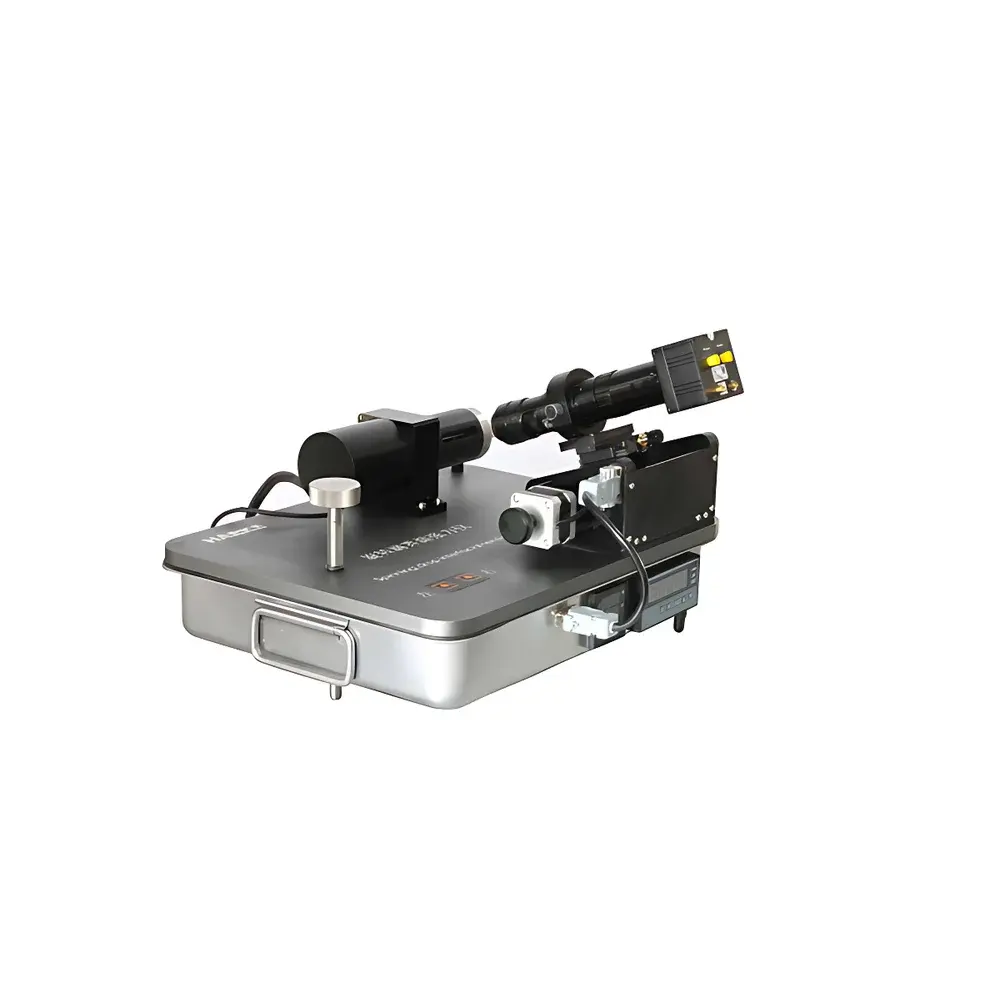
HARKE SFT-SP Advanced Rotational Drop Ultra-Low Interfacial Tensiometer
| Brand | HARKE |
|---|---|
| Origin | Beijing, China |
| Manufacturer Type | Direct Manufacturer |
| Country of Origin | China |
| Model | HARKE-SFT-SP |
| Measurement Range | 1×10⁻⁶ to 2×10³ mN/m |
| Resolution | 0.1 mN/m |
| Accuracy | ±1% F.S. |
| Temperature Control Range | Ambient to 70 °C |
| Temperature Display Range | 0–100 °C |
| Temperature Display Accuracy | ±0.1 °C |
| Optical System | 0.7×–5× Step Zoom Lens |
| Video Capture | High-Speed Digital Imaging with PC-Based Software Control |
| Sample Tube Inner Diameters | Φ2 mm and Φ6 mm |
| Lens Vertical Travel | 0–100 mm |
| Dimensions (W×D×H) | 420 × 320 × 260 mm |
| Weight | 15 kg |
| Power Supply | 220 V AC / 3 A / 50 Hz |
| Software | HARKE-SDT 1.0 |
| Measurement Method | Rotating Drop Method |
| Thermal Control Options | Peltier-assisted heating + optional external chiller integration |
Overview
The HARKE SFT-SP is an advanced rotational drop ultra-low interfacial tensiometer engineered for high-precision quantification of interfacial tension (IFT) between immiscible liquid phases—particularly oil/water, polymer melt/melt, or surfactant-laden systems—at values as low as 1×10⁻⁶ mN/m. Based on the rotating drop principle, the instrument measures IFT by analyzing the equilibrium shape deformation of a denser droplet suspended within a less-dense continuous phase under controlled centrifugal force. As rotational speed increases, the droplet elongates; its aspect ratio (length/diameter) is captured via real-time video imaging and correlated to interfacial tension using the scaled capillary number relationship derived from Young–Laplace equation solutions. This method eliminates gravitational distortion effects present in pendant/sessile drop techniques, enabling reliable sub-microN/m measurements essential for enhanced oil recovery (EOR), microemulsion formulation, nanoparticle-stabilized interfaces, and pharmaceutical emulsion development.
Key Features
- Ultra-low detection limit down to 1×10⁻⁶ mN/m, validated across multiple certified reference systems including n-decane/water and dodecane/brine with sodium dodecyl sulfate (SDS)
- Dual-calibrated sample tube configuration supporting both Φ2 mm and Φ6 mm inner diameters to accommodate viscosity-dependent droplet stability requirements
- Motorized, backlash-free vertical lens positioning system with 0–100 mm travel range and micrometer-level repeatability for optimal focus alignment across temperature gradients
- Integrated Peltier-based heating module delivering stable thermal control from ambient to 70 °C (±0.1 °C display resolution), with optional external recirculating chiller interface for sub-ambient operation
- High-speed CMOS camera (≥200 fps at full resolution) synchronized with motor encoder feedback for precise frame-triggered droplet morphology capture
- Rigid aluminum-alloy chassis and vibration-damped optical baseplate ensure mechanical stability during long-duration dynamic IFT monitoring (e.g., aging studies or temperature ramps)
Sample Compatibility & Compliance
The HARKE SFT-SP accommodates a broad spectrum of fluid pairs—including hydrocarbon/water, silicone oil/aqueous electrolyte, molten polymer blends, and ionic liquid systems—provided density contrast exceeds ~0.05 g/cm³ and kinematic viscosity remains below 1000 cSt at test temperature. Sample tubes are constructed from borosilicate glass with precision-ground ends to minimize meniscus-induced aberrations. The system complies with ASTM D971 (Standard Test Method for Interfacial Tension of Oil Against Water by the Ring Method—used for method correlation), ISO 6295 (Petroleum products — Determination of interfacial tension — Du Noüy ring method), and supports traceable calibration per ISO/IEC 17025 requirements when operated with NIST-traceable standards. Data acquisition and parameter logging meet GLP documentation expectations, with audit trail functionality available in HARKE-SDT 1.0 software for regulated environments.
Software & Data Management
HARKE-SDT 1.0 is a Windows-native application providing full instrument orchestration: motor speed ramping, temperature setpoint scheduling, auto-focus sequencing, and real-time droplet contour fitting using edge-detection algorithms based on Canny and active contour models. All raw video frames, processed images, and numerical outputs (IFT, droplet dimensions, rotation rate, temperature) are timestamped and saved in HDF5 format for interoperability with MATLAB, Python (h5py), and LabVIEW. Export options include CSV, PDF reports with embedded metadata (operator ID, calibration certificate ID, environmental conditions), and XML files compliant with ASTM E1447 data exchange standards. Software supports 21 CFR Part 11-compliant user access levels (administrator, technician, reviewer) with electronic signature capability and immutable audit logs.
Applications
- Screening of ultralow-IFT surfactants for chemical EOR applications, including alkali-surfactant-polymer (ASP) floods
- Stability assessment of Pickering emulsions stabilized by silica, cellulose nanocrystals, or MXenes
- Interfacial rheology precursor analysis for soft matter systems where dilatational modulus correlates with IFT kinetics
- Quality control of specialty lubricants, transformer oils, and fluorinated heat-transfer fluids
- Fundamental studies of temperature- and concentration-dependent IFT in deep eutectic solvents (DES) and switchable polarity solvents
- Validation of molecular dynamics (MD) simulations predicting interfacial free energy at atomistic resolution
FAQ
What is the minimum measurable interfacial tension value, and under what conditions is it achievable?
The instrument achieves 1×10⁻⁶ mN/m under optimized conditions: Φ2 mm tube, low-viscosity oil phase (e.g., n-decane), aqueous phase with high ionic strength (>1 M NaCl), rotational speeds >8000 rpm, and temperature stabilization within ±0.05 °C.
Can the system be used for dynamic interfacial tension measurements?
Yes—by programming time-resolved rotational speed and temperature profiles, the HARKE SFT-SP captures IFT evolution over minutes to hours, enabling adsorption kinetic modeling (e.g., Ward–Tordai analysis) for surfactant systems.
Is third-party software integration supported?
HARKE-SDT 1.0 provides a documented COM API and TCP/IP socket interface for integration with LIMS, MES, or custom Python-based automation frameworks.
How is calibration verified and maintained?
Calibration is performed using certified standard fluids (e.g., diethyl ether/water at 20 °C, IFT = 1.72 mN/m) and validated annually against NIST SRM 851. Gravimetric verification of rotational speed uses a calibrated optical tachometer traceable to NPL.
Does the instrument support automated cleaning protocols between samples?
While no built-in fluidic wash station is included, the software allows scripting of sequential purge cycles using external syringe pumps connected via digital I/O, facilitating unattended multi-sample workflows.



