
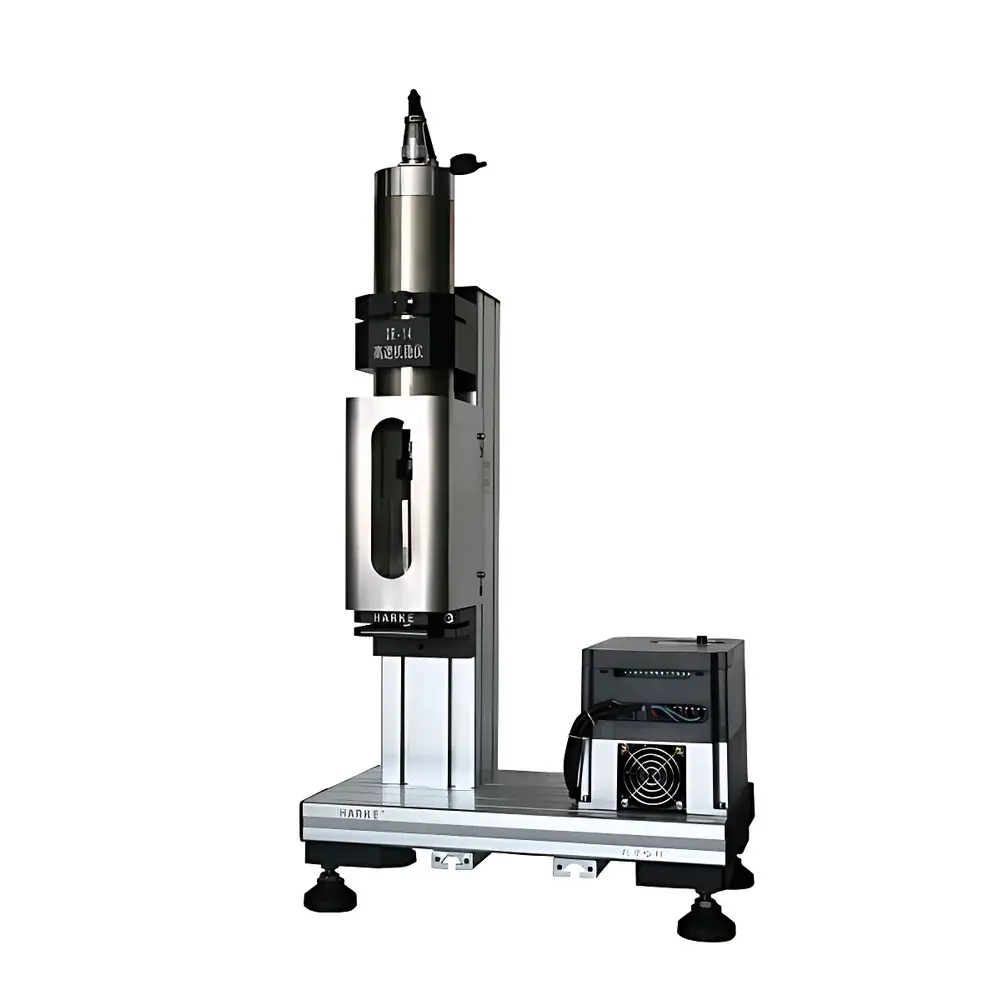
HARKE XR-14GT High-Speed Mechanical Stability Tester for Latex
| Brand | HARKE |
|---|---|
| Origin | Beijing, China |
| Manufacturer Type | Direct Manufacturer |
| Product Origin | Domestic (China) |
| Model | XR-14GT |
| Pricing | Upon Request |
| Speed Range | 3,000–20,000 rpm |
| Speed Stability at 14,000 rpm | ±100 rpm |
| Stirring Disk Dimensions (Natural Latex) | Ø20.83 ±0.03 mm × 1.57 ±0.05 mm |
| Stirring Disk Dimensions (Synthetic Latex) | Ø36.12 ±0.03 mm × 1.58 ±0.05 mm |
| Sample Container | Height 127 mm, ID 58 ±0.25 mm, Wall Thickness 2.5 mm |
| Disk-to-Bottom Distance | 13 ±1 mm |
| Operating Voltage | 220 V ±10%, 5 A |
| Ambient Temperature Range | 10–40 °C |
| Compatible Media | Natural or synthetic latex, pH 1–14 |
| Cooling Option | Circulating water cooling (optional, activated at ≥60 °C component temperature) |
Overview
The HARKE XR-14GT High-Speed Mechanical Stability Tester is a precision-engineered instrument designed specifically for evaluating the mechanical stability of natural and synthetic latex dispersions under standardized high-shear conditions. It operates on the principle of controlled high-speed rotational agitation—where a motor-driven stirring disk applies consistent tangential shear stress to a defined volume of latex within a calibrated cylindrical container. The time-dependent formation of coagulum (visible curd or gel particles) is quantified per ISO 2006, enabling laboratories to assess colloidal integrity, surfactant efficacy, and formulation robustness. Unlike generic mixers or homogenizers, the XR-14GT delivers traceable, repeatable shear input through its synchronous high-speed motor and frequency-controlled drive system—ensuring compliance with international test protocols used in rubber compound development, quality control, and raw material certification.
Key Features
- High-precision variable-frequency drive enabling continuous speed adjustment from 3,000 to 20,000 rpm—with factory-calibrated stability of ±100 rpm at the standard test speed of 14,000 rpm.
- Dual-configurable stainless-steel stirring disks: one optimized for natural latex (Ø20.83 ±0.03 mm, thickness 1.57 ±0.05 mm), another for synthetic latex (Ø36.12 ±0.03 mm, thickness 1.58 ±0.05 mm), both manufactured to ISO 2006 dimensional tolerances.
- Rigid, vibration-damped base frame with vertically adjustable sample holder—precisely positioning the disk 13 ±1 mm above the container bottom to ensure reproducible hydrodynamic shear geometry.
- Integrated circulating water cooling interface (inlet/outlet ports on motor housing) for thermal management during extended operation; automatically engaged when internal motor components reach ≥60 °C.
- Real-time digital speed display with intuitive rotary encoder control; preconfigured default frequency output (~234 Hz ≈ 14,000 rpm) aligned with ISO 2006 requirements.
- Low-noise synchronous motor architecture delivering long service life, minimal torque ripple, and high rotational repeatability across repeated test cycles.
Sample Compatibility & Compliance
The XR-14GT is validated for use with aqueous latex systems across the full pH range (1–14), including ammonia-stabilized natural rubber latex (NRL), carboxylated styrene-butadiene rubber (XSBR), nitrile rubber (NBR), and acrylic emulsions. Its sample container (ID 58 ±0.25 mm, height 127 mm, wall thickness 2.5 mm) conforms dimensionally and materially to ISO 2006 Annex A specifications. All mechanical interfaces—including disk mounting, shaft clamping, and container fixation—are engineered to eliminate runout, wobble, or axial displacement that could introduce non-uniform shear fields. The instrument supports GLP-compliant workflows: speed calibration records, operator logs, and environmental monitoring (ambient temperature 10–40 °C) are integral to method execution per ISO 2006 Clause 6. While not inherently 21 CFR Part 11 compliant, its analog/digital hybrid control architecture permits integration with external audit-trail-capable data acquisition systems.
Software & Data Management
The XR-14GT operates via embedded hardware controls without proprietary software dependency—ensuring operational simplicity and long-term maintenance feasibility. Speed setpoints, runtime duration, and motor status are managed directly through the front-panel frequency inverter interface. For traceable documentation, users are advised to record: start/stop timestamps, measured rpm (verified using an external contactless tachometer against reflective tape on the shaft), ambient temperature, and coagulum assessment results per ISO 2006 Section 8. Optional integration with laboratory information management systems (LIMS) is achievable via RS-232 or analog voltage output (0–10 V) for rpm feedback. All calibration parameters—including disk geometry verification, container dimensional checks, and speed validation—must be documented per internal SOPs aligned with ISO/IEC 17025 clause 6.5.
Applications
- Quality assurance of incoming natural rubber latex concentrate in glove manufacturing facilities.
- Formulation screening for synthetic latex stabilizers, dispersants, and pH buffers in adhesive and coating R&D.
- Batch release testing for medical-grade NRL products where mechanical stability correlates with protein denaturation risk.
- Accelerated aging studies assessing colloidal degradation under high-shear stress over time.
- Supplier qualification audits requiring ISO 2006–compliant mechanical stability data as part of technical specifications.
- Root cause analysis of coagulum formation in downstream processing (e.g., dipping, foaming, or casting operations).
FAQ
What standards does the XR-14GT comply with?
It fully meets the mechanical and dimensional requirements of ISO 2006 “Rubber latex — Determination of mechanical stability” for both natural and synthetic latex types.
Can the instrument be used outside the 14,000 rpm nominal test speed?
Yes—its 3,000–20,000 rpm range supports method development, comparative shear studies, and non-standard protocol adaptation, provided user-defined procedures are scientifically justified and documented.
Is the stirring disk interchangeable between natural and synthetic latex tests?
No—each disk type is geometrically distinct and must be selected and installed per ISO 2006 Annex A; cross-use invalidates test compliance.
How is speed accuracy verified during routine operation?
Using a calibrated non-contact tachometer aimed at the reflective tape affixed to the stirrer shaft; deviation beyond ±200 rpm at 14,000 rpm requires inverter frequency recalibration per Section 5.5 of the operating manual.
Does the instrument require external cooling water by default?
No—circulating water cooling is optional and only recommended for continuous operation exceeding 30 minutes or when motor surface temperature exceeds 60 °C, as indicated by thermal monitoring.
What maintenance is required to sustain ISO 2006 conformance?
Monthly verification of disk dimensions (micrometer), container inner diameter (caliper), disk-to-bottom distance (depth gauge), and speed stability (tachometer); annual calibration of the inverter’s frequency-to-rpm mapping traceable to national metrology standards.
Related Products





