
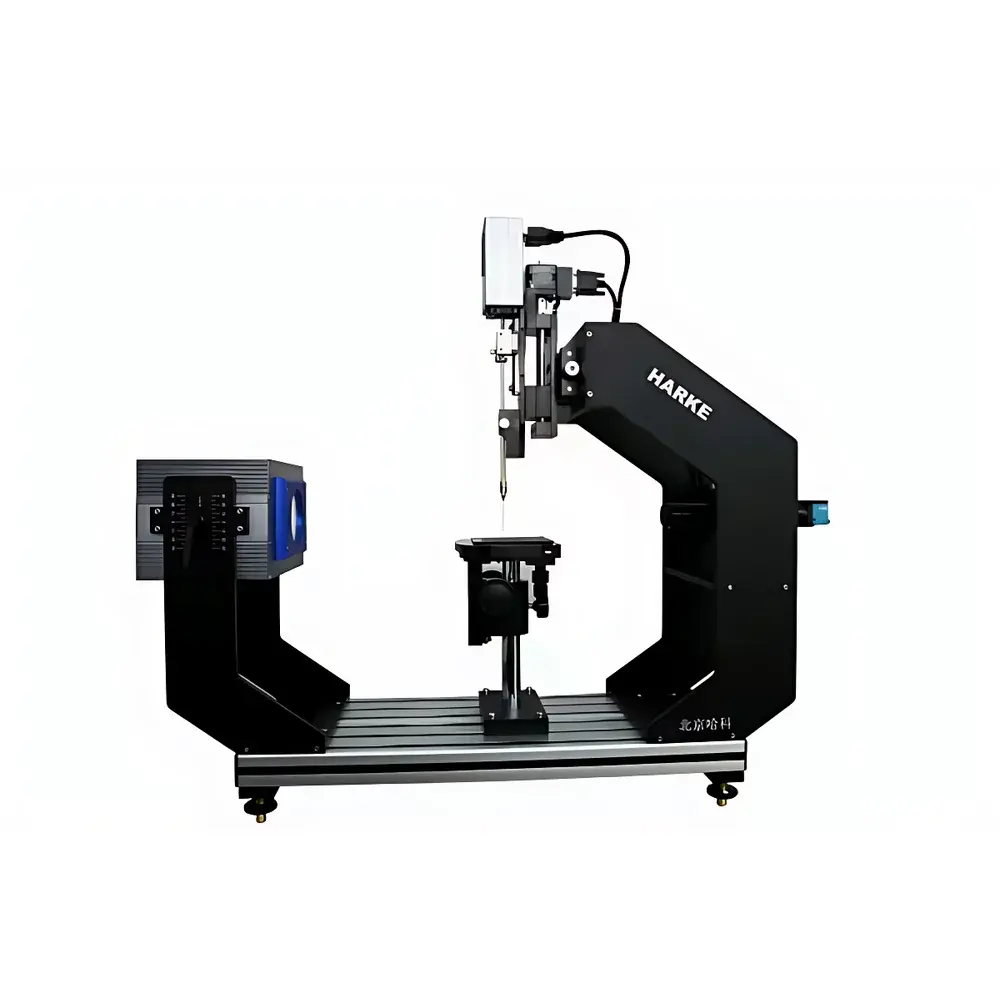
HARKE HARKE-SPCAX3 Video-Based Optical Contact Angle Analyzer
| Brand | HARKE |
|---|---|
| Model | HARKE-SPCAX3 |
| Origin | Beijing, China |
| Manufacturer Type | Direct Manufacturer |
| Instrument Category | Domestic |
| Instrument Type | Benchtop Laboratory System |
| Contact Angle Measurement Range | 0–180° |
| Contact Angle Accuracy | ±0.1° |
| Fixed Sample Stage Dimensions | 120 mm × 120 mm |
| Optical Magnification | 0.7×–4.7× |
| Surface/Interfacial Tension Range | 0–1000 mN/m |
| Surface/Interfacial Tension Accuracy | ±0.1 mN/m |
| Measurement Methods | Sessile Drop, Tilting Plate (Roll-off), Immersion (Fiber/Sheet), Captive Bubble |
| Analysis Algorithms | Tangent, Circle, Ellipse, Local Profile Fitting, Full Profile Fitting, Young–Laplace Fitting, Dynamic Tracking, Curve Ruler Method |
| Surface Energy Calculation Models | Zisman, Fowkes, Owens–Wendt–Rabel–Kaelble (OWRK) |
| Imaging System | High-Resolution CMOS Camera with Real-Time Recording & Frame Capture |
| Motorized Precision Dispensing | 1000 µL Range, ±0.1 µL Resolution |
| Manual Syringe Module | 2 mL Range, ±0.1 µL Resolution |
| Stage Motion | Vertical (Auto: 0–30 mm |
| Manual | 0–80 mm), Horizontal X/Y (50 mm / 30 mm), Extended Translation (150 mm Front–Back) |
| Integrated Heating Stage | Optional |
| Max Sample Thickness | 80 mm |
| Overall Dimensions | 230 mm (W) × 640 mm (D) × 750 mm (H) |
Overview
The HARKE HARKE-SPCAX3 is a high-precision, benchtop video-based optical contact angle analyzer engineered for rigorous surface and interfacial characterization in academic research laboratories, quality control environments, and materials development facilities. It operates on the principle of digital image capture and geometric analysis of liquid–solid–vapor interfaces, enabling quantitative determination of static and dynamic contact angles, surface free energy components, and interfacial tension via sessile drop, tilting plate, immersion, and captive bubble methodologies. Designed to meet the metrological demands of ISO 19403 (Contact angle measurement — Part 1–4), ASTM D7334 (Standard Practice for Surface Wettability of Coated Surfaces), and GB/T 24368–2009 (Glass surface hydrophobic contaminant detection using contact angle method), the instrument supports traceable, repeatable measurements under controlled environmental conditions. Its modular architecture integrates a motorized precision dispensing system, a parfocal zoom microscope (0.7×–4.7×), and a high-frame-rate CMOS camera capable of real-time video acquisition, frame-by-frame playback, and timestamped snapshot export—ensuring full experimental reproducibility and audit readiness.
Key Features
- High-resolution optical imaging system with parfocal continuous zoom lens (0.7×–4.7×) and auto-focus stabilization for consistent droplet morphology capture across magnifications
- Motorized microdispensing module with 1000 µL capacity and ±0.1 µL volumetric resolution, enabling precise, repeatable droplet deposition for dynamic contact angle profiling
- Dual-mode stage control: automated vertical translation (0–30 mm) combined with manual fine-adjustment (0–80 mm), plus extended front–back translation (150 mm) for large or irregularly shaped samples
- Comprehensive analytical suite supporting eight distinct contact angle fitting algorithms—including Young–Laplace curve fitting and full-profile dynamic tracking—to accommodate heterogeneous, rough, or chemically patterned surfaces
- Integrated surface energy calculation engine implementing Zisman, Fowkes, and OWRK models, with built-in database of standard probe liquids and automatic interfacial tension input validation
- Software-controlled heating stage option (not included by default) for temperature-dependent wettability studies compliant with ISO 21367 protocols
Sample Compatibility & Compliance
The HARKE-SPCAX3 accommodates substrates up to 100 mm wide × 80 mm thick, including rigid plates, flexible films, fibers, porous membranes, and coated or textured surfaces. Its open-stage design permits direct integration with external environmental chambers (e.g., humidity-controlled enclosures or gloveboxes) for in situ wettability assessment. The system conforms to GLP and GMP documentation requirements through time-stamped metadata embedding, user-access logging, and electronic signature support. All measurement data files retain embedded calibration parameters, environmental timestamps, and operator identifiers—ensuring full traceability per FDA 21 CFR Part 11 and ISO/IEC 17025 guidelines. As a contributor to GB/T 24368–2009, HARKE’s firmware and reporting templates are preconfigured to generate compliant test records for regulatory submissions in China and ASEAN markets.
Software & Data Management
The proprietary HARKE AnalyzeSuite™ software provides a unified interface for instrument control, real-time visualization, batch processing, and report generation. It supports dual-mode image handling: manual point-and-click annotation for rapid QA/QC checks, and fully automated edge detection with adaptive thresholding for high-throughput screening. All captured videos and still frames are stored in vendor-neutral TIFF and MP4 formats, with embedded EXIF metadata (exposure time, magnification, stage coordinates, ambient temperature/humidity if sensor-integrated). Export options include CSV for statistical analysis in MATLAB or Python, PDF reports with customizable headers and compliance footers, and XML datasets compatible with LIMS integration. Audit trails record every parameter change, image reprocessing event, and user login—retained for ≥36 months unless purged per institutional retention policy.
Applications
- Surface treatment validation for plasma-, corona-, or chemical functionalization of polymers and metals
- Hydrophobicity/hydrophilicity mapping of biomedical coatings, filtration membranes, and self-cleaning surfaces
- Adhesion prediction modeling via work of adhesion and spreading coefficient calculations
- Quality assurance of printed electronics, anti-fog films, and inkjet-receptive substrates
- Dynamic wetting behavior analysis during coating, dipping, or spray processes
- Interfacial tension quantification for surfactant formulation optimization in pharmaceutical emulsions and agrochemical suspensions
FAQ
What contact angle methods does the HARKE-SPCAX3 support?
It supports sessile drop, tilting plate (roll-off), immersion (for fibers and sheets), and captive bubble methods—making it one of the few commercially available systems offering all four standardized techniques.
Is the software compliant with 21 CFR Part 11?
Yes. HARKE AnalyzeSuite™ includes electronic signature capability, role-based access control, immutable audit trails, and data integrity safeguards required for regulated environments.
Can the system measure surface energy of low-energy surfaces like PTFE?
Yes. The integrated OWRK model, combined with high-precision contact angle data (<±0.1°) and multi-liquid selection, enables robust surface energy decomposition even for fluorinated and silicone-based substrates.
What is the maximum sample thickness supported?
The standard configuration accommodates samples up to 80 mm in thickness. Optional stage extensions or custom mounting fixtures can be configured upon request.
Does the instrument require external calibration standards?
No. The system includes factory-calibrated reference geometry patterns and certified goniometric standards traceable to NIM (National Institute of Metrology, China). User recalibration is optional and guided by on-screen wizard.



