
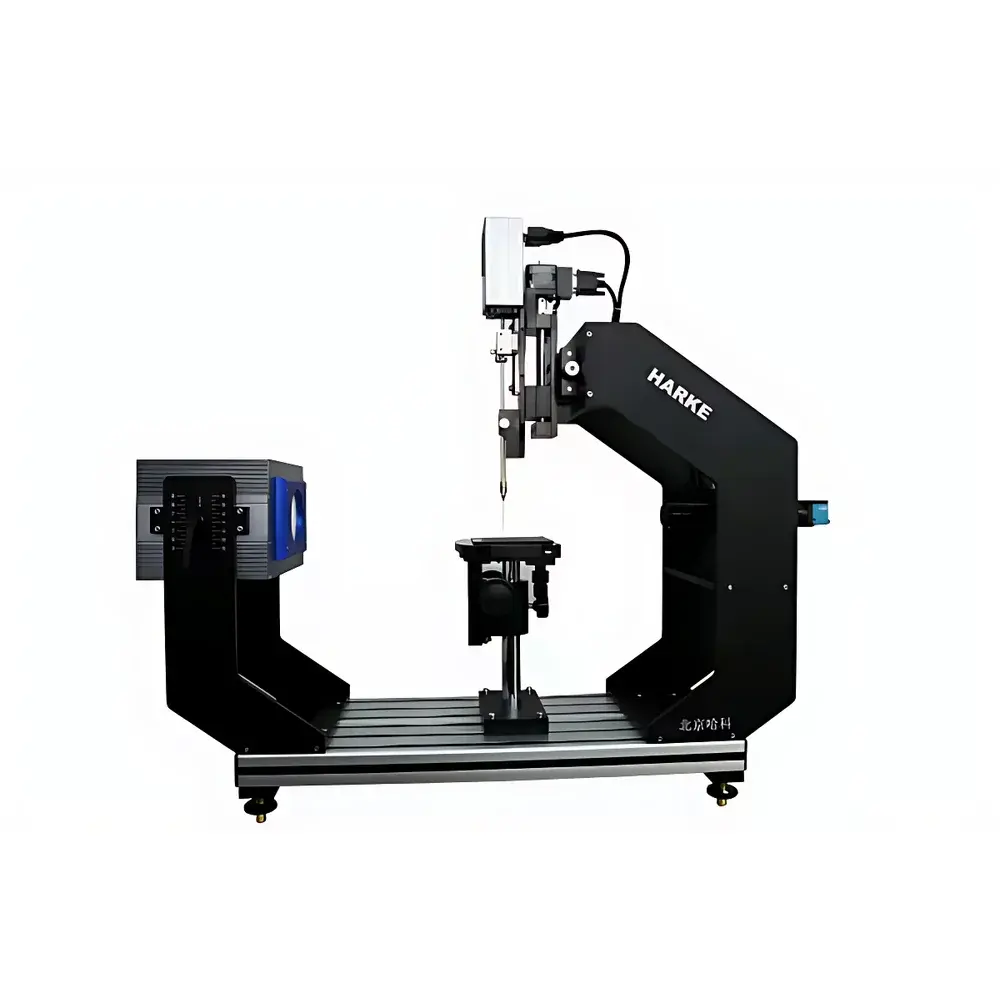
HARKE SPCA-Z Video-Based Contact Angle Analyzer for Fibrous Materials
| Brand | HARKE |
|---|---|
| Model | SPCA-Z |
| Type | Benchtop Video Optical Contact Angle Meter |
| Contact Angle Range | 0–180° |
| Contact Angle Accuracy | ±0.5° |
| Stage Dimensions | 100 mm × 120 mm |
| Optical Magnification | 0.7×–4.5× |
| Surface/Interfacial Tension Range | 0–1000 mN/m |
| Surface/Interfacial Tension Resolution | 0.01 mN/m |
| Imaging Frame Rate | Up to 1000 fps (configurable via USB 3.0 camera) |
| Software | SPCA 1.0 |
| Measurement Methods | Circle, Ellipse, Height-Width, and 5 additional geometric fitting algorithms |
| Sample Stage Positioning Accuracy | ±0.1 mm |
| Syringe Dispenser Travel | 30 mm |
| Lens Vertical Travel | 30 mm |
| Power Supply | 220 V, 3 A, 50 Hz |
| Operating Temperature | Ambient |
Overview
The HARKE SPCA-Z is a benchtop video-based optical contact angle analyzer specifically engineered for quantitative wettability characterization of fibrous and porous substrates—including natural fibers (e.g., cotton, wool), synthetic filaments (e.g., polyester, nylon), nonwovens, and fiber-reinforced composites. It operates on the principle of sessile drop analysis, where high-resolution side-view imaging captures the liquid–solid–vapor triple-phase boundary, enabling precise geometric fitting of the droplet profile to determine the static, advancing, or receding contact angle (θ). The system further supports dynamic interfacial tension quantification via pendant drop analysis, leveraging Young–Laplace equation fitting for surface and interfacial tension (γ) calculation across a broad range (0–1000 mN/m). Designed for laboratory environments requiring ISO/IEC 17025-aligned measurement traceability, the SPCA-Z delivers repeatable, operator-independent results essential for R&D, quality control, and regulatory documentation in textile science, biomaterials, filtration media, and functional coating development.
Key Features
- Benchtop modular architecture with rigid aluminum frame and vibration-damped optical baseplate for stable imaging under ambient lab conditions.
- Motorized precision XYZ stage with ±0.1 mm repeatability, supporting automated multi-point contact angle mapping across heterogeneous fiber mats or woven structures.
- Optically calibrated zoom lens system (0.7×–4.5×) with fixed magnification steps ensures consistent pixel-to-length calibration—critical for sub-degree angular resolution and reliable edge detection on low-contrast fiber surfaces.
- High-speed USB 3.0 monochrome CMOS camera (standard 30 fps; optional up to 1000 fps) enables time-resolved wetting kinetics analysis, including absorption rate quantification in capillary-active fiber bundles.
- Integrated syringe pump with 30 mm vertical travel and programmable dispensing control (volume step resolution ≤0.1 µL) for reproducible droplet deposition on irregular topographies.
- SPCA 1.0 software compliant with ALCOA+ data integrity principles: full audit trail, electronic signatures, user role management, and raw image + metadata archiving per FDA 21 CFR Part 11 requirements.
Sample Compatibility & Compliance
The SPCA-Z accommodates flat, curved, or loosely packed fibrous specimens up to 100 mm × 120 mm and 30 mm in height. Its adjustable sample stage and extended lens travel allow direct measurement on yarns, knitted fabrics, electrospun membranes, and fiber filters without sectioning or mounting artifacts. The system supports ASTM D7334 (Standard Practice for Surface Wettability of Coated Fabrics), ISO 27448 (Photocatalytic activity of surfaces), and GB/T 30129–2013 (Chinese standard for textile hydrophobicity evaluation). All measurement protocols are fully documented and configurable to meet GLP/GMP validation requirements for regulated industries.
Software & Data Management
SPCA 1.0 provides eight validated droplet contour fitting algorithms—including circle, ellipse, height-width, Young–Laplace, and polynomial-based spline fitting—to accommodate asymmetric drops on anisotropic fiber arrays. Batch processing mode enables statistical reporting (mean θ, SD, CV%) across ≥50 independent measurements. Export formats include CSV (with timestamp, image path, and raw pixel coordinates), TIFF (lossless 12-bit images), and PDF reports embedding annotated images, measurement logs, and instrument configuration history. Data storage follows ICH M7 and ISO 13485-compliant folder structures for audit readiness.
Applications
- Quantifying hydrophobicity/hydrophilicity of functionalized textile fibers post-plasma treatment or fluoropolymer finishing.
- Evaluating capillary rise dynamics in absorbent hygiene materials (e.g., SAP-containing nonwovens).
- Characterizing interfacial compatibility between resin matrices and carbon/glass fibers in composite pre-pregs.
- Validating anti-fouling performance of nanocoated filtration membranes via contact angle hysteresis (Δθ = θadv – θrec) analysis.
- Supporting USP and Ph. Eur. 2.9.36 methods for surface energy assessment of medical device packaging substrates.
FAQ
What sample preparation is required for fibrous materials?
Minimal preparation is needed: specimens must be flat-mounted on the stage without stretching or compression; loose fibers may be lightly tacked using conductive carbon tape to prevent displacement during dispensing.
Can the system measure contact angles on single filaments?
Yes—using high-magnification mode (4.5×) and micro-syringe (1 µL tip), static contact angles can be resolved on individual filaments ≥10 µm in diameter, provided sufficient contrast between filament and background.
Is temperature control integrated?
No built-in thermal chamber; however, the instrument is compatible with external environmental chambers (–20 °C to 80 °C) via standardized mounting interfaces and synchronized trigger I/O.
How is calibration verified?
Certified reference standards (e.g., NIST-traceable glass slides with known θ = 60° ± 0.3° and 110° ± 0.5°) are included; SPCA 1.0 auto-generates calibration verification reports with uncertainty budgets.
Does the software support GMP-compliant reporting?
Yes—SPCA 1.0 includes 21 CFR Part 11-compliant electronic signatures, immutable audit trails, and IQ/OQ documentation templates aligned with Annex 11 and EU GMP guidelines.
Related Products



