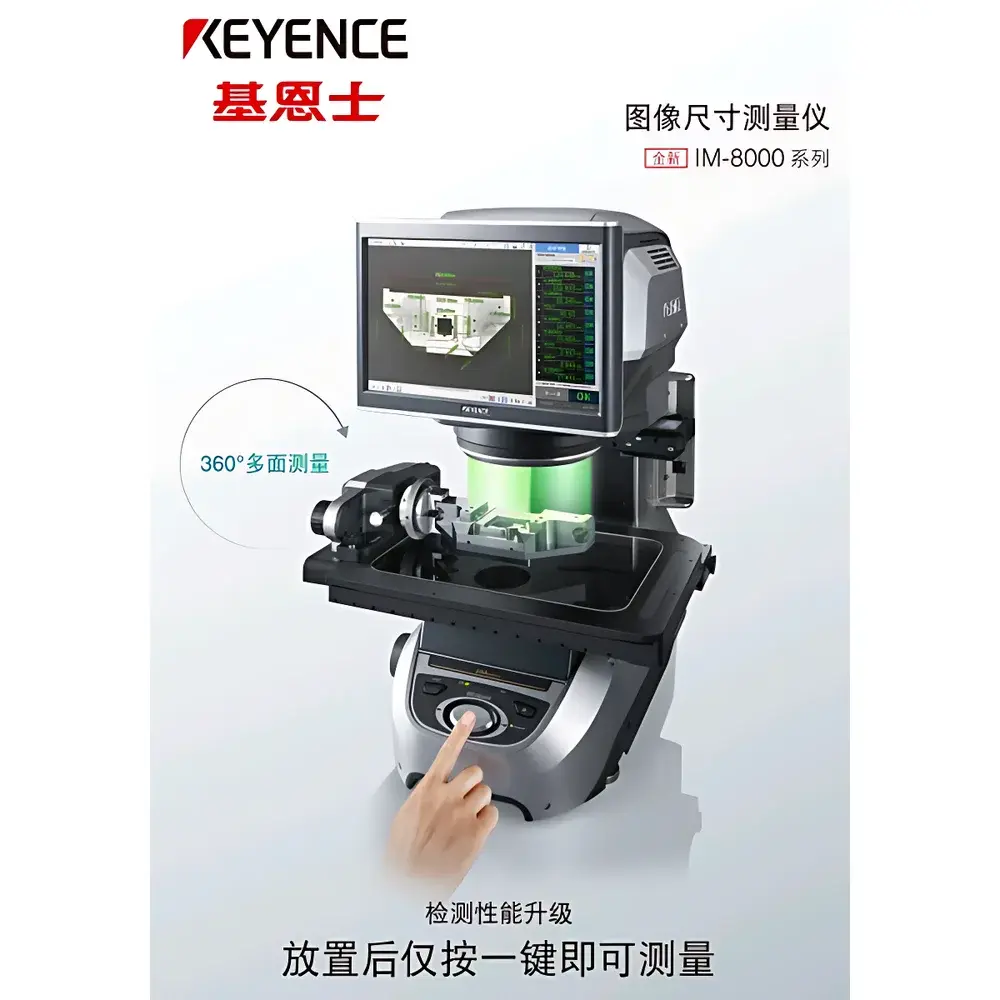
KEYENCE IM-8000 One-Touch High-Precision Image Measuring System
| Brand | KEYENCE |
|---|---|
| Origin | Japan |
| Manufacturer Type | Original Equipment Manufacturer (OEM) |
| Import Status | Imported |
| Model | IM-8000 |
| Operation Mode | Fully Automatic |
| Measurement Area | 300 mm × 200 mm |
| Measurement Accuracy | ±2–3.9 µm |
| Encoder Resolution | 0.1 µm |
| Measurement Speed | Up to 300 dimensions per second |
| Camera | 20 MP Monochrome CMOS Sensor |
| Illumination Sources | Backlight (contour), Top Ring Light, Bottom Ring Light, Slit Ring Light |
Overview
The KEYENCE IM-8000 is a fully automated, high-precision image measuring system engineered for rapid, repeatable geometric metrology in production and quality control environments. Unlike traditional coordinate measuring machines (CMMs) or manual optical comparators, the IM-8000 employs telecentric lens optics combined with high-resolution monochrome imaging and multi-directional programmable illumination to capture distortion-free, edge-sharp silhouettes of parts placed on its stage. Its measurement principle relies on sub-pixel edge detection algorithms applied to calibrated grayscale images—enabling non-contact, two-dimensional dimensional analysis without mechanical probing or operator interpretation. Designed for integration into high-mix, high-volume manufacturing lines—including automotive, electronics, medical device, and precision machining sectors—the IM-8000 delivers traceable, ISO/IEC 17025-aligned dimensional verification while minimizing human intervention and cycle time.
Key Features
- Fully automatic operation: Single-button initiation triggers full measurement sequence—including part recognition, focus optimization, illumination selection, edge extraction, and GD&T evaluation—without manual alignment or staging.
- Telecentric optical architecture: Eliminates perspective error across the entire 300 mm × 200 mm field of view, ensuring measurement linearity and scale stability independent of part height variation (±0.5 mm tolerance).
- Multi-spectral illumination suite: Four independently controllable LED light sources—backlight for contour definition, top ring light for surface feature contrast, bottom ring light for translucent material inspection, and slit ring light for edge gradient enhancement—enable adaptive imaging for diverse material types and surface finishes.
- 20-megapixel monochrome CMOS sensor: Optimized for high dynamic range and low noise performance, supporting reliable sub-pixel edge localization (<0.1 pixel uncertainty) under varying lighting conditions.
- Integrated encoder-based stage positioning: High-stability granite base with linear encoders offering 0.1 µm resolution ensures precise repeatability and supports optional Z-axis auto-focus calibration routines.
- Real-time measurement throughput: Capable of extracting and evaluating up to 300 geometric dimensions—including distances, angles, radii, positions, and true position tolerances—in under one second per part.
Sample Compatibility & Compliance
The IM-8000 accommodates flat, rigid, and semi-rigid components with maximum dimensions of 300 mm × 200 mm × 50 mm (L×W×H) and weights up to 5 kg. It supports metallic, plastic, ceramic, and composite parts with surface roughness down to Ra 0.2 µm. Reflective, transparent, or textured surfaces are handled via dynamic illumination sequencing and adaptive thresholding. The system complies with IEC 61000-6-2 (immunity) and IEC 61000-6-4 (emissions), meets CE marking requirements, and is designed to support compliance with ISO 9001, IATF 16949, and AS9100 quality management systems. Measurement data integrity aligns with ISO/IEC 17025 clause 7.7 (ensuring traceability, uncertainty estimation, and documented calibration procedures).
Software & Data Management
The IM-8000 runs KEYENCE’s proprietary IM Series software, which provides intuitive graphical programming via drag-and-drop measurement templates and parametric GD&T definition (e.g., ISO 1101, ASME Y14.5). All measurement programs include built-in audit trails, user access levels (admin/operator/inspector), and timestamped result logs. Raw image archives, measurement reports (PDF/CSV/XLSX), and statistical process control (SPC) charts are exportable with configurable metadata tags. For regulated industries, optional software modules support 21 CFR Part 11 compliance—including electronic signatures, change history logging, and role-based permissions—enabling use in FDA-regulated manufacturing and GLP/GMP environments.
Applications
- Electronics: PCB fiducial alignment verification, connector pin pitch and coplanarity, SMT component footprint validation.
- Automotive: Brake pad thickness uniformity, gasket hole pattern accuracy, stamped bracket profile conformity.
- Medical devices: Catheter hub geometry, syringe barrel concentricity, surgical instrument blade width and bevel angle.
- Precision machining: Gear tooth spacing, bearing raceway roundness, micro-fluidic channel width and depth (via calibrated focus stacking).
- Quality labs: First-article inspection, incoming material verification, capability studies (Cp/Cpk), and supplier audit documentation.
FAQ
What standards does the IM-8000 reference for measurement traceability?
The system is calibrated using NIST-traceable step gauges and certified gauge blocks; calibration certificates conform to ISO/IEC 17025 requirements and include expanded uncertainty budgets.
Can the IM-8000 measure features with poor contrast or reflective surfaces?
Yes—through synchronized illumination sequencing and real-time histogram-based threshold adaptation, the system dynamically optimizes edge detectability without user intervention.
Is it possible to integrate the IM-8000 into a factory MES or SCADA system?
Yes—via standard Ethernet/IP, Modbus TCP, or OPC UA protocols, the IM-8000 supports bi-directional communication for part ID triggering, pass/fail status output, and raw measurement data streaming.
Does the system require periodic recalibration by a certified technician?
Annual verification against traceable artifacts is recommended; however, daily self-diagnostic routines and built-in reference target checks enable in-house verification without external service.
How is measurement uncertainty quantified for each report?
Uncertainty values are calculated per ISO/IEC Guide 98-3 (GUM) using contributions from optical magnification stability, encoder resolution, temperature drift compensation, and edge detection repeatability—reported alongside each dimension.