
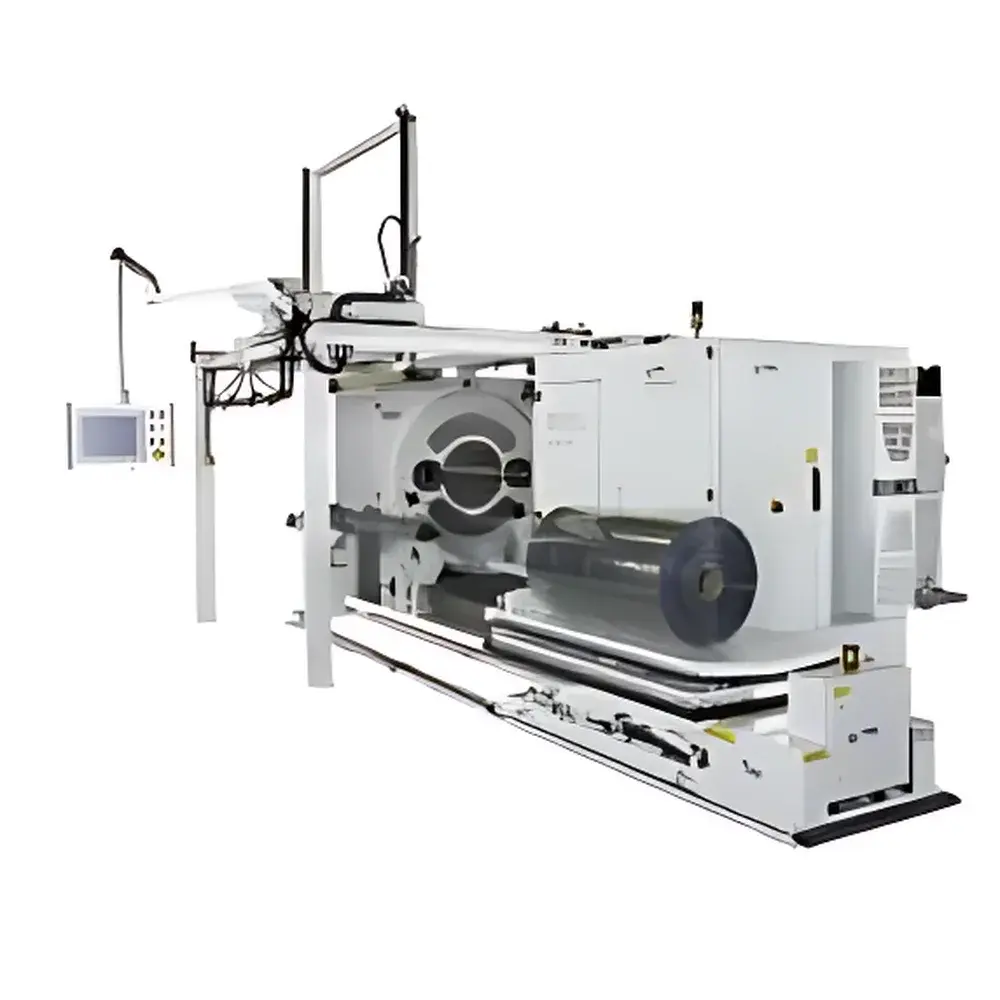
PSA AutoWind Fully Automatic Tower Slitting and Rewinding Machine
| Brand | PSA |
|---|---|
| Origin | Germany |
| Manufacturer Type | Authorized Distributor |
| Origin Category | Imported |
| Model | AutoWind |
| Pricing | Upon Request |
| Max Web Width | 4000 mm |
| Max Parent Roll Weight | 2000 kg |
| Max Rewind Diameter | Φ1500 mm |
| Core Diameters | 3"–10" (76–254 mm) |
| Compatible Core Types | Paper & Plastic Tubes |
| Slitting Methods | Razor Blade Cut, Score Cut, Crush Cut |
| Minimum Slit Width | 50 mm |
| Max Line Speed | 600 m/min |
| Blade Adjustment | Manual / Semi-Automatic / Fully Automatic |
| Handling Systems | Roll Support System, Core Handling System, Packaging Integration Interface |
| Rewind Configuration | Dual-Arm Mandrel-Based or Cantilever Arm Structure |
| Material Compatibility | Industrial Films, Packaging Films, Flexible & Rigid Films, Paper, Laminates |
Overview
The PSA AutoWind Fully Automatic Tower Slitting and Rewinding Machine is an engineered solution for high-precision, continuous web processing in converting lines. Designed around a vertical tower architecture, the AutoWind integrates synchronized slitting and dual-station rewind functionality to ensure uninterrupted production during roll changeovers. Its core operational principle relies on dynamic tension control, servo-driven mandrel positioning, and real-time web tracking—enabling stable winding of sensitive, high-speed substrates without edge deformation or telescoping. The system is purpose-built for integration upstream of final packaging or downstream of coating, printing, calendering, extrusion, or polishing processes—common in flexible packaging, label manufacturing, and industrial film production environments. Unlike conventional horizontal rewinders, the tower configuration minimizes floor space requirements while maximizing accessibility for operator intervention and maintenance.
Key Features
- Vertical tower design with dual independent rewind stations for seamless roll transitions and zero-speed splicing capability.
- Patented tapeless splice initiation system utilizing electrostatic-assisted adhesive transfer and precision vertical cross-cutting—eliminating manual tape application and reducing material waste.
- Modular slitting architecture supporting three interchangeable methods: razor blade cutting (for clean, burr-free edges), score cutting (for controlled delamination in laminates), and crush cutting (for non-woven or fibrous webs).
- Integrated tension management across unwind, slitting, and rewind zones via load-cell feedback and closed-loop pneumatic/servo-controlled brakes and drives.
- Core handling system with automatic core loading, alignment, and ejection—compatible with standard 3″, 6″, and 10″ paper or plastic cores (76–254 mm ID), including flanged and unflanged variants.
- Programmable logic controller (PLC) with HMI interface enabling recipe-based setup, fault diagnostics, and event logging compliant with ISO 13849-1 safety standards.
Sample Compatibility & Compliance
The AutoWind accommodates a broad spectrum of substrate types—including polyolefin, PET, BOPP, PVC, metallized films, aluminum foil laminates, coated papers, and multi-layer composites—with thickness ranges from 12 µm to 500 µm. Its mechanical design meets CE Machinery Directive 2006/42/EC requirements, and electrical systems comply with EN 61800-5-1 for adjustable speed drives. Optional configurations support ATEX Zone 22 certification for dust-explosive environments and meet FDA-relevant material contact criteria (USP Class VI) where applicable. All control software architecture supports audit trail generation and user access levels aligned with ISO 9001 and ISO 15378 quality management frameworks.
Software & Data Management
The AutoWind operates under PSA’s proprietary WindControl™ v4.2 firmware, offering web-based remote monitoring, OEE tracking, and predictive maintenance alerts via OPC UA connectivity. Data logging includes tension profiles, splice timestamps, core ID tracking, and slitting parameter history—exportable in CSV or XML format for integration into MES platforms (e.g., Siemens Opcenter, Rockwell FactoryTalk). Full compliance with FDA 21 CFR Part 11 is available through optional electronic signature modules, including role-based authentication, immutable audit trails, and data integrity validation protocols required for regulated pharmaceutical or medical device packaging lines.
Applications
- Continuous slitting and rewinding of extruded polymer films prior to pouch-making or lamination.
- In-line finishing for gravure and flexographic printing lines—ensuring consistent edge quality and register stability across slit lanes.
- High-volume production of pressure-sensitive label stock, requiring precise slit width repeatability ±0.15 mm and minimal lateral shift.
- Processing of abrasive or low-surface-energy substrates (e.g., silicone-coated release liners, fluoropolymer films) where static control and non-contact handling are critical.
- Recycling-oriented operations involving reclaimed film streams—leveraging adaptive tension algorithms to compensate for variable web stiffness and thickness variation.
FAQ
What roll changeover time does the AutoWind achieve during fully automatic operation?
Typical splice-to-splice transition time is ≤ 3.2 seconds at line speeds up to 600 m/min, verified per ISO 15223-2 test protocol.
Can the AutoWind be retrofitted with vision-guided edge registration?
Yes—optional CCD-based edge detection modules integrate directly with the PLC for closed-loop lateral guidance, supporting ±0.1 mm positional accuracy.
Is remote diagnostics supported out-of-the-box?
Standard Ethernet/IP and Modbus TCP interfaces enable secure remote access; advanced telemetry requires PSA CloudLink subscription.
Does the system support GMP-compliant batch record generation?
With validated WindControl™ Pharma Edition and electronic signature license, full batch documentation—including splice logs, tension deviations, and operator actions—is generated per Annex 11 requirements.
What maintenance intervals are recommended for the slitting assembly?
Blade replacement frequency depends on substrate abrasiveness; typical service intervals range from 8–12 shifts for razor blades and 200–300 operating hours for crush cut anvils, as documented in the Maintenance Logbook (Ref. AW-MB-2024 Rev. C).





