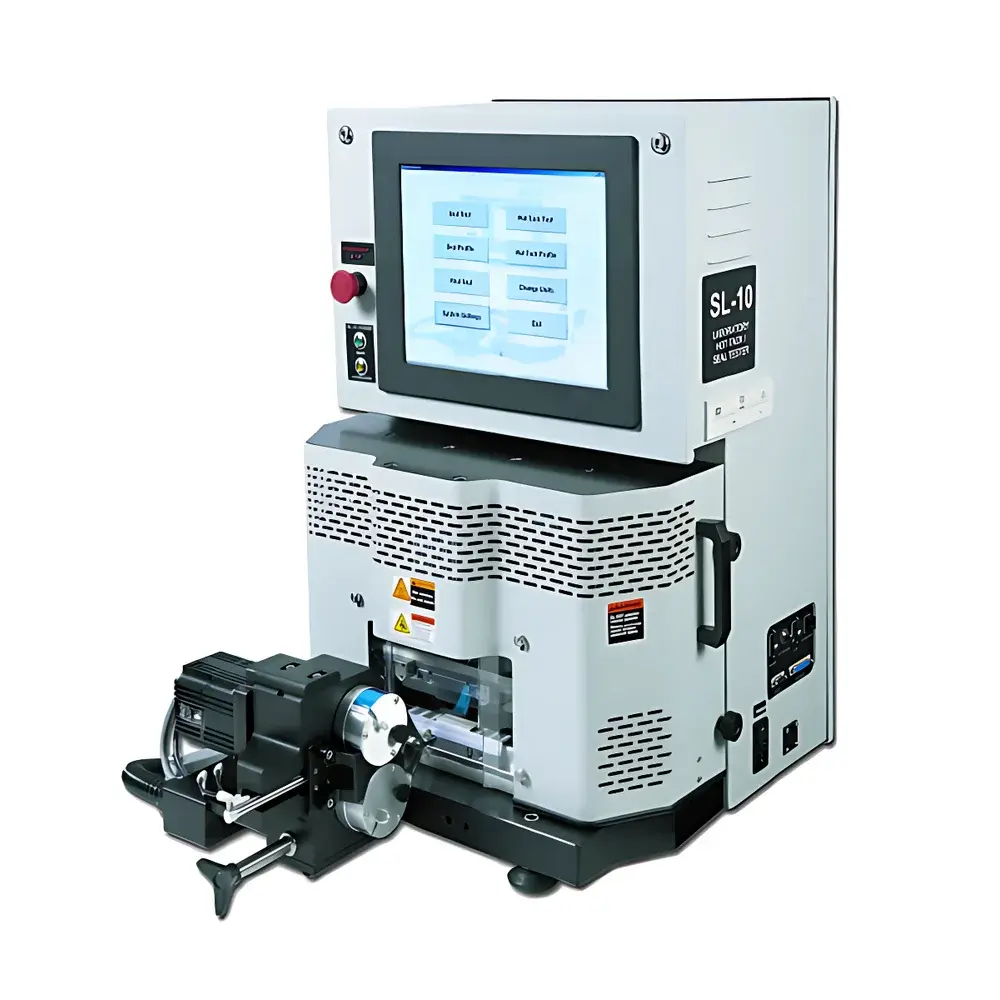
TMI Model 75-50 SL-10 Hot Tack & Heat Seal Tester
| Brand | TMI |
|---|---|
| Origin | USA |
| Manufacturer Type | Authorized Distributor |
| Origin Category | Imported |
| Model | 75-50 |
| Price | Upon Request |
| Heat Seal Temperature Range | Ambient to 350°C (662°F) |
| Temperature Resolution | ±0.1°C (0.18°F) |
| Temperature Accuracy | ±0.70°C (1.26°F) |
| Hot Tack Load Cell Capacity | 111.2 N (11.3 kgf) |
| Load Accuracy | 0.1% Full Scale |
| Peel Speed Range | 1–200 mm/sec (0.04–7.87 in/sec) |
| Seal Load Cell Capacity | 4448.2 N (453.6 kgf) |
| Load Accuracy | ±0.89 N (±0.09 kgf) |
| Seal Pressure Range | 137.9–2758 kPa (20–400 psi) |
| Pressure Resolution | 0.68 kPa (0.1 psi) |
| Seal Delay Time Range | 0.20–99.99 s |
| Time Resolution | 10 ms |
| Control Timing Accuracy | ±0.025 ms |
| Seal Jaw Length | Up to 203.2 mm (8.0 in) |
| Jaw Width | 12.7–25.4 mm (0.5–1.0 in) |
| Jaw Surface Configurations | Flat, Vertical, Horizontal, Custom, or Standard Geometries |
| Compliance | ASTM F1921, ASTM F2029, ASTM F88, ISO 11607-2, USP <1207> |
| Calibration Standard | ASTM E4 |
Overview
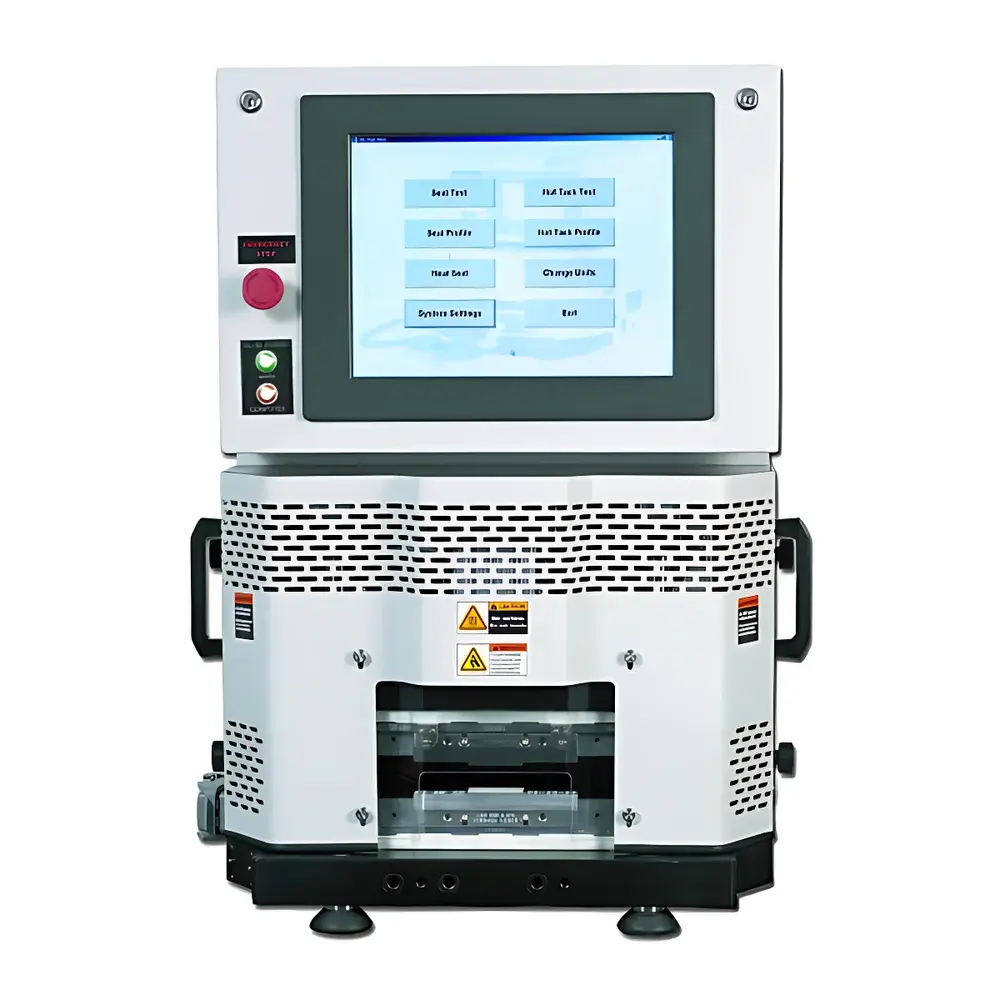
The TMI Model 75-50 SL-10 Hot Tack & Heat Seal Tester is a precision-engineered laboratory instrument designed for quantitative evaluation of heat seal integrity and hot tack strength in flexible packaging materials. It operates on the fundamental principles of controlled thermal energy transfer, mechanical force application, and real-time load-displacement measurement during both hot-tack (seal strength immediately post-sealing) and heat seal (cooled seal strength) phases. The system employs dual independent temperature-controlled sealing jaws, high-fidelity pressure transducers, and synchronized electromechanical actuation to replicate industrial sealing conditions under rigorously documented parameters. Its architecture supports full traceability and regulatory alignment—making it suitable for R&D labs, quality control environments, and validation protocols requiring compliance with FDA-regulated manufacturing practices.
Key Features
- Independent dual-zone thermal control across upper and lower sealing jaws, maintaining uniformity within ±1.1°C (±2°F) across the entire jaw width
- Real-time, dual-sensor pressure monitoring calibrated per ASTM E4, delivering accurate seal pressure values applied directly to the film surface
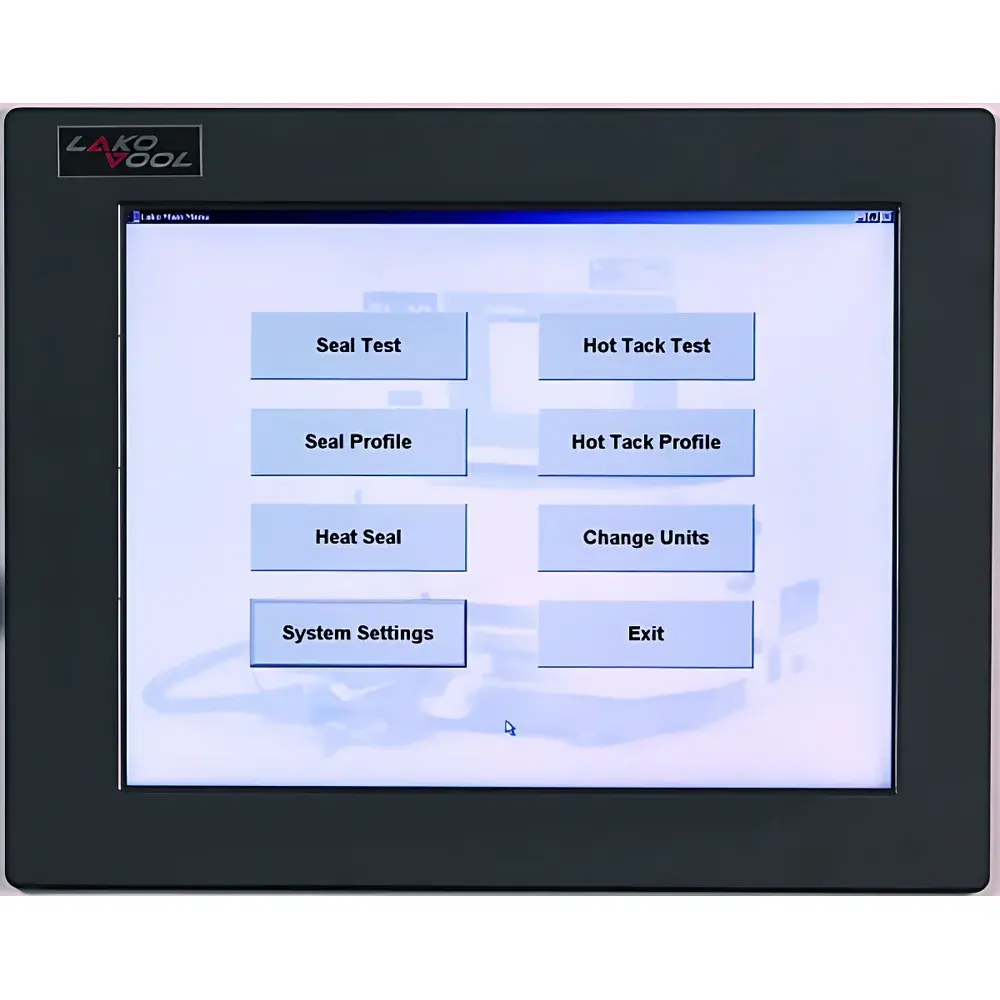
- Integrated 10.1-inch color touchscreen interface running Windows® 7 Professional (32-bit), enabling intuitive setup of temperature, dwell time, pressure, and peel speed
- Full computer automation for test execution, data acquisition, curve plotting (force vs. time/distance), and result archiving with timestamped metadata
- Safety-certified enclosure with interlocked guarding and emergency stop circuitry compliant with IEC 61000-6-2/6-4 and UL 61010-1
- Standard I/O suite: Gigabit Ethernet, two USB 2.0 ports, PS/2 keyboard port, VGA video output, and parallel printer interface
- Pre-installed Microsoft® Office suite for immediate report generation and data export (CSV, XLSX, PDF)
- Modular jaw design supporting rapid interchange of flat, vertical, horizontal, or custom-profile sealing tools—each engineered for repeatable contact geometry and minimal thermal lag
Sample Compatibility & Compliance
The SL-10 accommodates a broad spectrum of flexible barrier substrates including laminated polyolefins, metallized PET/PE, aluminum foil composites, paper-plastic hybrids, and medical-grade sterile packaging films. Its mechanical and thermal specifications align with internationally recognized test standards essential for regulatory submissions and internal quality audits. It fully satisfies the procedural requirements of ASTM F1921 (hot tack testing), ASTM F2029 (heat seal strength determination), ASTM F88 (seal strength of flexible barrier materials), ISO 11607-2 (packaging validation for terminally sterilized medical devices), and USP (package integrity evaluation). All calibration procedures adhere to ASTM E4 for force verification and NIST-traceable temperature references, ensuring data integrity for GLP/GMP environments and 21 CFR Part 11-compliant electronic records when paired with validated software extensions.
Software & Data Management
Data acquisition and analysis are managed via TMI’s proprietary SealTest™ software, preloaded on the embedded industrial PC. The software provides automated pass/fail evaluation against user-defined specification limits, statistical process control (SPC) charting (X̄-R, Cp/Cpk), and batch-level summary reporting. Raw force-time curves are stored in binary format with embedded environmental metadata (ambient temperature, humidity, operator ID, calibration status). Export functions support CSV for third-party statistical analysis, XML for LIMS integration, and PDF/A-1b for archival compliance. Audit trails record all parameter changes, test executions, and user logins—fully configurable to meet FDA 21 CFR Part 11 requirements when deployed with digital signature modules and role-based access controls.
Applications
- Determination of optimal sealing temperature, pressure, and dwell time windows for new packaging formulations
- Hot tack onset and decay profiling to assess melt-phase cohesion in heat-sealable layers
- Comparative evaluation of sealant resins (e.g., EVA, ionomer, metallocene PE) under accelerated aging or sterilization exposure
- Validation of sealing equipment performance across production shifts using reference standards
- Root cause analysis of seal failures (leak paths, channeling, delamination) through correlated thermal-mechanical response curves
- Supporting ISO 13485 and MDR Annex I documentation for Class II/III medical device packaging dossiers
FAQ
What standards does the SL-10 comply with for medical packaging validation?
The instrument meets ASTM F1921, ASTM F2029, ISO 11607-2, and USP , forming the technical foundation for packaging validation studies required by FDA and EU MDR.
Can the SL-10 perform both hot tack and cooled seal strength tests in a single sequence?
Yes—the system executes programmable multi-stage protocols: immediate peel initiation post-sealing (hot tack), followed by configurable cooling delays and secondary peel testing (heat seal strength).
Is external calibration required before first use?
The unit ships with NIST-traceable calibration certificates for temperature, force, and time domains; however, lab-specific verification per ASTM E74 and E4 is recommended prior to GxP use.
Does the system support automated sample loading?
An optional motorized auto-loading tray is available to eliminate operator-induced variability in specimen placement and orientation—critical for high-throughput QC labs.
What maintenance intervals are recommended for long-term accuracy?
Annual verification of thermal uniformity, pressure transducer linearity, and crosshead speed accuracy is advised; TMI provides certified service kits and remote diagnostics support.
Related Products