
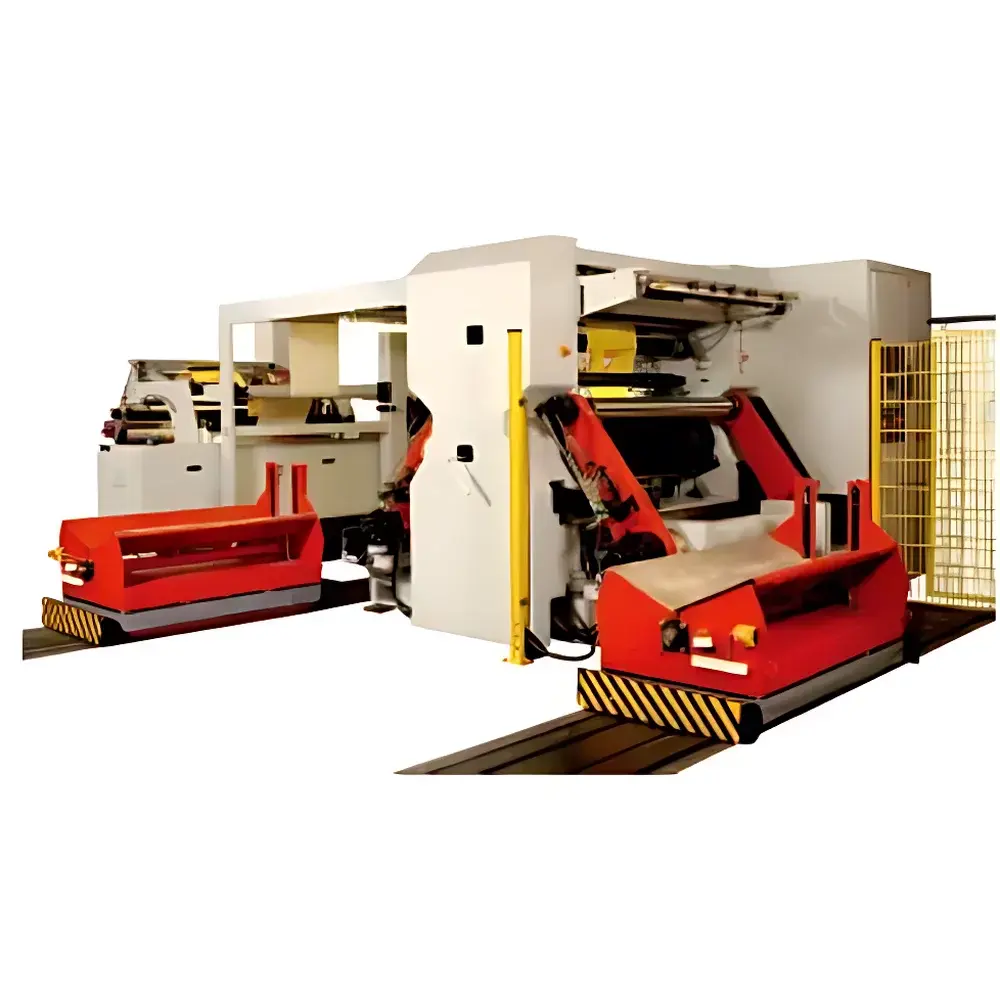
PSA SuperSlit Large-Format Rewind and Slitting Machine
| Brand | PSA |
|---|---|
| Origin | Germany |
| Manufacturer Type | Authorized Distributor |
| Origin Category | Imported |
| Model | SuperSlit |
| Pricing | Available Upon Request |
| Maximum Web Width | 800–4000 mm |
| Max Unwind Roll Weight | 5000 kg |
| Max Unwind Diameter | Φ1800 mm |
| Core Diameter Range | Φ50–200 mm |
| Slitting Methods | Guillotine, Score, Flying Cut, Pressure Cut, Tear Cut |
| Minimum Slit Width (with shaft-mounted winders) | 25 mm |
| Minimum Slit Width (with independent turret winders) | 240 mm |
| Max Rewind Diameter | Φ1500 mm |
| Max Line Speed | 800 m/min |
| Compatible Materials | Industrial Films, Packaging Films, Coated Flexible & Rigid Films, Paper, Laminates, Aluminum Foil Composites, Nonwovens, Multilayer Composites |
Overview
The PSA SuperSlit Large-Format Rewind and Slitting Machine is an engineered solution for high-precision, high-throughput slitting and rewinding of ultra-wide, heavy-gauge master rolls in industrial converting environments. Designed according to DIN EN ISO 12100 and CE-compliant mechanical safety standards, the SuperSlit employs a modular, dual-turret architecture optimized for continuous operation under demanding production conditions. Its core functionality integrates controlled unwinding dynamics with multi-method slitting kinematics—leveraging both fixed-shaft and independent turret configurations—to accommodate diverse substrate mechanical behaviors, including low-tension films, high-stiffness laminates, and abrasive metallized foils. Unlike conventional slitters limited by roll geometry or tension sensitivity, the SuperSlit’s dual-direction unwind capability and bridge-mounted auxiliary modules enable seamless integration into end-to-end converting lines—particularly where downstream automation (e.g., robotic palletizing, inline packaging, or inspection) requires synchronized roll handling and minimal dwell time.
Key Features
- Dual-position unwind station: Supports internal mounting or external standalone configuration, enabling flexible line layout and compatibility with existing extrusion or coating lines.
- Modular bridge-mount architecture: All optional units—including independent rewind stations, fully automated slitting carriages, and auto-core positioning systems—are integrated via overhead or underfloor bridge rails aligned with web travel direction, minimizing footprint impact and preserving mechanical alignment integrity.
- Multi-mode slitting system: Configurable for guillotine cut (for clean edge definition on rigid substrates), score cut (for controlled delamination of laminates), flying cut (for tension-sensitive webs), pressure cut (for coated papers), and tear cut (for perforated or pre-weakened materials).
- High-inertia drive architecture: Rated for 5000 kg master rolls and capable of stable operation at up to 800 m/min, with closed-loop tension control across all unwind, intermediate, and rewind zones using load-cell feedback and servo-regulated torque compensation.
- Automated roll transfer interface: Integrated with standard industrial robotics (e.g., ABB, KUKA) or conveyor systems per ISO/IEC 61131-3 PLC communication protocols; enables automatic roll cutoff, core ejection, and transport to downstream packaging or QA stations without manual intervention.
Sample Compatibility & Compliance
The SuperSlit accommodates a validated range of industrially relevant substrates: polyethylene and polypropylene films (including cast, blown, and metallized variants), BOPET/BOPP laminates, aluminum foil composites (e.g., Alu/PET/PE structures), coated kraft and specialty papers, nonwoven webs (spunbond/meltblown), and multilayer barrier films used in pharmaceutical and food packaging. All mechanical interfaces comply with EU Machinery Directive 2006/42/EC, and electrical control systems meet EN 61800-5-1 for adjustable speed drives. Optional validation packages support IQ/OQ documentation per GMP Annex 15 requirements for regulated packaging applications, including traceable calibration records for tension sensors and encoder-based speed verification.
Software & Data Management
Controlled via a Siemens SIMATIC S7-1500 PLC with HMI interface (SIMATIC WinCC Runtime Advanced), the SuperSlit provides real-time monitoring of critical process parameters—including web tension (±0.5% FS accuracy), slitting position repeatability (±0.15 mm), and rewind diameter growth rate. Data logging conforms to FDA 21 CFR Part 11 requirements when configured with electronic signature and audit trail modules. Historical operational data—including roll change timestamps, slitting method selection, and fault diagnostics—is exportable in CSV or OPC UA format for integration into MES platforms such as SAP ME or Rockwell FactoryTalk.
Applications
- Production of narrow-width technical films for capacitor dielectrics, solar backsheet substrates, and battery separator precursors.
- High-speed conversion of wide-web packaging laminates into retail-ready formats for confectionery, dairy, and medical device packaging.
- Slitting of heavy-gauge industrial liners (e.g., geotextiles, roofing membranes) requiring consistent edge quality and minimal web distortion.
- Processing of metallized composites for flexible electronics interconnects and EMI shielding applications.
- Reprocessing of off-spec or surplus master rolls into certified secondary grades under ISO 9001 traceability frameworks.
FAQ
What safety certifications does the SuperSlit hold?
CE marking per Machinery Directive 2006/42/EC, electromagnetic compatibility per EN 61000-6-2/-4, and functional safety compliance with EN ISO 13849-1 PL e.
Can the machine handle heat-sensitive films without edge deformation?
Yes—via flying cut mode with air-cushion support and active cooling of slitting blades; thermal drift is monitored via embedded RTD sensors in the cutting assembly.
Is remote diagnostics supported?
Standard Ethernet/IP and optional cellular (LTE-M) connectivity enable secure remote access for predictive maintenance alerts and firmware updates under ITAR-compliant encryption protocols.
What is the typical lead time for delivery and commissioning?
14–18 weeks from order confirmation, inclusive of FAT (Factory Acceptance Test) and on-site SAT (Site Acceptance Test) with operator training.
Does PSA provide validation documentation for regulated industries?
Yes—IQ/OQ documentation packages are available upon request, aligned with ISO/IEC 17025 and ASTM D882 for tensile property correlation during slitting qualification.




