
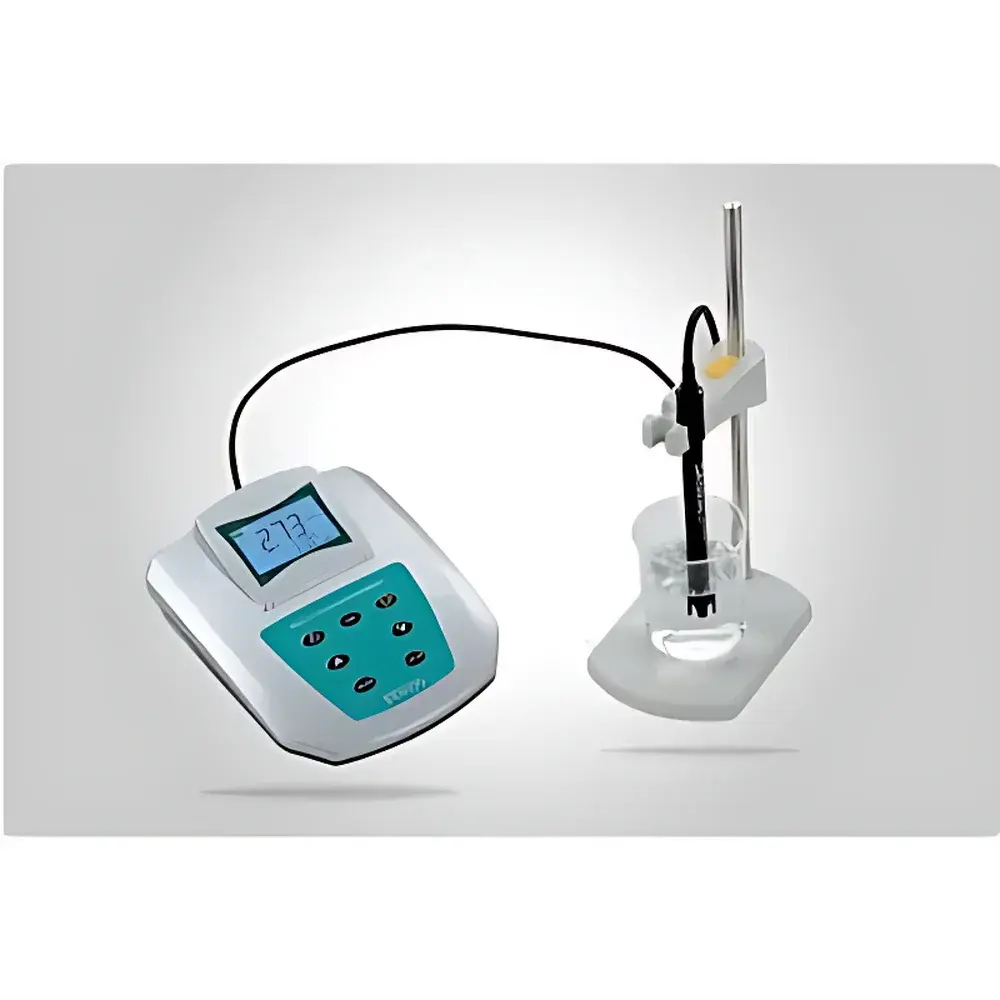
SANXIN DDS-11C Benchtop Conductivity Meter
| Brand | SANXIN |
|---|---|
| Model | DDS-11C |
| Measurement Range | (0–199.9) µS/cm, (200–1999) µS/cm, (2.00–19.99) mS/cm, (20.0–199.9) mS/cm |
| Accuracy | ±1.0% FS |
| Automatic Temperature Compensation | 0–50 °C |
| Data Storage | 50 sets |
| Power Supply | DC 9 V / 300 mA |
| Dimensions | 160 × 190 × 70 mm |
| Weight | 750 g |
| Electrode Included | 2301-F Plastic-Body Conductivity Cell (K = 1.0, ATC built-in) |
| Calibration Standards Supported | Dual-series recognition (US/EU and Chinese standard solutions) |
| Compliance | Designed for GLP-compliant routine lab use |
Overview
The SANXIN DDS-11C Benchtop Conductivity Meter is a precision-engineered electrochemical instrument designed for reliable, cost-effective measurement of electrical conductivity in aqueous solutions across academic, quality control, environmental monitoring, and industrial R&D laboratories. It operates on the fundamental principle of two-electrode AC conductometry—applying a low-frequency alternating current to minimize polarization effects and electrode fouling—enabling stable, repeatable quantification of ionic concentration in samples ranging from ultrapure water to concentrated brines. With an extended effective measurement span of 0.5 µS/cm to 200 mS/cm (achieved via range-switching and K = 1.0 cell optimization), the DDS-11C delivers full-scale accuracy of ±1.0% FS without requiring multiple electrodes or manual range recalibration. Its integrated automatic temperature compensation (ATC) circuit—calibrated to the standardized 25 °C reference using a built-in NTC thermistor—ensures traceable, thermally corrected results per ISO 7888 and ASTM D1125 guidelines.
Key Features
- Single-point calibration protocol with automatic recognition of eight certified conductivity standards—supporting both internationally harmonized (e.g., KCl 1413 µS/cm, 12.88 mS/cm per IUPAC) and China-specific reference solutions (e.g., GBW(E)130005 series)
- Intelligent microprocessor-controlled operation featuring auto-ranging, real-time stability detection (display holds value only when deviation < ±0.2% over 3 s), and programmable ATC coefficient selection (linear β = 2.0%/°C default or user-adjustable)
- Surface-mount technology (SMT) PCB architecture enhancing long-term signal integrity, EMI immunity, and thermal stability under continuous benchtop operation
- Onboard memory storing up to 50 measurement records—including conductivity value, temperature, date/time stamp, and calibration status—for audit-ready data review
- Optimized electrode interface accommodating standard BNC connectors and compatible with optional K = 0.1 or K = 10 cells for specialized applications (e.g., high-purity water or molten salt analysis)
Sample Compatibility & Compliance
The DDS-11C is validated for routine analysis of low-to-moderate ionic strength aqueous matrices including drinking water, boiler feedwater, wastewater effluents, nutrient solutions, buffer preparations, and pharmaceutical rinse waters. It meets essential functional requirements of ISO/IEC 17025-accredited testing labs when operated within specified environmental conditions (15–30 °C ambient, < 80% RH non-condensing). While not intrinsically compliant with FDA 21 CFR Part 11 out-of-the-box, its deterministic firmware behavior, immutable calibration logs, and timestamped data storage support retrospective GLP/GMP audit trails when paired with documented SOPs and controlled access protocols. The included 2301-F electrode features a rugged ABS housing, platinum black-plated electrodes, and integrated ATC sensor—certified to IP67 for incidental splash resistance and stable performance in field-deployable or teaching-lab environments.
Software & Data Management
Data export is facilitated via manual transcription or optional RS-232 serial interface (with TTL-to-USB adapter). No proprietary software is bundled; however, the meter’s ASCII-formatted output (e.g., “123.45 uS/cm @ 22.3 C”) is natively ingestible by LIMS platforms, Excel, or Python-based analytics pipelines using standard serial communication libraries (e.g., PySerial). All stored measurements retain full metrological context—no metadata stripping occurs during recall. Firmware revision history and last-calibration timestamp are accessible via diagnostic mode, supporting ISO 9001 clause 7.1.5 traceability requirements.
Applications
- Environmental labs: Monitoring conductivity as a surrogate parameter for total dissolved solids (TDS) in surface water and groundwater per EPA Method 120.1
- Pharmaceutical QC: Verifying conductivity specifications of Purified Water (PW) and Water for Injection (WFI) per USP
- Academic instruction: Teaching foundational electrochemistry concepts—including Kohlrausch’s law, molar conductivity trends, and temperature dependence of electrolyte mobility
- Food & beverage: Assessing mineral content consistency in bottled water, soft drinks, and dairy processing streams
- Power generation: Routine checks of condensate purity in steam-cycle systems to detect cooling water ingress
FAQ
Does the DDS-11C support GLP-compliant calibration documentation?
Yes—each calibration event is timestamped and stored alongside the reference solution ID and measured value. When combined with lab-defined calibration SOPs and manual logbook entries, it satisfies core GLP record-keeping expectations.
Can I use non-SANXIN conductivity electrodes with this meter?
Yes—the BNC input accepts any industry-standard two-electrode cell with K-factor labeling (0.1, 1.0, or 10.0); however, automatic K-factor recognition and optimized range switching are guaranteed only with SANXIN-certified cells.
Is temperature compensation adjustable or fixed?
The default linear coefficient (β = 2.0%/°C) aligns with KCl solutions; advanced users may select alternate coefficients (1.8–2.4%/°C) via hidden service menu to match sample-specific temperature response profiles.
What is the minimum detectable conductivity value with the included 2301-F electrode?
Under optimal conditions (clean cell, stable temperature, low-noise environment), the practical lower limit is ~0.5 µS/cm—validated against ASTM D5391 ultra-pure water testing procedures.
How frequently should the 2301-F electrode be cleaned and recalibrated?
Daily cleaning with deionized water is recommended; full recalibration is required before each analytical session or after exposure to viscous, oily, or precipitating samples—per ISO 5725-2 intermediate precision guidelines.



