
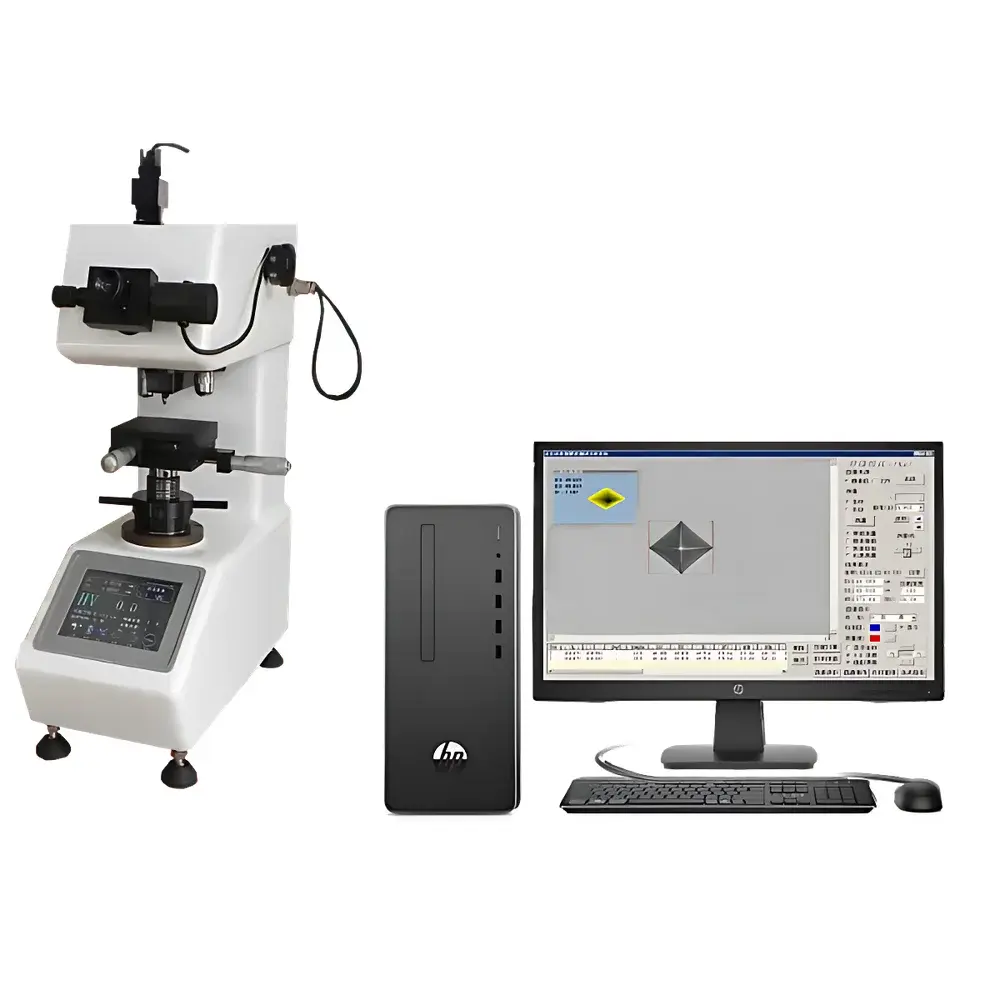
YANRUN HMAS-D1000 Automated Microhardness Testing System with Integrated Image Analysis Software
| Brand | YANRUN |
|---|---|
| Origin | Shanghai, China |
| Manufacturer Type | Original Equipment Manufacturer (OEM) |
| Product Category | Domestic |
| Model | HMAS-D1000 |
| Instrument Type | Microhardness Tester |
| Hardness Measurement Range | 0.001–3000 HV |
| Test Forces | 10, 25, 50, 100, 200, 300, 500, 1000 gf (0.098–9.807 N) |
| Standards Compliance | GB/T 4340 |
| X-Y Stage Travel | 25 × 25 mm |
| Minimum Detection Resolution | 0.25 µm |
| Optical Magnification | 100× (observation), 400× (measurement), ~1600× digital zoom |
| Load Application Speed | 0.05 mm/s |
| Dwell Time | 0–99 s (1 s increments) |
| Max Specimen Height | 65 mm |
| Depth of Field Compatibility | Up to 110 mm from indenter axis to chamber wall |
| Convertible Scales | HV, HK, HRA/B/C/D, HR15/30/45N/T, HBW, HEF |
| Power Supply | AC 220 V / 50 Hz |
Overview
The YANRUN HMAS-D1000 Automated Microhardness Testing System is a precision-engineered instrument designed for quantitative micro-scale hardness evaluation using the Vickers indentation method. It operates on the principle of controlled static indentation: a diamond pyramid indenter (136° apex angle) is applied to the specimen surface under precisely regulated test forces ranging from 10 gf to 1000 gf (0.098–9.807 N). After a defined dwell period (0–99 s), the resulting square-shaped impression is optically imaged and measured via high-resolution digital microscopy. The system calculates hardness values (HV) based on the diagonal length of the residual indent, following the ISO 6507-1 and ASTM E384 standards framework — with full alignment to GB/T 4340, the Chinese national standard for Vickers hardness testing. Unlike conventional manual microhardness testers, the HMAS-D1000 integrates mechanical stability, optical fidelity, and algorithm-driven image analytics into a unified platform — enabling repeatable, traceable, and auditable hardness assessment across thin films, case-hardened layers, metallurgical cross-sections, ceramics, and composite materials.
Key Features
- Automated indentation imaging workflow: Simultaneous ocular viewing and real-time CCD capture at 400× optical magnification (up to ~1600× digital zoom)
- Dual-path optical train: Independent 10× observation and 40× measurement objectives ensure optimal depth-of-field control and parallax-free alignment
- Manual turret with eight pre-calibrated test force levels (10–1000 gf), selected via external rotary dial with mechanical load verification
- High-stability aluminum alloy cast frame with anti-vibration base design and precision-ground Z-axis lift mechanism
- Sub-micron resolution: 0.25 µm minimum measurable diagonal length, supporting accurate HV evaluation down to 0.001 HV for ultra-thin coatings
- Integrated digital focus enhancement: Proprietary “Simulated Focus” algorithm dynamically sharpens indenter images without physical refocusing — improving edge detection reliability for low-contrast or shallow impressions
- Real-time SPC-ready output: On-screen hardness distribution mapping, statistical process control (SPC) charts, and automatic outlier flagging per ISO 22514-2
Sample Compatibility & Compliance
The HMAS-D1000 accommodates specimens up to 65 mm in height and supports lateral positioning within a 25 × 25 mm travel range on its calibrated X-Y stage (0.01 mm vernier readout). Its 110 mm clearance from indenter axis to internal chamber wall allows testing of irregularly shaped parts, heat-treated gears, turbine blades, and cross-sectional metallographic mounts. The system meets metrological requirements defined in GB/T 4340.1–2012 (equivalent to ISO 6507-1:2018) for hardness uniformity, repeatability, and traceability. While not certified to FDA 21 CFR Part 11 out-of-the-box, the HMAS software architecture supports audit trail configuration, electronic signature integration, and data integrity protocols required for GLP/GMP environments — subject to site-specific validation per ICH M7 and USP .
Software & Data Management
The proprietary HMAS hardness analysis software serves as the central processing engine. It delivers fully automated indentation detection using adaptive thresholding and sub-pixel centroid calculation — eliminating subjective operator interpretation. Core capabilities include:
- Multi-layer hardness profiling: Automatic depth-resolved HV gradient mapping for carburized, nitrided, or diffusion-bonded interfaces
- 3D indent reconstruction: Surface topography modeling with dimensional annotation (width, length, depth) and interactive rotation
- Comprehensive reporting: Export to PDF, Word (.docx), and Excel (.xlsx) formats with embedded raw images, metadata (test force, dwell time, operator ID), and calibration logs
- Background customization: Twelve selectable background colors optimized for contrast enhancement across diverse material types — including copper alloys, aluminum anodized layers, stainless steels, and tungsten carbide
- Error evaluation module: Statistical uncertainty quantification per ISO/IEC 17025:2017 Annex A.4, incorporating repeatability (r), reproducibility (R), and measurement uncertainty (k=2)
- Material brittleness grading: Reference-based classification of nitrided layer fracture behavior using standardized corner-chipping criteria per ISO 2639
Applications
The HMAS-D1000 is routinely deployed in metallurgical laboratories, aerospace component QA/QC departments, academic materials science research, and automotive powertrain R&D. Typical use cases include:
- Case depth verification of gear teeth and bearing races after induction hardening or carbonitriding
- Thin-film adhesion assessment via progressive-load microindentation and crack propagation analysis
- Intermetallic phase hardness mapping in aluminum-lithium or nickel-based superalloy microstructures
- Quality control of PVD/CVD-coated cutting tools (TiN, AlCrN, DLC) and biomedical implants (hydroxyapatite, zirconia)
- Failure analysis of solder joints, brazed assemblies, and thermally sprayed coatings
- Calibration transfer between reference blocks and production-line hardness verifiers
FAQ
Does the HMAS-D1000 support automatic focusing during measurement?
No — it uses manual Z-axis fine adjustment for initial focus, but incorporates “Simulated Focus” digital image enhancement to optimize edge clarity post-capture.
Can the system perform Knoop hardness measurements?
No — the HMAS-D1000 is configured exclusively for Vickers (HV) and related scale conversions (HK, HR, HBW); Knoop functionality requires hardware-level indenter exchange not supported by this model.
Is remote operation or network connectivity available?
The system operates via dedicated USB 2.0 interface to the included Windows-based PC; Ethernet or Wi-Fi connectivity is not natively integrated but may be enabled through third-party VNC or remote desktop deployment.
What calibration documentation is supplied?
Each unit ships with NIST-traceable hardness reference blocks (low- and high-range), a factory calibration certificate per GB/T 4340.2, and instructions for user-performed periodic verification.
How is data integrity ensured during long-term archival?
All measurement datasets include embedded timestamps, operator identifiers, environmental metadata (ambient temperature/humidity if externally logged), and checksum-verified binary image files — compatible with LIMS integration via CSV export or ODBC drivers.
Related Products



