
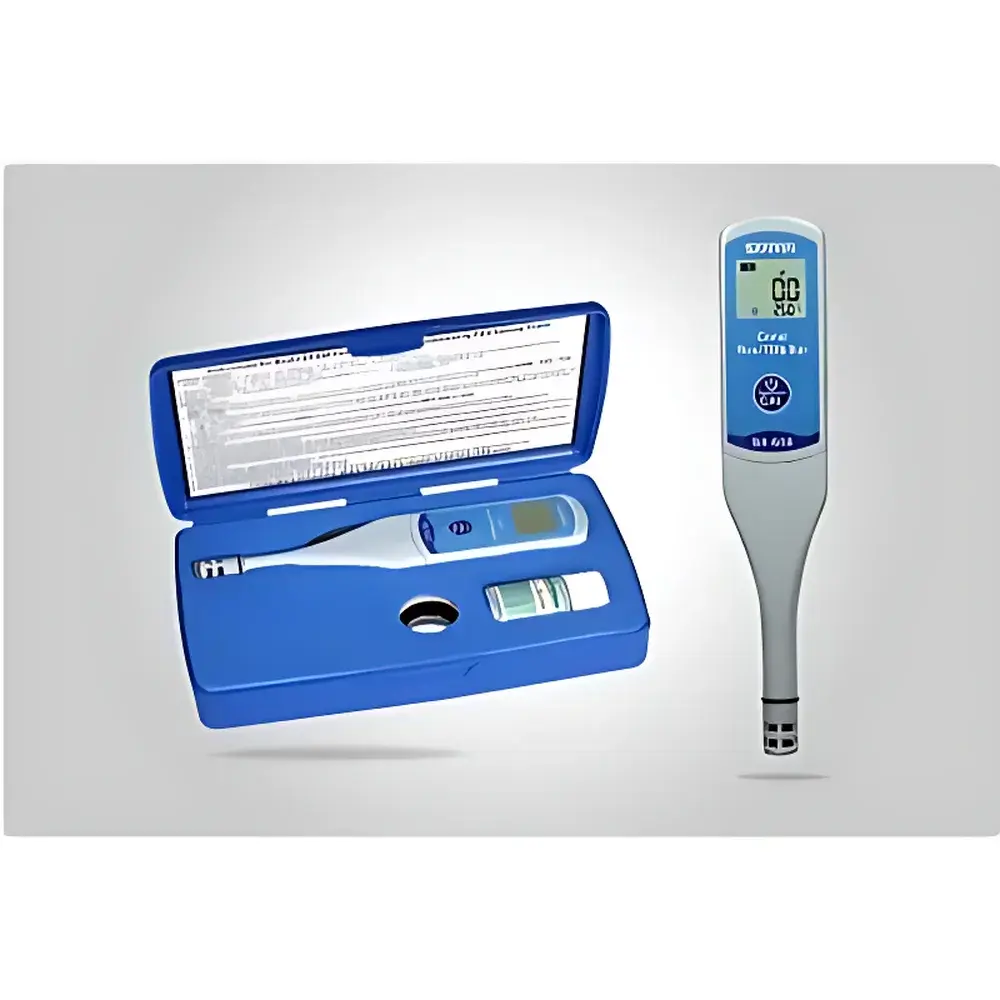
SANXIN SX650 Waterproof Pen-Type Conductivity / TDS / Salinity / Resistivity Meter
| Brand | SANXIN |
|---|---|
| Origin | Shanghai, China |
| Manufacturer Type | Direct Manufacturer |
| Product Category | Domestic |
| Model | SX650 |
| Detection Parameters | Single-Parameter |
| Portability | Pen-Style |
| Conductivity Range | 0–50.00 mS/cm |
| TDS Range | 0–35.0 g/L |
| Resistivity Range | 0–20.0 MΩ·cm |
| Salinity Range | 0–25.0 ppt |
| Temperature Range | 0–50 °C |
| Accuracy | ±1% FS (Conductivity), ±0.5 °C (Temperature) |
| Minimum Resolution | 0.001 µS/cm |
| Temperature Compensation | Automatic (0–50 °C), Coefficient: 2.0%/°C |
| Calibration | Single-point auto-calibration (1413 µS/cm standard) |
| Power Supply | Two CR2032 lithium batteries (≥100 hours continuous operation) |
| Dimensions & Weight | 148 × 29 × 14 mm / 38 g |
| IP Rating | IP57 |
Overview
The SANXIN SX650 is a compact, field-deployable pen-type conductivity meter engineered for rapid, reliable measurement of electrical conductivity, total dissolved solids (TDS), salinity, and resistivity in aqueous solutions. Based on four-electrode (or dual-electrode, depending on configuration) conductometric principles, the instrument applies a low-frequency AC excitation signal to minimize polarization effects and electrode fouling—critical for stable readings in turbid, high-ionic-strength, or organic-laden samples. Its integrated temperature sensor enables automatic temperature compensation (ATC) across the full operational range (0–50 °C), using a fixed 2.0%/°C linear coefficient compliant with ASTM D1125 and ISO 7888 standards for routine water quality assessment. Designed for use in environmental monitoring, aquaculture, hydroponics, educational labs, and field-based QA/QC workflows, the SX650 delivers laboratory-grade repeatability in a rugged, handheld form factor.
Key Features
- IP57-rated enclosure ensures dust resistance and immersion protection up to 1 m for 30 minutes—suitable for outdoor, marine, or wet-bench environments.
- High-resolution display with simultaneous dual-parameter readout (e.g., conductivity + temperature) and intuitive icon-driven interface.
- Single-point calibration using standardized 1413 µS/cm KCl solution—fully compliant with USP and EPA Method 120.1 protocols for conductivity verification.
- Low-power architecture powered by two replaceable CR2032 coin-cell batteries, supporting ≥100 hours of continuous operation without degradation in measurement stability.
- Auto-ranging functionality across five decades (0.001 µS/cm to 50.00 mS/cm), eliminating manual range selection errors and reducing operator training burden.
- Integrated memory stores last-calibration date, temperature coefficient setting, and unit preferences—retained after battery replacement.
Sample Compatibility & Compliance
The SX650 is validated for use with potable water, wastewater effluents, seawater dilutions, nutrient solutions, and brackish groundwater. It is not intended for highly viscous, non-aqueous, or strongly oxidizing media (e.g., concentrated acids or chlorine solutions >5 ppm). All measurements conform to traceable reference standards: conductivity values are referenced to NIST-traceable KCl solutions; temperature accuracy meets IEC 60751 Class B tolerance. The device satisfies general requirements for GLP-compliant field instrumentation under ISO/IEC 17025:2017 Annex A.2.3 for portable electrochemical sensors used in environmental testing laboratories.
Software & Data Management
While the SX650 operates as a standalone, battery-powered instrument without Bluetooth or USB connectivity, its firmware supports audit-ready calibration logging—including timestamped calibration events, offset verification, and user-defined calibration ID entry. All stored parameters (e.g., temperature coefficient, unit selection) persist through power cycles. For regulatory environments requiring electronic records, users may manually transcribe readings into LIMS-compatible spreadsheets or integrate via optional third-party data loggers compliant with FDA 21 CFR Part 11 (when paired with validated external capture hardware and SOP-controlled workflows).
Applications
- Field validation of reverse osmosis (RO) and deionized (DI) water systems in pharmaceutical manufacturing cleanrooms.
- Routine salinity monitoring in marine aquariums and coastal aquaculture operations per FAO Technical Paper No. 589 guidelines.
- TDS screening of irrigation water in precision agriculture to prevent soil salinization.
- Quick-check verification of calibration standards prior to benchtop conductivity analyzer use in ISO 17025-accredited labs.
- Undergraduate electrochemistry teaching labs—demonstrating Kohlrausch’s law, ion mobility, and temperature dependence of electrolytic conduction.
FAQ
What calibration standard is required for the SX650?
A single-point calibration using 1413 µS/cm KCl solution (at 25 °C) is recommended and supported by factory-default settings.
Does the SX650 support variable temperature compensation coefficients?
No—the device uses a fixed 2.0%/°C linear compensation coefficient, optimized for natural waters and consistent with ASTM D1125 Annex A1.
Can the SX650 measure ultrapure water (UPW) resistivity accurately?
It provides qualitative screening up to 20.0 MΩ·cm, but for UPW applications requiring ≤±0.1 MΩ·cm uncertainty (e.g., semiconductor rinse water), a dedicated toroidal or electrodeless sensor with guarded cell design is recommended.
Is the battery compartment sealed to maintain IP57 rating after replacement?
Yes—the O-ring-sealed battery cover retains full IP57 integrity when properly reinstalled and torqued per manufacturer specifications.
How often should calibration be performed in routine field use?
Daily calibration is advised for critical applications; weekly calibration suffices for stable, low-risk environments—documented per internal QA procedures aligned with ISO 9001 clause 7.1.5.2.



