
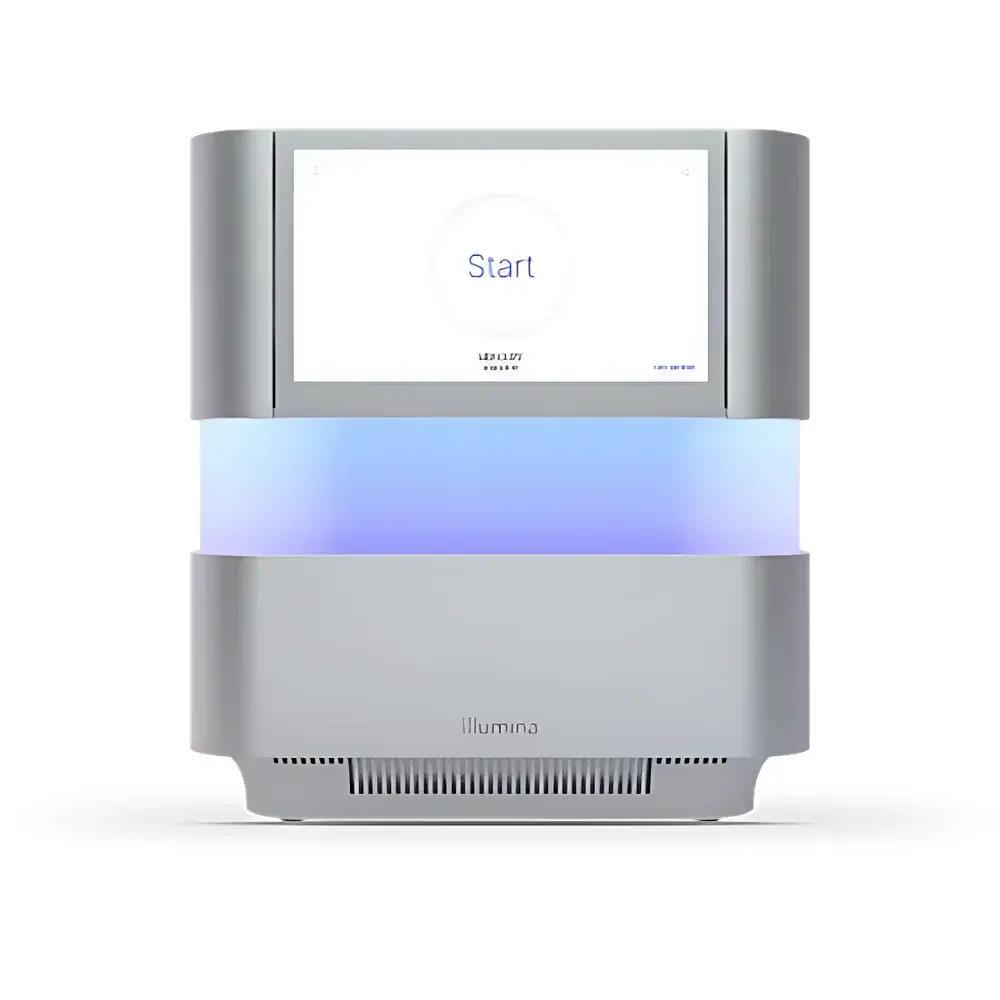
Illumina NextSeq 1000/1000-CN Desktop Sequencing System
| Brand | Illumina |
|---|---|
| Origin | Shanghai, China |
| Model | NextSeq 1000/1000-CN |
| Instrument Type | Short-Read Sequencing Platform (Illumina SBS Chemistry) |
| Read Length | Up to 2 × 150 bp |
| Output per Flow Cell | Up to 30 Gb (P1), 120 Gb (P2), 360 Gb (P3) |
| Q30 Score | ≥85% at 2 × 150 bp |
| Run Time | ~19–48 hours depending on read length and flow cell type |
| Flow Cell Compatibility | P1, P2, P3 (P3 limited to NextSeq 2000/2000-CN) |
| On-Instrument Secondary Analysis | Integrated DRAGEN Bio-IT FPGA Accelerator |
| Laser Wavelengths | 449 nm, 523 nm, 820 nm |
| Operating Temperature | 15–30 °C |
| Relative Humidity | 20–80% non-condensing |
| Altitude Limit | ≤2000 m |
| Safety Classification | Class 1 Laser Product |
| Compliance | IEC 61010-1, CE, FCC/IC, NRTL certified |
Overview
The Illumina NextSeq 1000/1000-CN is a compact, high-performance desktop sequencing system engineered for mid-throughput next-generation sequencing (NGS) applications in academic, clinical research, and translational laboratories. It employs Illumina’s proven sequencing-by-synthesis (SBS) chemistry with reversible terminators and fluorescent nucleotides, enabling highly accurate, scalable short-read sequencing. Unlike legacy first-generation Sanger platforms, the NextSeq 1000/1000-CN delivers massively parallel sequencing across up to 300 million clusters per flow cell—supporting both single-end and paired-end reads. Its integrated DRAGEN Bio-IT FPGA hardware accelerator enables real-time secondary analysis—including alignment, variant calling, and gene expression quantification—without reliance on external compute infrastructure. Designed for flexibility and reproducibility, the system supports multiple flow cell types (P1, P2, P3) and read configurations (1 × 50 bp to 2 × 300 bp), making it suitable for diverse workflows ranging from targeted panels and exome sequencing to total RNA-Seq and single-cell transcriptomics.
Key Features
- Integrated DRAGEN FPGA-based secondary analysis engine—enables on-instrument alignment, variant calling (SNV/indel), and RNA quantification with <1-hour turnaround post-run for typical WES or RNA-Seq datasets.
- Compact benchtop footprint (60 × 65 × 60 cm) with self-contained thermal, fluidic, and optical subsystems—no external chillers, compressors, or high-power racks required.
- Three-tiered flow cell architecture (P1/P2/P3) offering scalable output: 30 Gb (P1), 120 Gb (P2), and 360 Gb (P3) per run at 2 × 150 bp, with Q30 scores ≥85% across all configurations.
- Dual-laser excitation (449 nm, 523 nm) and near-infrared detection (820 nm) for robust signal discrimination and reduced phasing/pre-phasing artifacts.
- Onboard Linux-based control computer (288 GB RAM, 3.8 TB SSD) running CentOS 7.6—fully validated for GLP/GMP-aligned data integrity and audit-trail compliance.
- Automated cluster generation, sequencing, and base calling—run times range from ~19 hr (2 × 150 bp, P1) to ~48 hr (2 × 150 bp, P3), including full cycle completion.
Sample Compatibility & Compliance
The NextSeq 1000/1000-CN accepts standard Illumina-compatible libraries prepared using TruSeq, Nextera, or IDT for Illumina kits—including stranded mRNA, total RNA, exome capture, amplicon, and single-cell 3′/5′ gene expression libraries. It supports dual indexing (up to 384 unique dual indexes) and is validated for use with Illumina’s XLEAP-SBS reagents (Q2 2024 release), extending shelf life and improving signal fidelity. The system meets international safety and electromagnetic compatibility standards: IEC 61010-1 (electrical safety), CE marking (EU Directive 2014/30/EU), FCC Part 15 Class A (USA), IC ES-3001 (Canada), and NRTL certification (UL 61010-1). While not classified as a medical device under FDA 21 CFR Part 809 or EU IVDR, its data outputs are compatible with CLIA-certified bioinformatics pipelines and support 21 CFR Part 11-compliant audit trails when deployed with BaseSpace Sequence Hub or local DRAGEN deployments under controlled IT governance.
Software & Data Management
Instrument operation and data handling are managed via Illumina Experiment Manager (IEM) v6.0+ and BaseSpace Sequence Hub—a cloud-hosted platform supporting HIPAA-compliant storage, role-based access control (RBAC), and automated pipeline execution (e.g., DRAGEN Germline, RNA, or QC workflows). Local analysis is fully supported through the embedded DRAGEN server, which logs all processing steps—including parameter versioning, input checksums, and runtime metrics—for full traceability. Raw BCL files are stored on the internal SSD with automatic encryption-at-rest; FASTQ and VCF outputs can be exported via SFTP, NFS, or direct USB transfer. Network requirements include ≥200 Mb/s dedicated upload bandwidth per instrument for BaseSpace synchronization and ≥5 Mb/s for metadata telemetry and remote diagnostics.
Applications
The NextSeq 1000/1000-CN is optimized for applications requiring balanced throughput, accuracy, and turnkey usability. Typical use cases include: whole-exome sequencing (WES) at >90× mean coverage across 30–48 samples per P3 run; total RNA-Seq with 50M read pairs per sample (16–24 samples/run); single-cell RNA-Seq (5K cells/sample, 20K reads/cell) across 4–12 samples per P2 run; small RNA/miRNA profiling (11M reads/sample, up to 108 samples on P3); and 16S rRNA metagenomic profiling (384-indexed samples per run). Its dynamic range and low duplication rates (<5% typical) make it especially valuable for low-input and degraded samples—such as FFPE-derived DNA or plasma cfDNA—when combined with appropriate library prep chemistries.
FAQ
Is the NextSeq 1000/1000-CN compliant with FDA 21 CFR Part 11?
Yes—when deployed with BaseSpace Sequence Hub or validated local DRAGEN environments that enforce electronic signatures, audit trails, and secure user authentication.
Can P3 flow cells be used on the NextSeq 1000/1000-CN?
No—P3 flow cells and associated reagents are exclusively compatible with the NextSeq 2000/2000-CN platform.
What is the maximum supported read length?
The system supports up to 2 × 300 bp reads; however, the 1000/1000-CN configuration is optimized for 2 × 150 bp with ≥85% Q30 bases.
Does the instrument require external computing resources?
No—integrated DRAGEN FPGA provides full secondary analysis capability without external servers or GPUs.
How is data integrity ensured during sequencing runs?
All raw BCL files are checksum-verified during acquisition; every base call includes confidence scoring (Q-value), and full run logs—including temperature, pressure, and laser power histories—are archived automatically.
Related Products




