
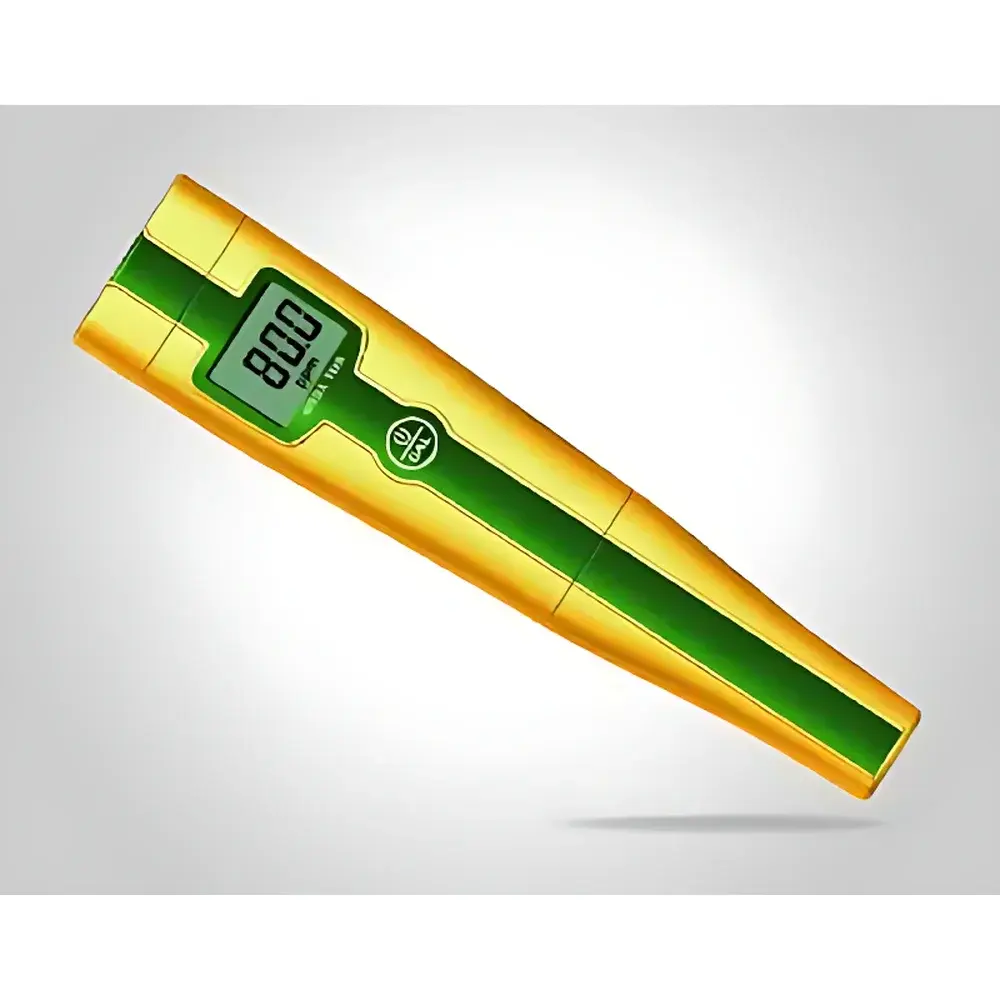
SANXIN 5031 Portable TDS Meter
| Brand | SANXIN |
|---|---|
| Origin | Shanghai, China |
| Manufacturer Type | Direct Manufacturer |
| Region of Origin | Domestic (China) |
| Model | 5031 |
| Price | ¥426 |
| Measurement Range | (0–5.00) ppt (auto-ranging across three segments: 0–49.9 ppm, 50–499 ppm, 0.50–5.00 ppt) |
| Resolution | 0.1/1 ppm |
| Accuracy | ±1% FS |
| Temperature Compensation | Automatic, 5–50 °C (reference 25 °C, temp. coefficient 2%/°C) |
| Calibration | Single-point auto-calibration with 4.20 ppt standard solution |
| Power Supply | Two AAA batteries (1.5 V × 2) |
| Dimensions | 39 × 25 × 176 mm |
| Weight | 87 g |
| Ingress Protection | IP57 |
| Replaceable Electrode | Yes |
Overview
The SANXIN 5031 Portable TDS Meter is a compact, field-deployable electrochemical instrument engineered for rapid, reliable quantification of total dissolved solids (TDS) in aqueous solutions. Based on the fundamental principle of electrical conductivity measurement, the device calculates TDS by applying a standardized conversion factor—typically 0.7—to the measured conductance value, expressed in microsiemens per centimeter (µS/cm). This empirical correlation is widely accepted in water quality monitoring where direct gravimetric TDS determination is impractical. The meter operates under the assumption that dissolved ionic species—including Na⁺, K⁺, Ca²⁺, Mg²⁺, Cl⁻, SO₄²⁻, HCO₃⁻, and NO₃⁻—dominate the conductive contribution, making it especially suitable for potable water, aquarium systems, hydroponics, and low-ionic-strength environmental samples. Its robust architecture integrates a temperature-compensated conductivity sensor with digital signal processing optimized for stability across dynamic thermal environments (5–50 °C), referencing 25 °C as the standard calibration point per ASTM D1125 and ISO 7888.
Key Features
- Triple-range automatic scaling: seamlessly switches between 0–49.9 ppm, 50–499 ppm, and 0.50–5.00 ppt to maintain optimal signal-to-noise ratio across diverse sample matrices
- Replaceable conductivity electrode: enables long-term operational continuity and cost-effective maintenance without instrument replacement
- IP57-rated enclosure: provides dust resistance and immersion protection up to 1 m for 30 minutes—certified per IEC 60529 for use in humid laboratories, outdoor fieldwork, and rinse-prone benchtop environments
- High-efficiency power management: dual AAA alkaline cells deliver over 100 hours of continuous measurement time, minimizing downtime in extended deployment scenarios
- Intuitive single-point calibration protocol using a certified 4.20 ppt NaCl standard solution, aligned with USP conductivity verification guidelines for non-sterile water testing
- Ergonomic pen-style form factor (39 × 25 × 176 mm; 87 g): designed for one-handed operation, pocket portability, and glove-compatible tactile feedback
Sample Compatibility & Compliance
The 5031 is validated for use with freshwater, drinking water, reverse osmosis permeate, distilled water, and low-conductivity process streams (conductivity < 10 mS/m). It is not intended for high-salinity seawater, industrial brines, or viscous organic solvents. All measurements comply with the temperature compensation methodology defined in ISO 7888:2019 (Water quality — Determination of electrical conductivity) and support routine verification against NIST-traceable conductivity standards. While not 21 CFR Part 11 compliant due to its standalone analog-digital hybrid architecture, the device meets GLP documentation requirements when used with controlled calibration logs and operator-annotated field records.
Software & Data Management
As a self-contained handheld instrument, the 5031 does not interface with external software or cloud platforms. All data are displayed in real time on a high-contrast LCD screen with backlighting. No internal memory or USB export capability is included; users must manually record readings in laboratory notebooks or LIMS-integrated paper forms. Calibration events and battery status are indicated via dedicated icons—consistent with IEC 61000-4-30 Class S instrumentation design conventions for basic electrochemical meters.
Applications
- Routine verification of reverse osmosis and deionization system performance in pharmaceutical water loops
- Field assessment of source water quality prior to disinfection in municipal pre-treatment facilities
- Monitoring nutrient concentration stability in closed-loop hydroponic cultivation systems
- Quick-check validation of cleaning-in-place (CIP) rinse water conductivity in food & beverage production lines
- Classroom demonstrations of ionic solute behavior and temperature-dependent conductivity effects
- Baseline screening of groundwater wells during environmental site assessments (ESA)
FAQ
What is the relationship between TDS and conductivity?
TDS is estimated from conductivity using a fixed linear conversion factor (typically 0.7), based on the assumption that dissolved ions dominate solution conductance. No direct mass-based measurement occurs.
Can the 5031 measure seawater or brackish water?
No—the upper limit of 5.00 ppt (5000 ppm) is insufficient for typical seawater (~35,000 ppm); use a high-range conductivity meter with appropriate salinity algorithms instead.
Is temperature compensation adjustable by the user?
No—compensation follows a factory-set 2%/°C coefficient referenced to 25 °C, consistent with standard water quality practice and non-configurable per design.
How often should calibration be performed?
Daily calibration is recommended for critical applications; otherwise, verify before each measurement session or after exposure to extreme temperatures or contaminants.
Does the electrode require storage solution?
Yes—store the replaceable electrode in a dilute KCl solution (e.g., 3 M KCl) when not in use to prevent membrane desiccation and ensure stable junction potential.



