
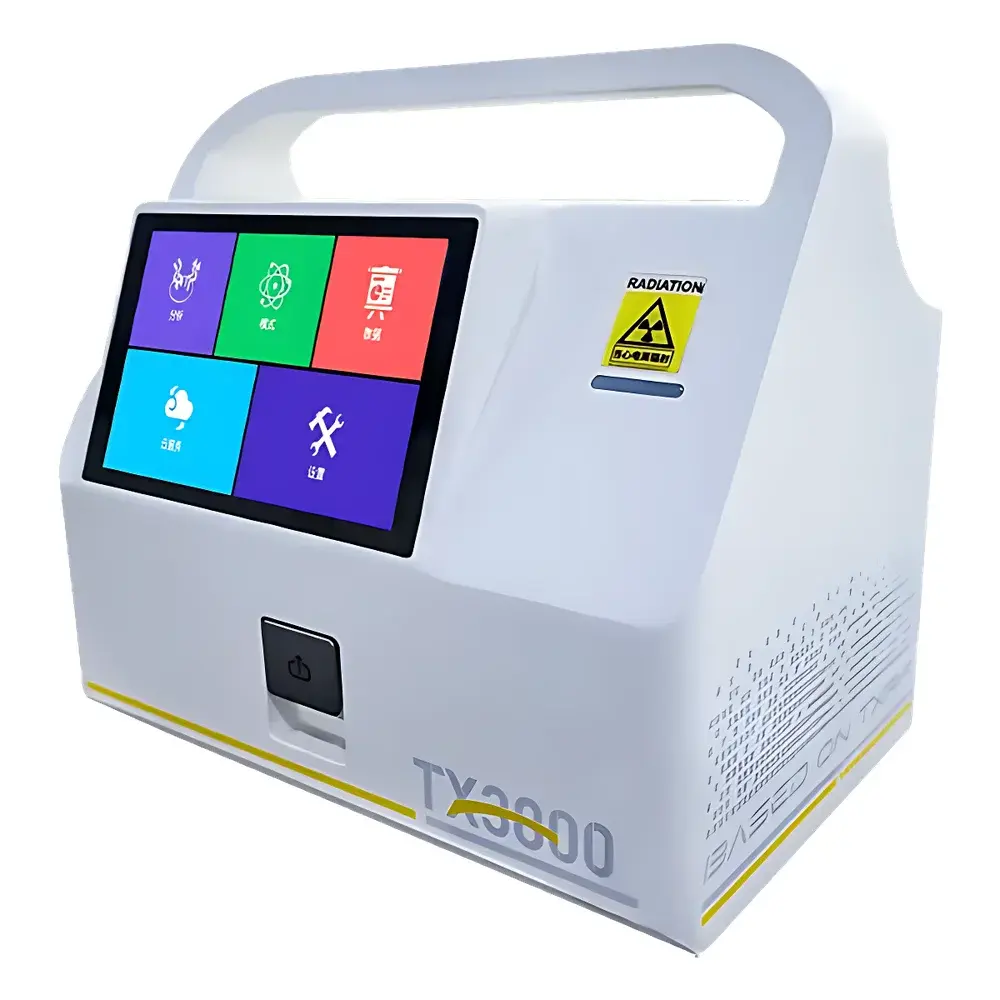
LANScientific TX3800 Portable Total Reflection X-Ray Fluorescence Spectrometer
| Brand | LANScientific |
|---|---|
| Origin | Jiangsu, China |
| Manufacturer Type | Original Equipment Manufacturer (OEM) |
| Instrument Type | Total Reflection XRF (TXRF) |
| Element Range | Mg–U |
| Detection Limit | 0.1 ppb – 100 ppm |
| Detector | 65 mm² Silicon Drift Detector (SDD) |
Overview
The LANScientific TX3800 is a field-deployable, benchtop-compatible total reflection X-ray fluorescence (TXRF) spectrometer engineered for ultra-trace elemental analysis in minimal sample volumes. Unlike conventional energy-dispersive XRF (ED-XRF), the TX3800 exploits the principle of total external reflection—where an incident X-ray beam strikes a flat, polished quartz carrier at a grazing angle (95% compared to standard ED-XRF, enabling detection limits down to 0.1 pg (≈0.1 ppb in 10 µL aqueous matrix) for elements from magnesium (Mg, Z=12) to uranium (U, Z=92). The instrument operates without vacuum or helium purge, eliminating infrastructure dependencies while maintaining high spectral resolution (FWHM ≤135 eV at Mn Kα) and quantitative reproducibility (RSD < 3% at 10 ppb level across 20 replicates). Its solid-state optical path, fixed-geometry optics, and integrated thermal stabilization ensure measurement stability under variable ambient conditions—critical for mobile laboratory and on-site deployment.
Key Features
- Ultra-low background TXRF architecture with <0.1° incidence angle control and monolithic quartz sample carriers
- High-efficiency 65 mm² silicon drift detector (SDD) with Peltier cooling and real-time pulse processing
- Integrated micro-droplet deposition guidance system supporting 1–20 µL sample volumes (liquid, digested suspensions, or dried residues)
- Self-calibrating quantification using internal standard addition (e.g., Ga or Y) and fundamental parameter (FP) algorithms
- Ruggedized aluminum chassis (weight: 14.2 kg; dimensions: 320 × 360 × 280 mm) with IP52-rated enclosure for field use
- No consumables required: no gas purge, no vacuum pump, no filament replacement, no collimator alignment
- FDA 21 CFR Part 11–compliant audit trail, electronic signature support, and secure user role management
Sample Compatibility & Compliance
The TX3800 accepts liquid samples (aqueous, organic solvents, acid digests), dried thin-film residues, and homogenized suspensions deposited onto certified quartz carriers. It supports direct analysis of environmental waters (drinking, wastewater, leachates), biological fluids (serum, urine, CSF), food extracts, soil digests (EPA Method 3050B/3052), and semiconductor wafer rinse solutions. All measurements comply with ISO 12847:2017 (TXRF for trace metal analysis in water), ASTM D7724–22 (trace metals in fuels), and CLP Regulation (EC) No 1272/2008 for hazardous substance screening. The system meets IEC 61000-6-3 (EMC) and IEC 61000-6-2 (immunity) standards and carries CE marking for electromagnetic compatibility and low-voltage safety. Radiation exposure is limited to <0.5 µSv/h at 5 cm distance (verified per IEC 62495), qualifying it for unshielded operation in shared lab spaces and field vehicles.
Software & Data Management
The proprietary QuantStudio TXRF software (v4.3+) provides fully automated acquisition, spectrum deconvolution (using iterative least-squares fitting with Voigt line profiles), and matrix-matched calibration workflows. It embeds NIST SRM reference libraries (e.g., SRM 1643e, SRM 2783) and supports custom calibration curves with up to 32 internal standards. Raw data (SPE files), processed spectra (.csv/.xlsx), and full audit logs are stored in AES-256 encrypted SQLite databases. Software modules include GLP/GMP mode (with electronic signatures, change control, and versioned method templates), batch reporting (PDF/HTML export with embedded metadata), and remote diagnostics via TLS-secured SSH tunneling. Data integrity conforms to ALCOA+ principles (Attributable, Legible, Contemporaneous, Original, Accurate, Complete, Consistent, Enduring, Available).
Applications
- Environmental Monitoring: Quantification of As, Cd, Cr, Pb, Hg, Sb, Se, and U in groundwater, soil pore water, and atmospheric particulate filters (PM2.5/PM10) per EPA 6020B and ISO 17294-2
- Food Safety & Agriculture: Screening of toxic metals in infant formula, rice, honey, wine, and seafood extracts; compliance with EU Commission Regulation (EU) No 2023/915 and FDA Food Code Chapter 3
- Pharmaceutical QC: Residual catalyst (Pd, Pt, Rh) and elemental impurity (ICH Q3D Class 1–3) testing in APIs and finished dosage forms
- Materials Science: Surface contamination mapping on Si wafers (≤1×10¹⁰ atoms/cm2 sensitivity), thin-film composition verification, and glass batch homogeneity assessment
- Forensics & Cultural Heritage: Micro-sampling of paint layers, ink residues, and archaeological soil strata without destructive sectioning; elemental fingerprinting for provenance studies
- Clinical & Biomedical Research: Multi-element profiling (Fe, Zn, Cu, Se, Mo) in serum/plasma for nutritional status evaluation and metalloprotein biomarker discovery
FAQ
What sample preparation is required for TXRF analysis?
Minimal preparation is needed: liquids are diluted to known volume (typically 10 µL), spiked with internal standard, and deposited onto quartz carriers. Solid samples require acid digestion (HNO3/H2O2) prior to deposition. No filtration, centrifugation, or matrix matching is mandatory.
Can the TX3800 analyze non-aqueous matrices such as oils or polymers?
Yes—organic solvents (e.g., kerosene, toluene) and polymer digests (microwave-assisted HF/HNO3) are compatible when internal standard recovery remains ≥85%. Viscosity must be <50 cP for uniform droplet formation.
How does TXRF differ from conventional ED-XRF in terms of detection limits?
TXRF achieves sub-ppt detection due to suppressed continuum background and enhanced signal-to-noise ratio. Typical ED-XRF detection limits for heavy metals in water range from 1–10 ppb; TX3800 delivers 0.1–0.5 ppb for the same elements under identical sample mass conditions.
Is method validation support available for regulatory submissions?
Yes—LANScientific provides IQ/OQ/PQ documentation templates, uncertainty budget worksheets per EURACHEM/CITAC Guide, and GMP-compliant validation protocols aligned with USP , EP 2.4.20, and ISO/IEC 17025:2017 requirements.
What maintenance schedule is recommended?
Annual energy calibration using Mn/Kα and Co/Kα check sources is advised. Detector performance is monitored continuously via built-in pulse height analyzer diagnostics; no routine servicing or recalibration is required between certifications.




