
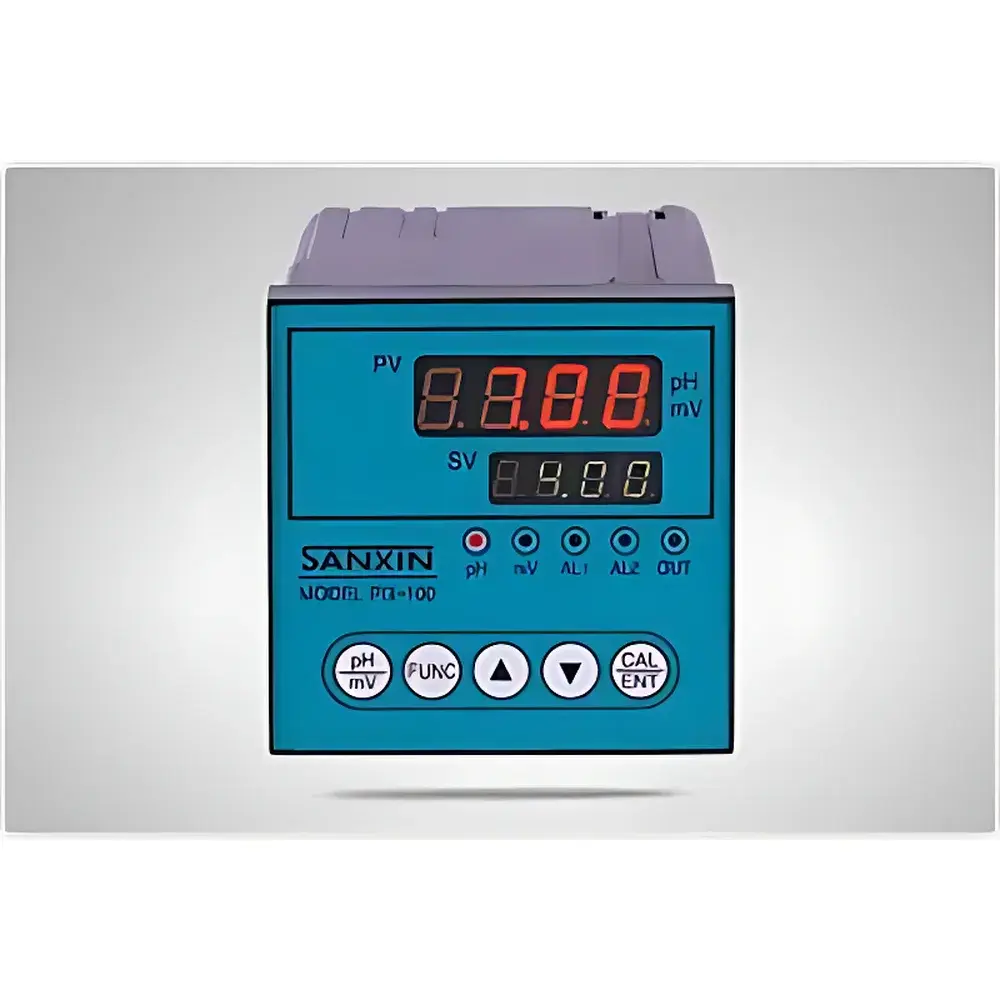
Sanxin PG100 Intelligent Digital pH/ORP Controller
| Brand | Sanxin Peirui |
|---|---|
| Origin | Shanghai, China |
| Manufacturer Type | Direct Manufacturer |
| Product Category | Domestic (China-Made) |
| Model | PG100 |
| Input Signals | 0–5 V DC, 1–5 V DC, 0–10 mA DC, 4–20 mA DC |
| Measurement Range | 0.00–14.00 pH / 0–1400 mV |
| Resolution | 0.01 pH / 1 mV |
| Accuracy | ±0.05 pH ±1 digit (pH) |
| Output Signals | 0–10 V DC, 4–20 mA DC |
| Alarm Outputs | 2 independent relay outputs (configurable as high/low limit, with adjustable hysteresis) |
| Control Output | 1 SPST switch output (ON/OFF control, selectable direct/reverse action, adjustable deadband) |
| Calibration | Two-point pH calibration using standard buffers (e.g., pH 4.00 & 6.86, or pH 6.86 & 9.18) |
| Power Supply | 90–260 V AC, 50–60 Hz |
| Operating Environment | 0–50 °C, 35–85% RH (non-condensing) |
| Weight | ~0.25 kg |
| Display | Dual-line LED (pH/mV and status/control parameters simultaneously) |
| Signal Processing | Digital filtering algorithm for noise suppression and signal stabilization |
Overview
The Sanxin PG100 Intelligent Digital pH/ORP Controller is a dedicated industrial process monitoring and control instrument engineered for continuous, reliable measurement of hydrogen ion activity (pH) and oxidation-reduction potential (ORP) in aqueous systems. Based on potentiometric electrochemical principles, the PG100 interfaces directly with standard glass pH electrodes and ORP (redox) electrodes—converting millivolt-level electrode signals into calibrated digital readings via high-impedance input circuitry and precision analog-to-digital conversion. Its dual-parameter capability enables simultaneous oversight of acid-base equilibrium and redox state, making it suitable for applications where both chemical neutrality and oxidative stability are critical process variables—such as wastewater neutralization, chemical dosing control, electroplating bath management, and bioreactor monitoring. The controller features an embedded microprocessor architecture with real-time digital filtering to suppress electromagnetic interference (EMI), line noise, and transient spikes commonly encountered in industrial environments.
Key Features
- Dual-line LED display showing primary measurement (pH or mV) and secondary parameter (e.g., alarm status, setpoint, or control mode) concurrently
- Two fully independent, user-configurable relay alarm outputs—each assignable as high-limit, low-limit, or window-type alarms with adjustable hysteresis (deadband)
- One SPST (single-pole, single-throw) switch output for ON/OFF process control, supporting selectable direct or reverse action to accommodate pump start/stop, valve actuation, or dosing solenoid logic
- Flexible analog input compatibility: accepts 0–5 V DC, 1–5 V DC, 0–10 mA DC, and 4–20 mA DC signals from remote transmitters or electrode signal conditioners
- Standard analog output options: isolated 0–10 V DC or 4–20 mA DC for integration with DCS, PLC, or SCADA systems
- Two-point pH calibration routine supporting common NIST-traceable buffer pairs (e.g., pH 4.00/6.86 or pH 6.86/9.18), with automatic temperature compensation (ATC) support when used with optional temperature sensor input
- Switch-mode power supply (90–260 V AC, 50–60 Hz) ensures stable operation across global mains voltages and reduces thermal drift
- Compact DIN-rail mountable housing (approx. 0.25 kg) designed for panel integration in control cabinets; conforms to IP65 front-panel rating when installed with gasket
Sample Compatibility & Compliance
The PG100 is intended for use with standard combination pH electrodes (e.g., Ag/AgCl reference, glass sensing membrane) and platinum or gold-based ORP electrodes compliant with IEC 60746-2 (Electrochemical analyzers — Part 2: pH meters). It supports measurement in non-viscous, aqueous solutions with conductivity ≥50 µS/cm and temperature within 0–50 °C. While not certified for hazardous locations, its robust PCB layout—utilizing surface-mount technology (SMT) and conformal coating—ensures long-term reliability in typical industrial settings including water treatment plants, food processing lines, and chemical manufacturing units. The device meets EMC requirements per IEC 61326-1 (industrial environment) and safety standards per IEC 61010-1. It does not include FDA 21 CFR Part 11 compliance features (e.g., electronic signatures or audit trails), and is therefore deployed in non-GMP contexts where GLP-aligned documentation suffices.
Software & Data Management
The PG100 operates as a standalone hardware controller without embedded firmware-upgradable software or network connectivity (no Ethernet, USB, or Bluetooth). Configuration is performed locally via push-button interface and LED menu navigation. All calibration data, alarm thresholds, control setpoints, and hysteresis values are stored in non-volatile memory and retained during power loss. No proprietary PC software is required or provided; however, analog output signals (4–20 mA or 0–10 V) may be logged by external data acquisition systems compliant with Modbus RTU or HART protocols if paired with compatible signal converters. For traceability, users are advised to maintain manual calibration logs per ISO/IEC 17025 Clause 7.7 (monitoring and measurement equipment).
Applications
- Continuous pH control in municipal and industrial wastewater neutralization tanks
- ORP-guided chlorine or ozone dosing in potable water disinfection systems
- Acid/alkali feed control in chemical mixing skids and CIP (clean-in-place) rinse cycles
- Redox monitoring in electroplating baths (e.g., nickel, copper, chromium) to maintain optimal deposition conditions
- pH stabilization in fermentation vessels and bioreactors during upstream processing
- Quality assurance testing in electrochemical plating lines and printed circuit board (PCB) etching processes
FAQ
Does the PG100 support automatic temperature compensation (ATC)?
Yes—when connected to a compatible Pt100 or thermistor-based temperature sensor (input via dedicated terminal), the unit applies Nernst equation-based ATC to pH measurements. ORP compensation is not applied, as redox potential exhibits complex, solution-dependent temperature behavior.
Can the alarm relays drive a 24 V DC solenoid valve directly?
The relays are rated for 250 V AC / 30 V DC at 3 A resistive load. For inductive loads such as solenoids, a flyback diode must be installed externally to suppress back-EMF and prevent contact arcing.
Is calibration data exportable or password-protected?
No. Calibration parameters are stored internally but cannot be exported, backed up, or locked with user passwords. All configuration changes require physical access and button navigation.
What is the maximum cable length between the PG100 and a pH electrode?
For optimal signal integrity, electrode cable length should not exceed 15 meters using shielded, twisted-pair coaxial cable (e.g., Belden 8761). Longer runs require an in-line signal conditioner or preamplifier located near the electrode.
Does the PG100 meet CE or RoHS directives?
Yes—the unit carries CE marking and complies with EU RoHS Directive 2011/65/EU. Declaration of Conformity is available upon request from Sanxin Peirui’s technical support team.
Related Products




