
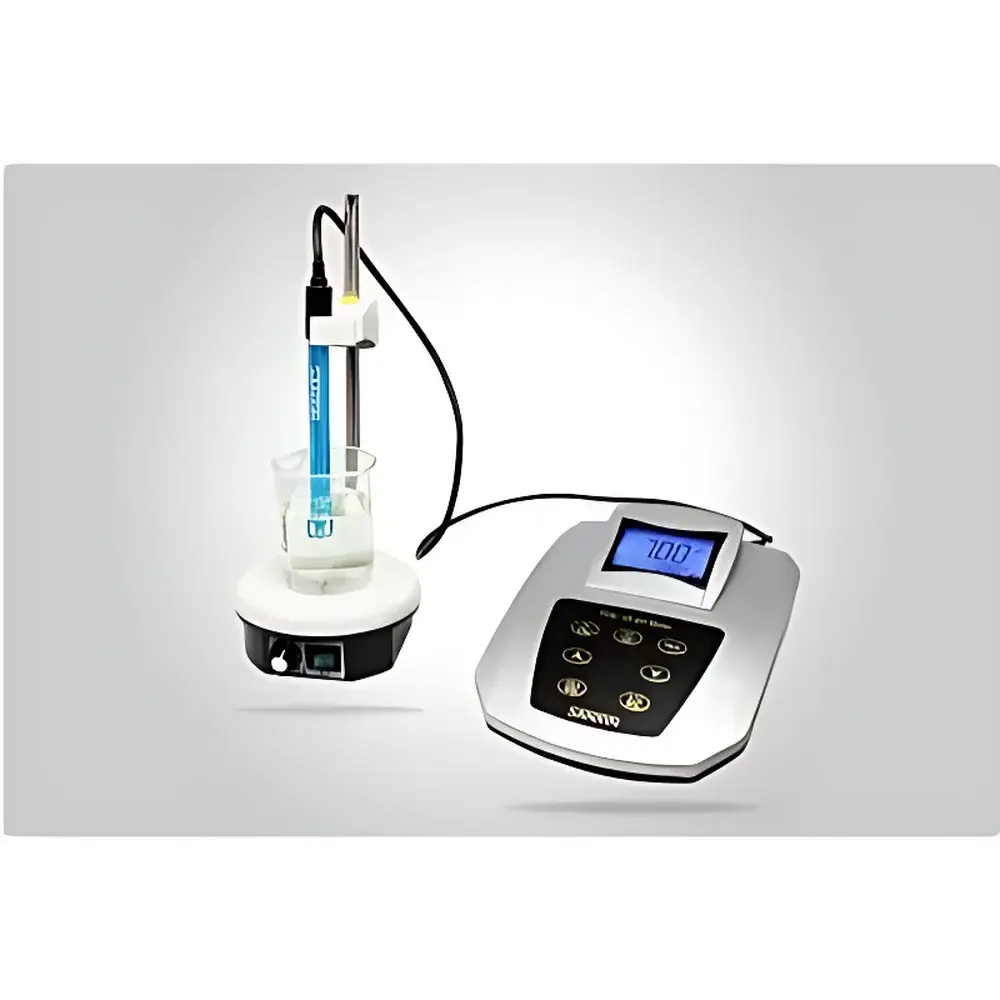
Sanxin PHS-3D Benchtop pH Meter
| Brand | Sanxin Peirui |
|---|---|
| Origin | Shanghai, China |
| Manufacturer Type | Direct Manufacturer |
| Product Type | Benchtop |
| Parameter Type | Single-Parameter (pH) |
| Measurement Accuracy | ±0.01 pH |
| pH Range | 0–14 |
| Resolution | 0.01 pH |
| Temperature Compensation | 0–100 °C (Manual or Automatic with ATC Probe) |
| mV Range | ±19999 mV |
| mV Resolution | 1 mV |
| mV Accuracy | ±0.1% F.S. ±1 digit |
| Temperature Measurement Range | 0–100 °C |
| Temperature Accuracy | ±1 °C |
| Display | Backlit LCD showing pH and temperature simultaneously |
| Calibration Points | Five built-in buffer points (pH 4.00, 6.86, 7.00, 9.18, 10.01), user-editable |
| Electrode Slope Display | Yes, post-calibration % slope shown |
| Data Storage | 25 readings with min/max tracking |
| Interface | RS-232 serial output |
| Compliance | Designed for GLP-compliant laboratory workflows |
Overview
The Sanxin PHS-3D Benchtop pH Meter is a precision electrochemical instrument engineered for routine pH and millivolt measurements in quality control laboratories, academic teaching environments, and industrial process support settings. It operates on the fundamental principle of potentiometric measurement: detecting the potential difference between a pH-sensitive glass electrode and a stable reference electrode immersed in an aqueous solution, then converting that voltage into a pH value using the Nernst equation. The instrument features a dedicated single-chip microcontroller architecture optimized for signal stability, low-drift performance, and noise-resistant analog-to-digital conversion—critical for reproducible results across diverse sample matrices. Its benchtop form factor ensures ergonomic operation and integration into fixed workstations, while its dual-mode temperature compensation (manual or automatic via ATC-equipped electrodes) corrects for the inherent temperature dependence of electrode response, ensuring traceable accuracy per ISO 3696 and ASTM E70 guidelines.
Key Features
- High-resolution backlit LCD display simultaneously showing pH value and temperature reading, enhancing readability under varied ambient lighting conditions.
- Intelligent auto-calibration algorithm supporting one-, two-, or three-point calibration with five programmable standard buffer points (pH 4.00, 6.86, 7.00, 9.18, and 10.01), all editable to match regional or application-specific buffer formulations.
- Real-time electrode slope calculation and display post-calibration—enabling immediate assessment of electrode health and readiness for measurement.
- Dual temperature compensation modes: automatic compensation when using an integrated ATC (Automatic Temperature Compensation) pH electrode, or manual input for non-ATC configurations.
- Integrated RS-232 serial interface for direct connection to PCs or LIMS systems, supporting automated data capture and long-term trend analysis.
- Onboard memory storing up to 25 measurement records—including timestamped values, minimum/maximum tracking, and associated calibration metadata—facilitating basic GLP documentation without external software.
Sample Compatibility & Compliance
The PHS-3D is validated for use with aqueous solutions across the full pH 0–14 range, including low-ionic-strength samples (e.g., deionized water), mildly viscous or suspended-phase systems (when used with optional stirring electrode holders), and buffered reagent solutions. It is not intended for non-aqueous solvents, high-salinity brines (>5 M NaCl), or strongly oxidizing/reducing media without prior electrode qualification. The instrument complies with IEC 61010-1 safety standards for electrical laboratory equipment and supports regulatory workflows aligned with FDA 21 CFR Part 11 when connected to validated data acquisition software enabling electronic signatures, audit trails, and secure user access controls. Calibration verification logs—including date, buffer IDs, slope, offset, and operator ID—can be exported via RS-232 for inclusion in QC reports or internal audit packages.
Software & Data Management
While the PHS-3D operates as a standalone instrument, its RS-232 port enables seamless integration with third-party laboratory data management platforms. When paired with compliant terminal emulation or custom scripting (e.g., Python + PySerial), users can implement automated calibration logging, real-time data streaming, and CSV-based report generation. The built-in memory retains 25 entries with min/max statistics—sufficient for shift-based monitoring or daily instrument verification checks. For full GLP/GMP compliance, Sanxin recommends coupling the meter with validated PC software that enforces user authentication, change control, and immutable audit trails—features required for ISO/IEC 17025-accredited testing laboratories.
Applications
- Quality assurance testing of pharmaceutical excipients and final dosage forms per USP and EP 2.2.3.
- pH monitoring during chemical synthesis, fermentation broth analysis, and wastewater effluent characterization.
- Educational labs requiring robust, entry-level instrumentation for electrochemistry fundamentals and electrode theory instruction.
- Food & beverage production lines verifying acidification steps, marinade consistency, and preservative efficacy.
- Environmental field labs conducting surface water and soil leachate screening where benchtop stability and repeatability are prioritized over portability.
FAQ
Does the PHS-3D support automatic temperature compensation (ATC)?
Yes—when used with a compatible tri-combination pH electrode equipped with an integrated temperature sensor, the instrument performs real-time ATC across 0–100 °C.
What calibration buffers are preloaded in the instrument?
Five standard points are factory-configured: pH 4.00, 6.86, 7.00, 9.18, and 10.01—all modifiable via the front-panel menu to accommodate local buffer standards or custom formulations.
Can the instrument store calibration history separately from measurement data?
No—the internal memory stores only 25 sequential measurement records. Calibration parameters (slope, offset, date) are displayed during setup but not archived independently unless exported via RS-232.
Is the RS-232 interface opto-isolated?
No—this is a standard unisolated RS-232 port; users deploying it in electrically noisy industrial environments should consider adding an external isolator or USB-to-RS232 adapter with surge protection.
What is the recommended recalibration frequency for routine QC use?
Per ISO 5725 and CLSI EP21-A, recalibration is advised before each analytical batch or at least once per 8-hour shift when measuring critical samples; verification with a secondary check standard (e.g., pH 7.00) is recommended between calibrations.




