
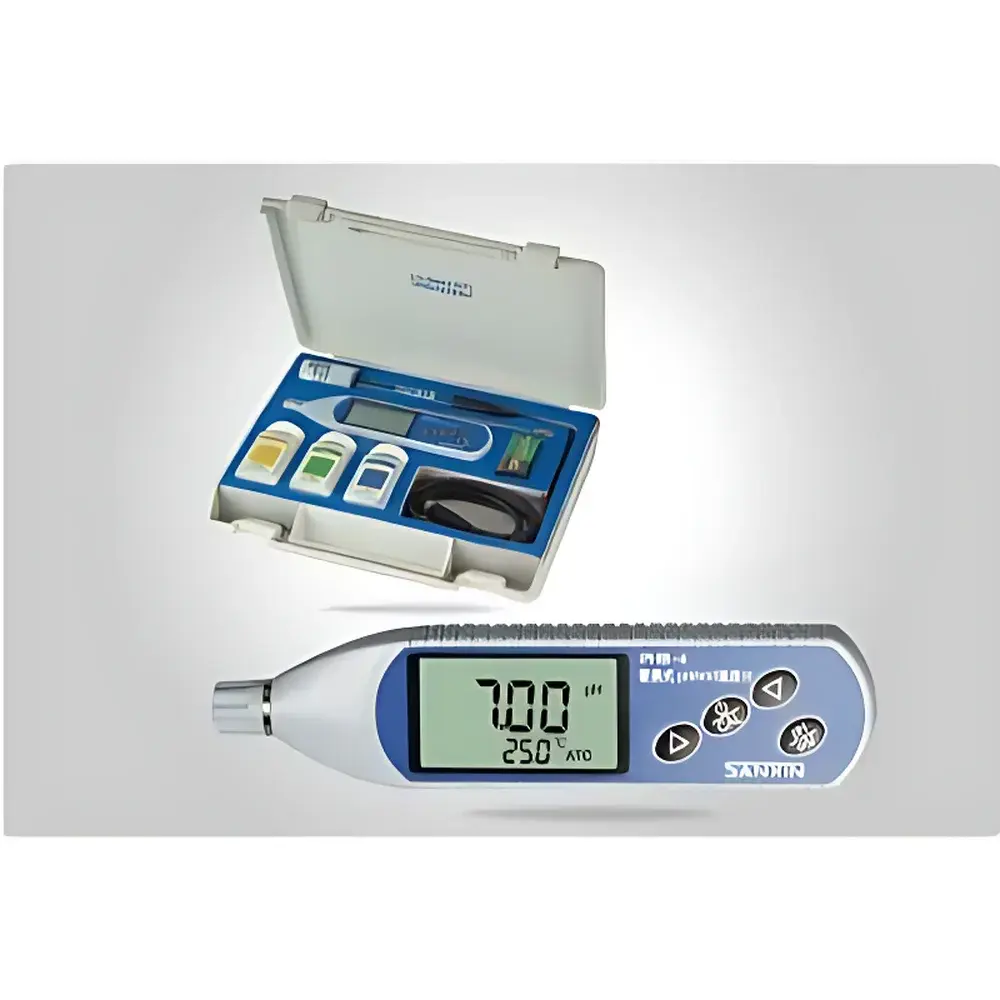
SANXIN PHB-4 Portable pH Meter
| Brand | SANXIN |
|---|---|
| Origin | Shanghai, China |
| Manufacturer Type | Manufacturer |
| Model | PHB-4 |
| pH Range | 0.00–14.00 pH |
| mV Range | ±1999 mV |
| pH Resolution | 0.01 pH |
| mV Resolution | 1 mV |
| Operating Temperature | 5–35 °C |
| Relative Humidity | ≤85% RH |
| Electrode | 201B-S pH/ATC Tri-combination Electrode |
| Calibration | Dual-slope 3-point auto-calibration with built-in standard buffer points (5 configurable) |
| Display | Dual-parameter LCD showing pH and temperature simultaneously |
| Temperature Compensation | Automatic (ATC) |
| Electrode Slope Monitoring | Real-time % slope display post-calibration |
Overview
The SANXIN PHB-4 Portable pH Meter is a field-deployable, laboratory-grade instrument engineered for reliable and repeatable pH and redox potential (mV) measurements in diverse aqueous environments. Designed around the principles of potentiometric measurement using a glass membrane electrode system, the PHB-4 detects hydrogen ion activity via the Nernst equation—generating a voltage differential proportional to pH across a pH-sensitive hydrated silica gel layer. Its integrated ATC (Automatic Temperature Compensation) circuit employs a built-in thermistor within the 201B-S tri-combination electrode to correct for thermal effects on electrode response, ensuring traceable accuracy across variable ambient conditions. Intended for routine use in environmental monitoring workflows—including surface water surveys, drinking water verification, rainwater acidity assessment, and low-conductivity source water analysis—the PHB-4 meets the functional requirements of ISO 10523 (Water quality — Determination of pH), ASTM D1293 (Standard Test Methods for pH of Water), and EPA Method 150.1, supporting data integrity in regulatory-compliant field sampling.
Key Features
- Tri-combination electrode (201B-S) featuring optimized low-ionic-strength membrane formulation and robust double-junction reference design—enabling stable response in deionized water, river water, tap water, and acid rain where conventional electrodes exhibit drift or sluggish equilibration.
- Dual-slope, three-point automatic calibration algorithm that validates both offset and sensitivity against user-selected standard buffers (pH 4.01, 6.86, 7.00, 9.18, or 10.01); slope percentage is calculated and displayed immediately after calibration completion for electrode health assessment.
- Five programmable buffer memory slots with factory-default values aligned to IUPAC-recommended standard solutions; users may edit or overwrite calibration points to match site-specific or metrology lab protocols.
- Simultaneous dual-parameter LCD display showing real-time pH value and measured temperature (°C), eliminating manual cross-reference during field logging.
- Integrated ATC functionality with ±0.1 °C resolution and compensation range covering full operational ambient conditions (5–35 °C).
- Compact, IP67-rated housing with rubberized grip and sealed keypad—designed for durability during transport, boat-based sampling, or extended outdoor deployment without protective cases.
Sample Compatibility & Compliance
The PHB-4 is validated for direct immersion measurement in liquid samples with conductivity ≥20 µS/cm. It performs robustly in natural waters (e.g., rivers, lakes, reservoirs), municipal distribution systems, atmospheric precipitation (acid rain), and purified water streams where ionic strength falls below 50 µS/cm—addressing a known limitation of generic pH sensors. The 201B-S electrode’s low-resistance reference junction minimizes liquid junction potential errors in dilute matrices. Instrument compliance supports GLP-aligned documentation: all calibration events (date, time, buffer IDs, slope %, offset mV) are retained in non-volatile memory. While the PHB-4 does not include electronic audit trail or CFR Part 11 compliance features, its calibration records satisfy basic QA/QC reporting needs under ISO/IEC 17025 Clause 7.7 and EPA Contract Lab Program (CLP) field instrument verification requirements.
Software & Data Management
The PHB-4 operates as a standalone, battery-powered meter with no proprietary software dependency. All calibration parameters, slope diagnostics, and measurement history remain stored onboard for up to 200 readings (timestamped and tagged with temperature). Data export is manual via visual transcription or optional RS-232 interface (with compatible serial-to-USB adapter and terminal emulator). No cloud connectivity, firmware OTA updates, or database synchronization capabilities are provided—ensuring deterministic behavior and minimizing cybersecurity exposure in remote or infrastructure-limited settings. Calibration logs meet minimum traceability thresholds for third-party environmental audits when paired with field notebooks documenting sampling location, time, operator ID, and electrode lot number.
Applications
- Field-based ambient water quality monitoring per national or regional environmental protection agency protocols (e.g., China MEP HJ 1147–2020, US EPA Region 10 Surface Water Monitoring Guidance).
- Routine verification of municipal drinking water pH at intake, treatment stages, and distribution endpoints in accordance with WHO Guidelines for Drinking-water Quality and GB 5749–2022.
- Acid deposition studies measuring pH of rainfall, fog, or snowmelt—leveraging the electrode’s stability in sub-100 µS/cm matrices.
- Educational laboratories requiring rugged, entry-level instrumentation for teaching electrochemical fundamentals, calibration theory, and environmental sampling best practices.
- Pre-screening of industrial effluents prior to lab-based IC or ICP-MS analysis, ensuring sample integrity during preservation and transport.
FAQ
What buffer solutions are pre-programmed into the PHB-4?
The device ships with five IUPAC-standard calibration points (pH 4.01, 6.86, 7.00, 9.18, and 10.01 at 25 °C); all can be edited or replaced with custom values.
Does the PHB-4 support manual temperature input if the ATC electrode is disconnected?
No—temperature compensation requires the integrated thermistor in the 201B-S electrode; manual entry is not supported.
How often should the 201B-S electrode be recalibrated during continuous field use?
Calibration is recommended before each sampling session and repeated every 2–4 hours during extended operation, especially when transitioning between sample types with markedly different ionic strengths.
Is the PHB-4 suitable for measuring pH in seawater or high-salinity brines?
Not recommended—its electrode design targets low-to-moderate conductivity waters; for marine applications, a dedicated seawater pH probe with KCl-saturated reference electrolyte is required.
What is the expected service life of the 201B-S electrode under typical field conditions?
With proper storage (in 3 M KCl solution), regular cleaning, and avoidance of protein/fouling agents, functional lifespan averages 12–18 months in freshwater monitoring programs.







