
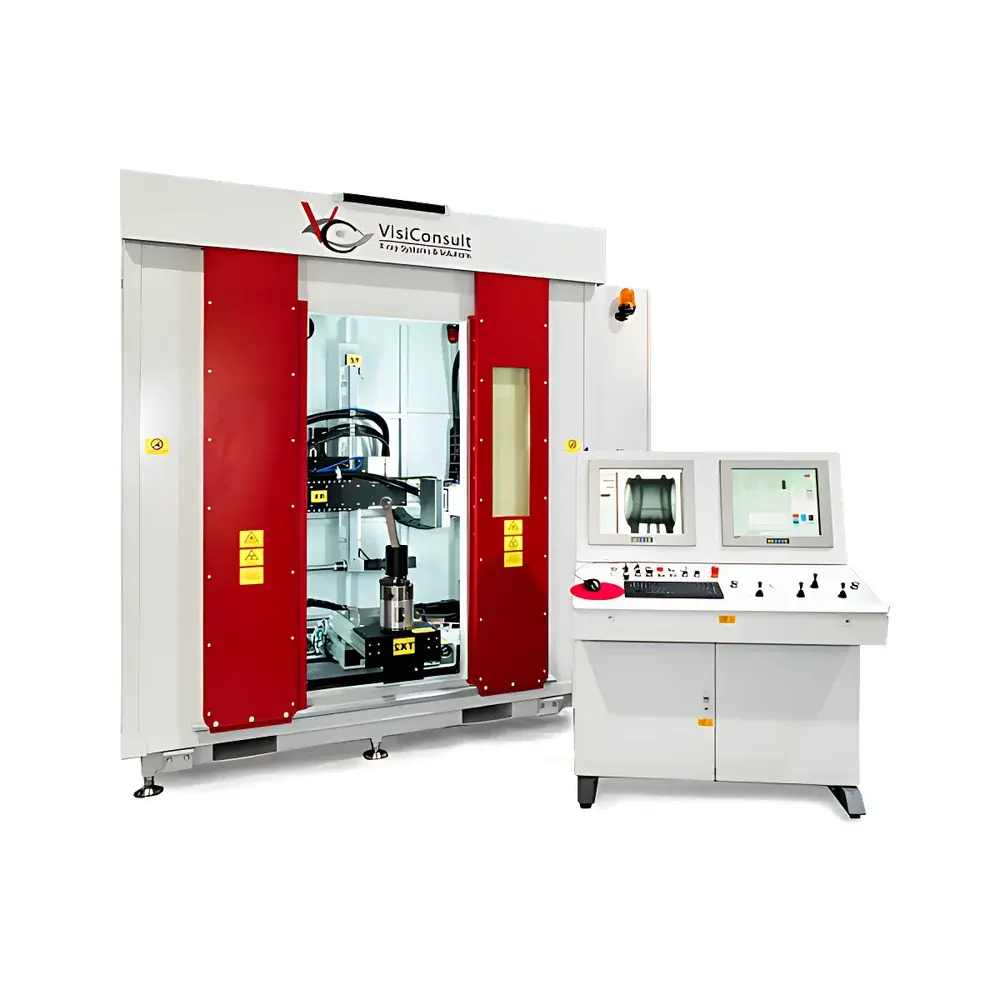
Visiconsult XRH222 Industrial Micro-CT System
| Brand | Visiconsult |
|---|---|
| Origin | Germany |
| Model | XRH222 |
| Type | Industrial Micro-Computed Tomography System |
| Application Scope | NDT for Castings, Composites, Welds, Electronics & Aerospace Components |
| Compliance | DICOM/DICONDE-compliant |
| Automation Capability | Integrated ADR (Automated Defect Recognition), Real-time Imaging, Process Automation |
| Design | Ruggedized Industrial Platform for Lab & Production Floor Use |
Overview
The Visiconsult XRH222 Industrial Micro-CT System is a high-stability, multi-purpose X-ray computed tomography platform engineered for non-destructive 3D volumetric inspection in both laboratory and production-integrated environments. Based on cone-beam micro-CT architecture, the system employs high-resolution flat-panel detectors and precision rotational stages to reconstruct isotropic voxel datasets with sub-micron spatial resolution—enabling quantitative analysis of internal geometry, material density distribution, and structural integrity without sample sectioning. Unlike conventional 2D radiography, the XRH222 delivers true volumetric data compliant with ASTM E1441 (Standard Guide for Computed Tomography (CT) Imaging), ISO 15708 (Non-destructive testing — Qualification of computed tomography (CT) systems), and supports traceable dimensional metrology per VDI/VDE 2630-1.1. Its modular mechanical design accommodates parts ranging from small electronic assemblies (400 mm height), making it suitable for validation across mixed-product manufacturing lines where throughput, repeatability, and regulatory audit readiness are critical.
Key Features
- Rugged industrial-grade gantry with vibration-damped base and temperature-stabilized X-ray tube housing—designed for continuous operation in factory environments (IP54-rated enclosure options available)
- High-fidelity micro-focus X-ray source (tungsten target, focal spot ≤ 5 µm) paired with large-area amorphous silicon flat-panel detector (≥ 2048 × 2048 pixels, 12-bit dynamic range)
- Integrated Automated Defect Recognition (ADR) engine based on supervised machine learning models trained on defect libraries for porosity, inclusions, cracks, and delaminations
- Real-time radiographic imaging mode with adjustable frame rate (up to 30 fps) and hardware-based image enhancement (contrast optimization, noise suppression)
- Full CT reconstruction pipeline including Feldkamp-Davis-Kress (FDK) algorithm, iterative reconstruction (SART), and GPU-accelerated processing
- Native support for DICONDE (Digital Imaging and Communication in Non-Destructive Evaluation) standard for long-term archival, cross-system interoperability, and PACS integration
Sample Compatibility & Compliance
The XRH222 accommodates a broad spectrum of industrial components—including aluminum die-cast housings, carbon-fiber-reinforced polymer (CFRP) laminates, laser-welded battery modules, multilayer PCBs, turbine blades, and additive-manufactured metal parts. Sample mounting interfaces comply with ISO 10360-8 for coordinate measuring machine (CMM)-compatible fixturing, enabling hybrid metrology workflows. All CT datasets meet GLP/GMP documentation requirements: raw projections and reconstructed volumes are stored with embedded metadata (exposure parameters, stage position logs, calibration timestamps). The system supports FDA 21 CFR Part 11-compliant user access control, electronic signatures, and full audit trail generation when operated with validated software configurations.
Software & Data Management
Control and analysis are performed via Visiconsult’s proprietary CT Suite v5.x—a Windows-based application certified for ISO/IEC 17025 laboratory management systems. The suite includes modules for acquisition planning (dose optimization, angular step selection), volume rendering (MIP, MPR, VR), quantitative defect sizing (ISO 25178-2 surface texture parameters applied to internal void surfaces), wall thickness analysis, and GD&T evaluation against CAD reference models (via STL import with ICP alignment). All processed data exports to standard formats: DICOM-CT, TIFF stacks, OBJ/STL meshes, CSV reports with statistical summaries. Network storage integration supports centralized archiving in NAS or SAN environments with role-based permissions and automated backup scheduling.
Applications
- Foundry QA: Porosity quantification in high-pressure die-cast engine blocks per ASTM E155 and ISO 10049
- Aerospace NDT: Detection and characterization of entrapped core residues in investment-cast turbine vanes
- Electronics Reliability: Solder joint void analysis in BGA packages and interconnect integrity assessment in 3D IC stacks
- Composite Certification: Fiber orientation mapping and resin-rich zone identification in prepreg laminates
- Additive Manufacturing: As-built geometry verification, powder removal validation, and melt pool defect correlation
- Failure Analysis Labs: Non-invasive root cause investigation of field-return components without destructive sectioning
FAQ
Does the XRH222 support quantitative dimensional metrology?
Yes—it enables traceable CT-based metrology per VDI/VDE 2630-1.1 when calibrated using certified reference standards (e.g., NIST SRM 2825). Uncertainty budgets include contributions from geometric magnification, detector linearity, and reconstruction artifacts.
Can ADR models be customized for proprietary defect types?
Yes—Visiconsult provides model retraining services using customer-supplied ground-truth annotated datasets under NDA, with validation per ISO/IEC 17025 clause 7.7.
Is remote operation supported for production-line deployment?
Yes—the system integrates with industrial Ethernet (PROFINET, EtherCAT) and offers OPC UA server interface for MES/SCADA connectivity and unattended batch scanning.
What is the typical reconstruction time for a 1024³ volume dataset?
Using GPU-accelerated FDK reconstruction on a dual-NVIDIA RTX 6000 Ada workstation, average time is 90–120 seconds; iterative reconstruction adds ~5× computational overhead but improves low-contrast detectability.
Does the system comply with radiation safety regulations for factory floor use?
Yes—fully shielded cabinet design meets EN 62463 (Radiation Protection for Industrial X-ray Equipment) and includes interlocked doors, dose monitoring sensors, and annual third-party radiation survey certification.



