
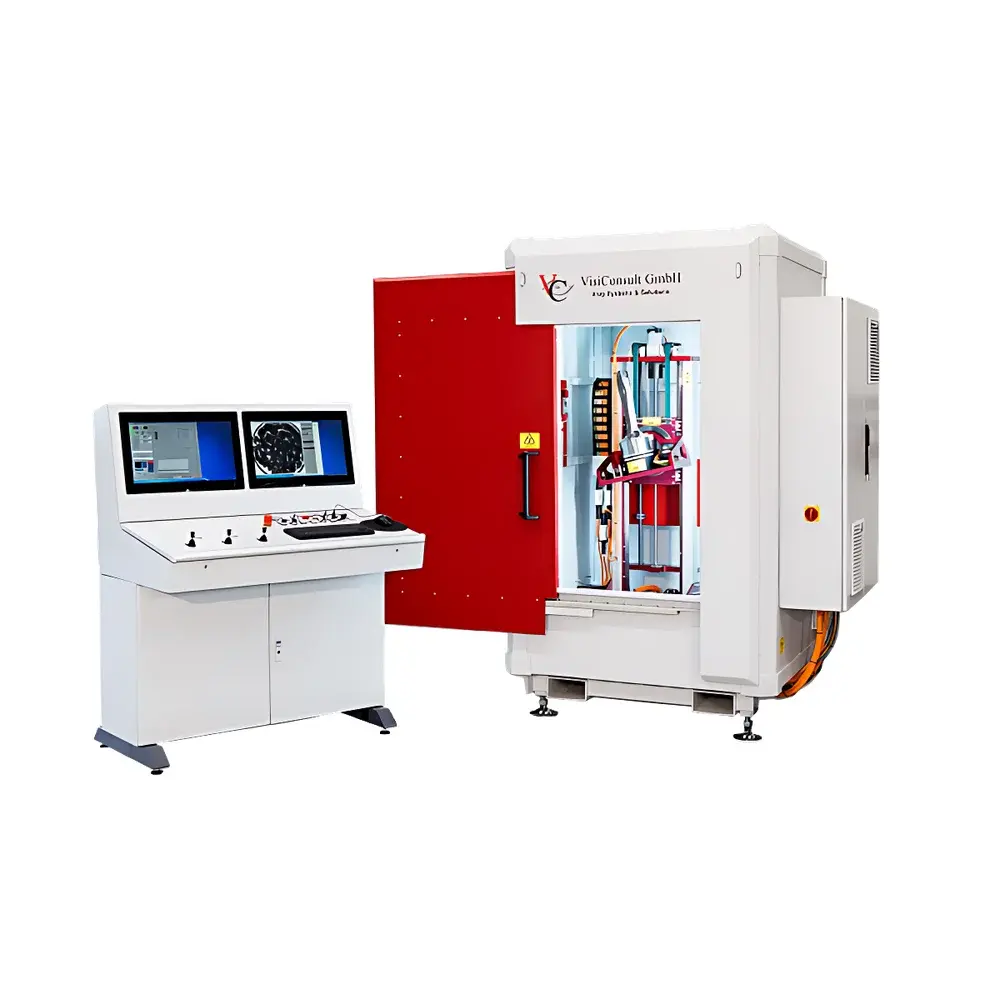
VisiConsult XRH111 Industrial Micro-CT System
| Brand | VisiConsult |
|---|---|
| Origin | Germany |
| Model | XRH111 |
| Application Scope | CT & Automated Defect Recognition (ADR) |
| Design Type | Compact Benchtop Micro-CT Platform |
| Compliance | ISO 17025-ready architecture, CE-marked for industrial NDT use |
| Construction | Rigid steel frame with radiation-shielded enclosure |
| Detector Type | High-resolution flat-panel detector (FPD) |
| X-ray Source | Microfocus sealed-tube generator (nominal focal spot ≤ 5 µm) |
| Max. Object Diameter | 200 mm |
| Max. Sample Height | 300 mm |
| Spatial Resolution (CT) | ≤ 10 µm (system-level, dependent on magnification and sample geometry) |
| Repeatability | < 0.5% intensity variation over 8-hour operation |
| Software Platform | visiXpert v6.x with reconstruction engine (FDK, iterative SART), ADR module compliant with ASTM E2983–22 for defect classification |
Overview
The VisiConsult XRH111 Industrial Micro-CT System is a compact, benchtop-scale computed tomography platform engineered for high-fidelity non-destructive evaluation (NDE) in production-integrated and laboratory environments. Based on cone-beam micro-CT geometry, the system employs a microfocus X-ray source and a high-dynamic-range flat-panel detector to acquire projection data across 360° rotation. Reconstruction is performed using filtered back-projection (FDK) and optionally iterative algorithms (SART), enabling isotropic voxel resolution down to 10 µm under optimal magnification conditions. Unlike large floor-standing CT systems, the XRH111 integrates full CT acquisition, volumetric rendering, quantitative density analysis, and automated defect recognition (ADR) within a footprint of less than 1.2 m² — making it suitable for QA labs, R&D centers, and Tier-1 supplier inspection cells where space, capital expenditure, and operational flexibility are constrained.
Key Features
- Compact industrial design: Steel-framed, self-shielded enclosure compliant with IEC 61331-1 for Class II radiation safety; no external lead room required.
- Dual-mode operation: Seamless switching between 2D radiography (real-time DR), laminography, and full 3D CT acquisition via unified software interface.
- Microfocus X-ray source: Sealed-tube generator with adjustable kV (40–225 kV) and µA (10–500 µA) settings; focal spot size ≤ 5 µm ensures high geometric magnification and edge sharpness.
- Automated Defect Recognition (ADR): Rule-based and AI-assisted classification engine calibrated per ASTM E2983–22; supports porosity, inclusion, crack, and shrinkage detection with configurable sensitivity thresholds.
- Reconstruction flexibility: GPU-accelerated FDK for rapid preview; optional iterative reconstruction (SART) for low-contrast or noisy datasets.
- Traceable metrology: Integrated calibration phantom support and DICOM-compliant output enable measurement traceability to NIST-traceable standards.
Sample Compatibility & Compliance
The XRH111 accommodates samples up to Ø200 mm × H300 mm and weighing ≤ 15 kg. Its rotating manipulator stage supports tilt-and-rotate positioning for optimized projection coverage of complex geometries (e.g., turbine blades, electronic assemblies, additive-manufactured parts). The system meets CE marking requirements under the EU Electromagnetic Compatibility Directive 2014/30/EU and the Low Voltage Directive 2014/35/EU. Radiation shielding complies with German RöV (Röntgenverordnung) and aligns with ISO 17025:2017 clause 6.4.3 for equipment suitability in accredited testing laboratories. All CT datasets are stored in vendor-neutral DICOM-CT format, supporting audit readiness for ISO 9001, AS9100, and IATF 16949 quality management systems.
Software & Data Management
Control and analysis are managed through visiXpert v6.x — a Windows-based application with role-based user permissions, electronic signature support, and full 21 CFR Part 11 compliance mode (audit trail, data integrity controls, and secure archive export). The software includes volume rendering, cross-sectional slicing, wall thickness mapping, porosity quantification (per ASTM E2983–22 Annex A2), and GD&T overlay tools for nominal-actual comparison. Raw projections and reconstructed volumes are archived in encrypted SQLite databases with SHA-256 checksum validation. Export options include STL, PLY, CSV (defect logs), and PDF reports containing metadata (kV/mA/time/focal spot/detector gain), ensuring full analytical reproducibility.
Applications
- Electronics: Void analysis in solder joints, wire bond integrity, encapsulation delamination, and PCB trace continuity verification.
- Automotive & Aerospace: Inspection of castings (e.g., aluminum engine blocks), powder-bed fusion AM parts (porosity distribution, unmelted powder retention), and composite layup uniformity.
- Medical Device Manufacturing: Validation of polymer implant internal structure, filter membrane pore distribution, and catheter lumen coaxiality.
- Research & Failure Analysis: Correlative 3D morphology studies combined with SEM/EDS or mechanical test correlation (e.g., fatigue crack initiation mapping).
- Quality Assurance: First-article inspection, PPAP documentation support, and periodic process capability monitoring (Cp/Cpk) using volumetric defect metrics.
FAQ
What is the minimum detectable defect size under standard CT acquisition?
Detection limit depends on material density, sample geometry, and acquisition parameters; typical minimum resolvable spherical void diameter is ~15 µm at 10× geometric magnification in aluminum alloys.
Does the system support dimensional metrology per ISO 15530-3?
Yes — when used with certified calibration phantoms and validated scan protocols, the XRH111 achieves volumetric measurement uncertainty ≤ (5 + L/100) µm (k = 2) for features ≥ 50 µm, meeting ISO 15530-3 requirements for CT-based metrology.
Can ADR rules be customized for proprietary defect classes?
Yes — users define custom classifiers via threshold-based feature extraction (e.g., aspect ratio, sphericity, grayscale gradient) and export rule sets as XML templates for deployment across multiple instruments.
Is remote diagnostics and software update supported?
Yes — visiXpert includes secure TLS-encrypted remote access (opt-in); firmware and software updates are delivered via signed packages with SHA-256 verification and rollback capability.
What training and documentation are provided upon installation?
Standard delivery includes on-site operator certification (2 days), comprehensive technical manual (PDF + printed), DICOM conformance statement, and ISO/IEC 17025 implementation guide for method validation.



