
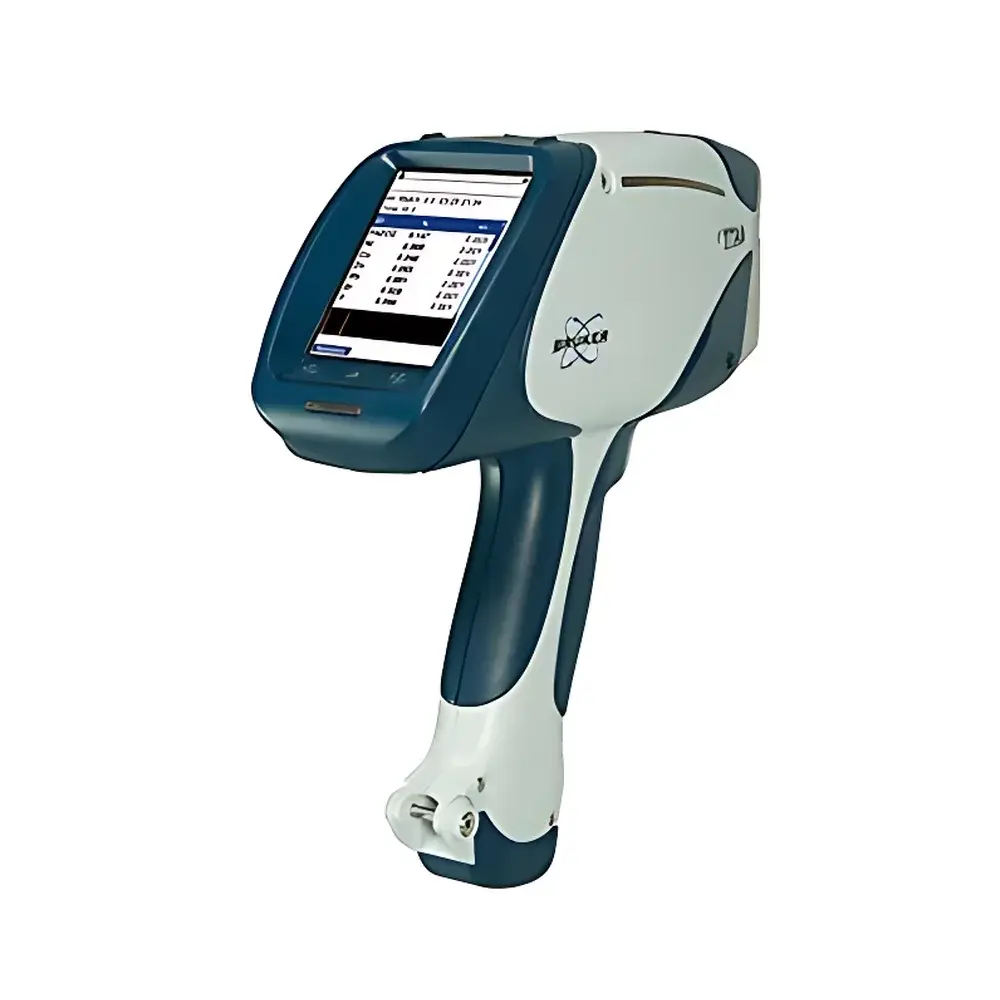
Bruker S1 TITAN Handheld Energy Dispersive X-Ray Fluorescence Spectrometer
| Brand | Bruker |
|---|---|
| Origin | Germany |
| Model | S1 TITAN |
| Application | Handheld/Portable |
| Element Range | Mg–U |
| Detection Limit | 1 ppm – 99.99% (w/w) |
| Energy Resolution | <140 eV (Mn Kα) |
| Repeatability | ±0.1% RSD |
| Detector | Silicon Drift Detector (SDD) |
| X-ray Tube | 50 kV microfocus |
| Weight | 1.23 kg |
| Compliance | ASTM E1621, ISO 12885, RoHS Directive 2011/65/EU, USP <232>/<233>, EPA Method 6200 |
Overview
The Bruker S1 TITAN is a high-performance, handheld energy dispersive X-ray fluorescence (EDXRF) spectrometer engineered for field-deployable elemental analysis with laboratory-grade precision. Operating on tube-based excitation (50 kV microfocus X-ray source) and detection via a high-efficiency silicon drift detector (SDD), the instrument delivers rapid, non-destructive quantification of elements from magnesium (Mg) to uranium (U) in solid, powdered, or irregularly shaped samples. Its core analytical principle relies on measuring characteristic secondary X-ray photons emitted upon sample irradiation—enabling qualitative identification and quantitative determination based on fundamental parameter (FP) algorithms calibrated against certified reference materials. Designed for mission-critical environments—including industrial QA/QC, mining exploration, environmental screening, and regulatory compliance—the S1 TITAN integrates Bruker’s proprietary SharpBeam® X-ray optics and SMART®Grade adaptive acquisition to optimize signal-to-noise ratio, minimize dose exposure, and extend battery runtime without compromising analytical fidelity.
Key Features
- Ultra-lightweight ergonomic design (1.23 kg) with IP54-rated sealed housing for dust and moisture resistance in harsh field conditions
- SharpBeam® optimized X-ray geometry: aligns collimated beam path, detector active area, and sample surface to maximize photon collection efficiency while reducing power consumption and thermal load
- X-Flash® SDD detector with <140 eV energy resolution at Mn Kα, enabling clear peak separation for overlapping transitions (e.g., S Kα/Pb Mα, Cr Kβ/Mn Kα)
- Integrated 5-inch capacitive color touchscreen with glove-compatible interface and real-time spectral visualization
- SMART®Grade acquisition logic: automatically adjusts live time and voltage based on sample composition and count rate to maintain optimal dead-time correction and precision
- Battery life up to 10 hours per charge (Li-ion, hot-swappable), supporting continuous operation during extended site surveys or plant audits
- Onboard calibration libraries for alloys (ASTM E2922), soils (EPA 6200), mining ores (ISO 12885), consumer goods (RoHS, ASTM F963), and precious metals (USP )
Sample Compatibility & Compliance
The S1 TITAN accommodates heterogeneous, irregular, and minimally prepared samples—including scrap metal fragments, drill cores, soil composites, coated electronics, and jewelry—without requiring homogenization or pelletization. Its collimated beam (3 mm or 8 mm spot size options) ensures representative micro-area analysis while mitigating matrix effects through FP modeling. The system complies with international regulatory frameworks: RoHS Directive 2011/65/EU and Annex II substance limits; California Proposition 65; ASTM E1621 (standard test method for elemental analysis by EDXRF); ISO 12885 (guidelines for portable XRF in mining); and USP Chapters and for elemental impurities in pharmaceuticals. Full audit trail functionality—including user login, method versioning, timestamped spectra, and raw data export—supports GLP/GMP-aligned workflows and FDA 21 CFR Part 11 readiness when paired with Bruker’s PC-based S1 DataAnalyzer software.
Software & Data Management
Data acquisition, processing, and reporting are managed through Bruker’s embedded TitanOS operating system and optional S1 DataAnalyzer desktop suite. TitanOS provides intuitive workflow navigation, customizable report templates (PDF/CSV), and real-time pass/fail decision logic against user-defined specification limits. S1 DataAnalyzer extends capabilities with advanced spectral deconvolution, multi-layer film thickness calculation, statistical process control (SPC) charting, and batch report generation compliant with ISO/IEC 17025 documentation requirements. All spectral files (.spx) retain full metadata—including acquisition parameters, calibration history, and GPS coordinates—and support third-party integration via XML or OPC UA protocols for LIMS and MES systems.
Applications
- Positive material identification (PMI) across refinery piping, aerospace fasteners, and nuclear-grade components per ASME B31.3 and ASTM E2922
- In-situ ore grade estimation and lithological mapping during exploration drilling and open-pit surveying
- Regulatory screening of restricted substances in electronics (Pb, Cd, Hg, Cr⁶⁺, Br), packaging (TPCH), toys (ASTM F963), and textiles
- Recycled metal sorting and scrap yard valuation using alloy grade classification (e.g., stainless steels, aluminum series, titanium grades)
- Environmental site assessment: heavy metal contamination (As, Pb, Cd, Hg) in soils, sediments, and sludges per EPA Method 6200
- Precious metal assay in jewelry, bullion, and catalytic converters with certified CRM traceability
FAQ
What regulatory standards does the S1 TITAN support for RoHS compliance testing?
The instrument meets EU RoHS Directive 2011/65/EU requirements for Pb, Cd, Hg, Cr⁶⁺, and Br quantification in homogeneous materials, with validated methods aligned to IEC 62321-5 and EN 62321-5.
Can the S1 TITAN analyze light elements such as magnesium and aluminum in air?
Yes—optimized vacuum path and helium purge accessory (optional) enable reliable Mg–P quantification in ambient air; Al–S detection is fully supported without purge.
Is method validation required before deploying the S1 TITAN for GMP-regulated testing?
Per USP and ICH Q2(R2), users must perform system suitability testing, limit of detection/quantitation verification, and accuracy/precision assessment using matrix-matched CRMs prior to routine use.
How does SharpBeam® technology improve measurement reproducibility?
By fixing the geometric relationship between X-ray tube focal spot, collimator aperture, and SDD active area, SharpBeam® eliminates alignment drift and reduces angular dependence—yielding <0.1% RSD for repeated measurements on heterogeneous surfaces.
Does the S1 TITAN support remote firmware updates and cloud-based data synchronization?
Firmware updates are performed locally via USB or Wi-Fi; secure cloud sync requires optional Bruker Connect subscription and on-premise gateway configuration for HIPAA/FDA-compliant data routing.





