
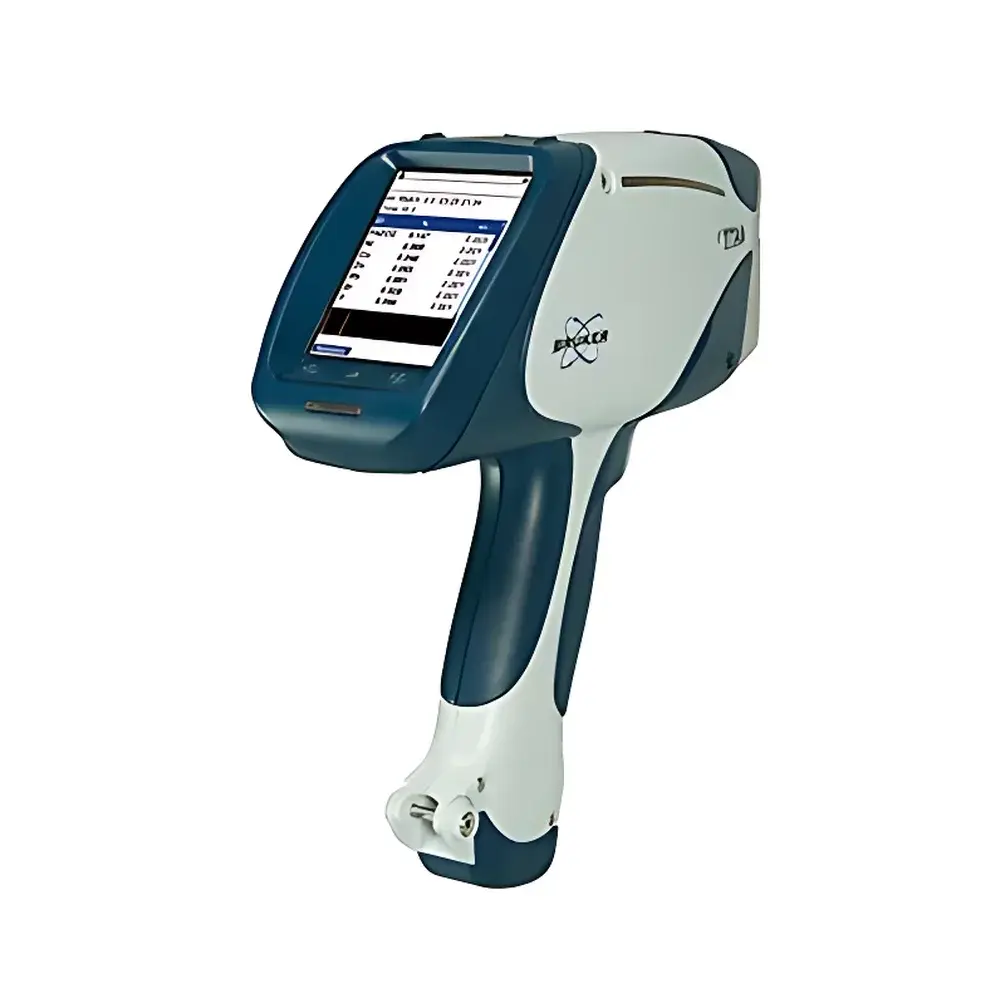
Bruker S1 TITAN Handheld Energy Dispersive X-Ray Fluorescence (ED-XRF) Spectrometer
| Brand | Bruker |
|---|---|
| Origin | Germany |
| Configuration | Handheld Portable |
| Element Range | Mg–U |
| Detection Limit | 1 ppm |
| Concentration Range | 1 ppm – 99.99 wt% |
| Energy Resolution | <140 eV (Mn Kα) |
| Detector Type | Silicon Drift Detector (SDD) |
| Compliance | CE, RoHS, FCC Class B, IEC 61000-4-2/3/4/6 |
Overview
The Bruker S1 TITAN is a field-deployable, handheld energy dispersive X-ray fluorescence (ED-XRF) spectrometer engineered for rapid, non-destructive elemental analysis of solid and powdered samples in situ. Based on fundamental XRF physics—where primary X-rays excite atoms in the sample, inducing characteristic secondary (fluorescent) X-ray emission—the S1 TITAN quantifies elemental composition by measuring the energy and intensity of emitted photons. Its optimized X-ray tube, high-efficiency SDD detector, and real-time spectrum deconvolution algorithms enable reliable detection of elements from magnesium (Mg, Z = 12) to uranium (U, Z = 92) without vacuum or helium purge—overcoming a longstanding limitation for light-element analysis in portable platforms. Designed for rugged outdoor use, it features an IP54-rated enclosure, integrated GPS, and optional camera for geo-referenced spectral logging—making it suitable for geological surveying, mining QA/QC, environmental site assessment, and industrial scrap sorting.
Key Features
- Light-element capability: Accurate quantification of Mg, Al, Si, P, S, and Cl under ambient air conditions—no He flushing or vacuum required.
- Silicon Drift Detector (SDD): High count-rate performance (>100,000 cps), excellent peak-to-background ratio, and <140 eV resolution at Mn Kα (5.89 keV) for precise peak separation.
- Optimized excitation: Rhodium-target microfocus X-ray tube with multiple kV/mA settings (up to 50 kV / 40 µA), enabling tailored excitation for low-Z and high-Z elements.
- Ruggedized design: Magnesium alloy housing, shock-absorbing rubber overmold, and drop-tested to MIL-STD-810G standards (1.2 m onto concrete).
- Real-time data processing: Onboard Linux-based OS with Bruker’s proprietary S1 PX software; live spectrum display, automatic peak identification, and matrix-matched calibration libraries.
- Regulatory-ready operation: Supports audit trails, user access levels, and electronic signatures compliant with GLP and ISO/IEC 17025 documentation requirements.
Sample Compatibility & Compliance
The S1 TITAN accommodates heterogeneous and irregular samples—including drill cores, ore chips, soil slurries, filter membranes, metal alloys, slag, tailings, and industrial catalysts—without sample preparation beyond surface cleaning. Its collimated beam (3 mm or 8 mm spot size, selectable) minimizes matrix effects and enables micro-analysis of inclusion-rich or layered materials. All measurements adhere to ASTM E1621 (Standard Guide for XRF Elemental Analysis), ISO 21043 (XRF in geosciences), and USP / (elemental impurities in pharmaceuticals). For environmental applications, it supports EPA Method 6200 (field screening of soils and sediments) and aligns with EU WEEE/RoHS directive screening protocols.
Software & Data Management
S1 PX software provides full control of acquisition parameters, library management, and statistical reporting. Calibration models are built using certified reference materials (CRMs) traceable to NIST or BAM standards and support fundamental parameter (FP) and empirical (type-standard) quantification. Data export options include CSV, PDF reports with embedded spectra, and XML for LIMS integration. The system logs operator ID, GPS coordinates, timestamp, measurement duration, and instrument status—enabling full traceability per FDA 21 CFR Part 11 requirements when configured with password-protected user roles and electronic signature workflows.
Applications
- Geological exploration: Real-time grade estimation of Cu, Zn, Pb, Au, and REEs in outcrops and core trays; rapid lithological classification via major oxide ratios (e.g., SiO₂/Al₂O₃).
- Mining operations: In-pit ore sorting, truckload assay verification, stockpile homogeneity assessment, and cut-off grade validation prior to processing.
- Environmental monitoring: Screening for As, Cd, Cr, Hg, Pb, and U in contaminated soils, dredged sediments, and landfill leachates.
- Recycling & scrap metal: Identification of alloy grades (e.g., stainless steels, Ni-based superalloys), detection of regulated elements (Co, Be, Sb), and segregation of mixed metal streams.
- Industrial quality assurance: Verification of catalyst composition (Pt, Pd, Rh), refractory raw materials (Al₂O₃, ZrO₂), and pigment formulations (TiO₂, Fe₂O₃).
FAQ
Does the S1 TITAN require helium or vacuum for light-element analysis?
No—its optimized geometry, high-sensitivity SDD, and advanced background subtraction allow robust Mg–Cl quantification in ambient air.
Can the instrument be calibrated for specific ore types?
Yes—users can develop custom calibrations using local CRMs or synthetic standards; Bruker offers application-specific method packages for base metals, precious metals, and rare earths.
Is the S1 TITAN compliant with radiation safety regulations?
Yes—it meets IEC 62495 (handheld XRF safety) and includes automatic beam shuttering, proximity sensor interlock, and dose rate monitoring below 1 µSv/h at 5 cm.
How is data integrity ensured during field use?
All spectra and metadata are cryptographically timestamped and stored locally with optional cloud sync; audit logs record every user action and parameter change.
What maintenance is required for long-term field reliability?
Annual detector performance verification and X-ray tube output calibration are recommended; no routine consumables are required beyond periodic window cleaning and battery replacement.






