
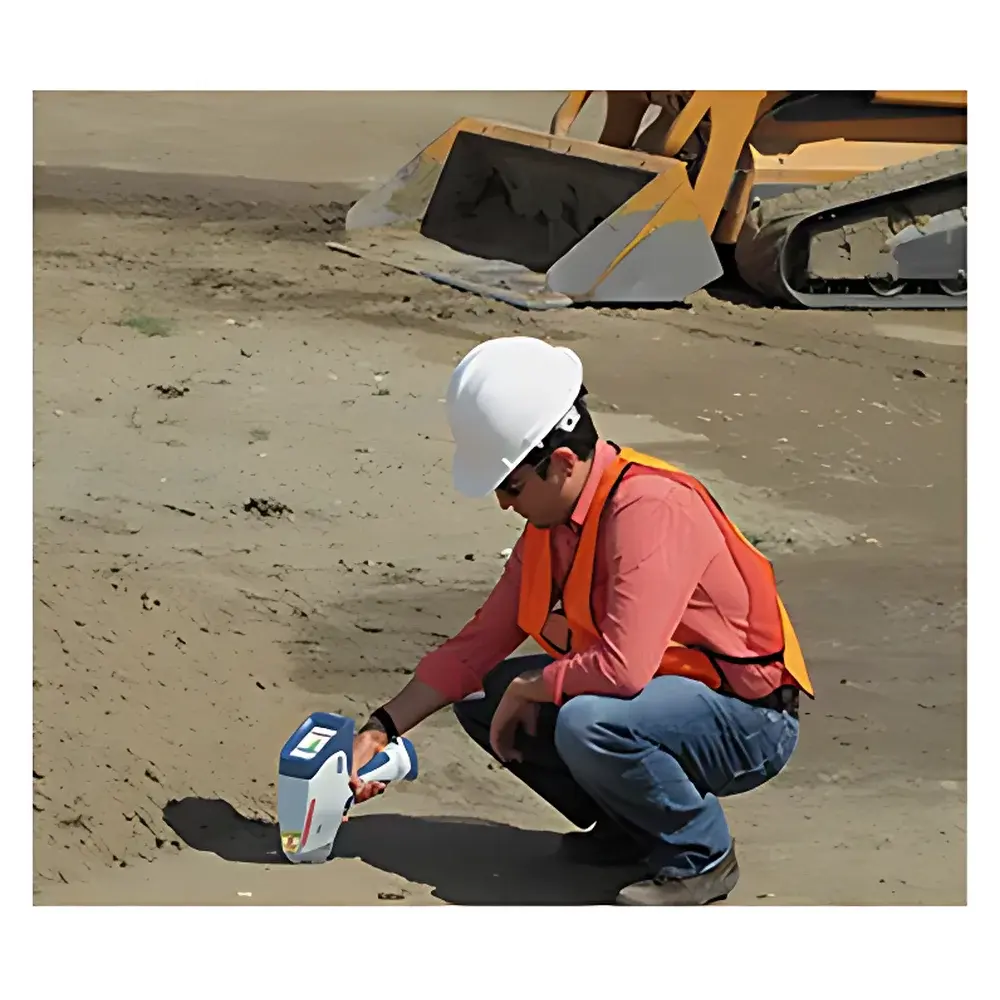
Bruker S1 TITAN Portable Soil Heavy Metal Analyzer
| Brand | Bruker |
|---|---|
| Origin | Germany |
| Model | S1 TITAN |
| Application | Handheld/Portable |
| Industry-Specific Use | Soil and Atmospheric Environmental Monitoring |
| Elemental Range | Mg to U |
| Quantification Range | 1 ppm – 99.99% |
| Energy Resolution | <140 eV (Mn Kα) |
| Detector | Silicon Drift Detector (SDD) |
| Compliance | ASTM D7213, ISO 18562-2, EPA Method 6200 |
Overview
The Bruker S1 TITAN Portable Soil Heavy Metal Analyzer is a field-deployable energy dispersive X-ray fluorescence (EDXRF) spectrometer engineered for rapid, non-destructive elemental quantification in heterogeneous environmental matrices. Operating on the principle of primary X-ray excitation and secondary characteristic X-ray emission, the instrument enables real-time detection of heavy metals—including Pb, As, Cd, Hg, Cr, Ni, Cu, and Zn—in soil, sediment, sludge, dust, and solid waste samples. Its compact, ergonomic design integrates a high-power microfocus X-ray tube (up to 50 kV, 4 W), a large-area silicon drift detector (SDD) with Peltier cooling, and real-time spectrum deconvolution algorithms optimized for low-Z to high-Z element discrimination in complex, matrix-rich environmental samples. The system delivers laboratory-grade analytical performance under field conditions without sample digestion or chemical reagents—supporting immediate decision-making during environmental site assessments, regulatory compliance checks, and emergency response operations.
Key Features
- Optimized EDXRF architecture with dual excitation modes (vacuum and air) to enhance sensitivity for light elements (Mg–P) and heavy metals (As–U) simultaneously
- Silicon drift detector (SDD) offering <140 eV energy resolution at Mn Kα (5.9 keV), enabling robust peak separation in multi-element soil spectra
- Integrated GPS, barometer, and inclinometer for georeferenced data logging and spatial trend mapping
- Ruggedized IP54-rated housing with MIL-STD-810G certification for shock, vibration, and dust resistance in outdoor and industrial environments
- Battery-powered operation (up to 12 hours per charge) with hot-swappable Li-ion packs for uninterrupted field surveys
- Onboard calibration verification using certified reference materials (CRMs) traceable to NIST and BAM standards
Sample Compatibility & Compliance
The S1 TITAN is validated for direct analysis of unprepared or minimally homogenized soil, sediment, sludge, fly ash, filter media, and particulate matter collected on membranes. It meets method requirements specified in ASTM D7213 (Standard Test Method for Determination of Metals in Soils by Portable X-Ray Fluorescence Spectrometry), ISO 18562-2 (Biocompatibility evaluation of breathing gas pathways), and EPA Method 6200 (Field Portable X-Ray Fluorescence Spectrometry). Data acquisition supports GLP/GMP-aligned workflows, including user authentication, electronic signatures, and audit-trail-enabled result export compliant with FDA 21 CFR Part 11 when integrated with Bruker’s proprietary software suite.
Software & Data Management
The instrument operates with Bruker’s proprietary S1 PXRF software, featuring intuitive touchscreen interface, automated spectral fitting using fundamental parameters (FP) and empirical calibrations, and customizable reporting templates. All measurement metadata—including acquisition time, location coordinates, atmospheric pressure, detector temperature, and live count rates—is embedded in each spectrum file (.spx). Raw and processed data export seamlessly to CSV, PDF, and XML formats compatible with GIS platforms (e.g., ArcGIS, QGIS) and LIMS systems. Remote firmware updates and method library synchronization are supported via secure HTTPS-based cloud portal access.
Applications
- Regulatory monitoring of contaminated sites (brownfields, mining tailings, industrial perimeters) per EU Soil Thematic Strategy and US EPA Region 10 guidelines
- Pre- and post-remediation verification of heavy metal removal efficiency (e.g., Cd, Pb, As immobilization in phytostabilization trials)
- High-resolution spatial screening of agricultural soils for food safety risk assessment (e.g., rice paddy Cd accumulation mapping)
- Real-time characterization of airborne particulate matter (PM10, PM2.5) collected on filters during stack emission testing
- Supporting ISO/IEC 17025-accredited laboratories in developing in-house validation protocols for portable XRF in environmental testing
FAQ
Does the S1 TITAN require sample preparation prior to analysis?
No—soil and solid samples can be analyzed directly after homogenization and light compaction; no acid digestion or pelletizing is necessary for screening-level quantification.
How is instrument performance verified in the field?
Daily calibration verification is performed using onboard check standards (e.g., Fe/Cu/Zn/Cd/Pb multi-element foil), with automatic pass/fail reporting based on predefined control limits.
Can the analyzer distinguish between Cr(III) and Cr(VI)?
No—EDXRF is an elemental technique and cannot resolve oxidation states; speciation requires complementary methods such as HPLC-ICP-MS or XANES.
Is spectral interference correction applied automatically?
Yes—the FP-based quantification engine applies matrix correction algorithms incorporating particle size, moisture content, and organic matter estimates derived from Compton/Rayleigh scatter ratios.
What documentation accompanies each unit for regulatory audits?
Each S1 TITAN ships with a full traceability package: factory calibration certificate, detector resolution report, CRM validation data, and ISO/IEC 17025-compliant uncertainty budget documentation.




